Lyric Line Syllable Count Calculator
Paste a verse, hook, rap bar, bridge, or hymn stanza to estimate syllables per lyric line, stress density, pacing, and how many bars the words need at your tempo.
Meter model: English lyric syllables vary by singer, dialect, elision, and melisma. This tool gives a practical writing estimate, then highlights lines that are crowded, sparse, or stress-heavy against your chosen grid.
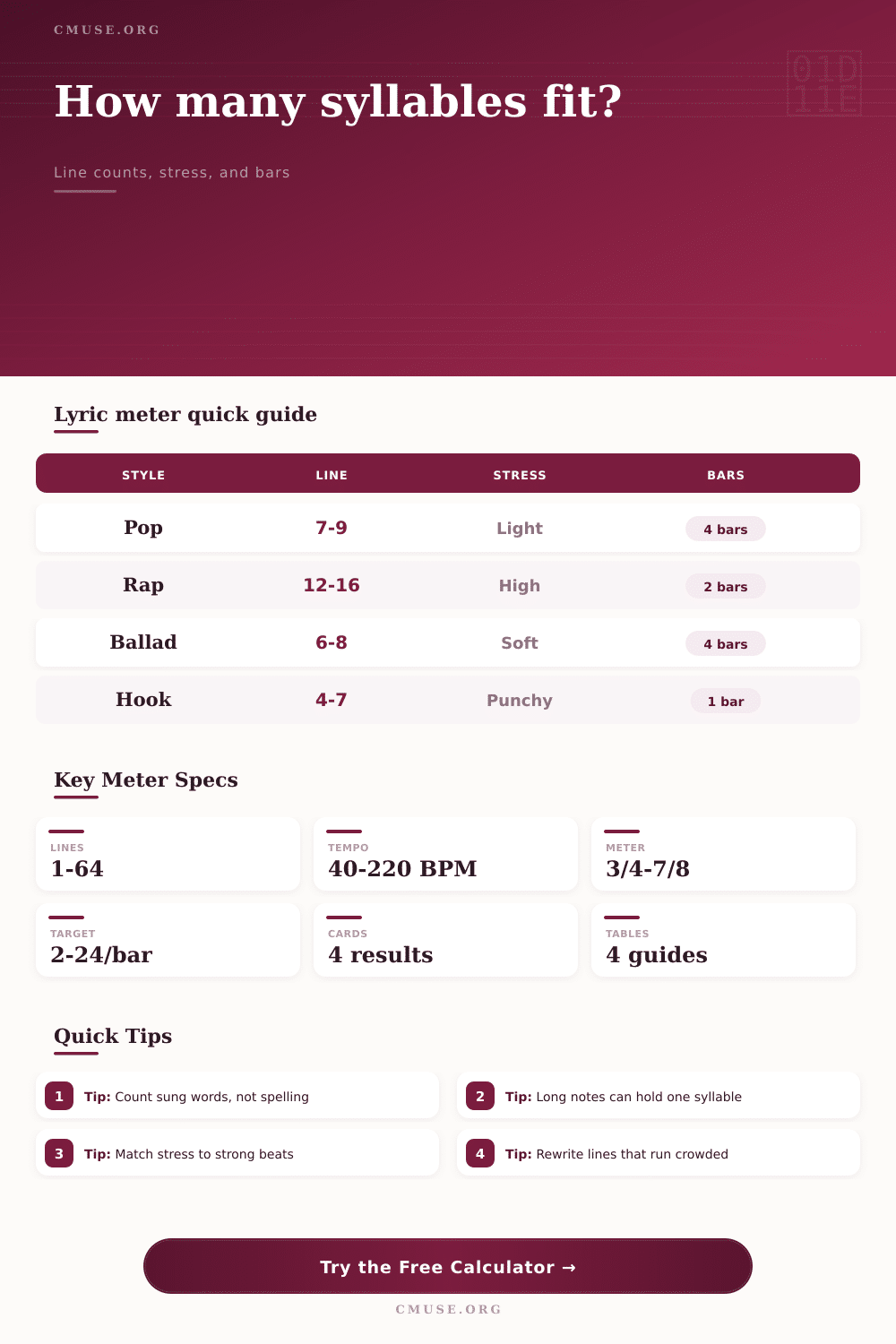
Use these tables as writing targets. The exact fit depends on melody, articulation, rests, and where the strongest words land.
| Song Section | Common Line Range | Meter Feel | Useful Check |
|---|---|---|---|
| Verse line | 7-12 syllables | Conversational, moderate density | Keep repeated line lengths within 2 syllables for a stable stanza. |
| Pre-chorus line | 8-14 syllables | Rising, slightly crowded | Let final words open up before the chorus downbeat. |
| Hook phrase | 4-9 syllables | Short, accented, memorable | Stress the title word on a strong beat or long note. |
| Bridge line | 6-11 syllables | Contrast, often looser | Change line length without losing phrase boundaries. |
| Meter Pattern | Line Counts | Typical Use | Composer Note |
|---|---|---|---|
| Common meter | 8 / 6 / 8 / 6 | Hymns, folk, ballads | Strong alternation makes rhyme placement easy to hear. |
| Long meter | 8 / 8 / 8 / 8 | Anthems and steady stanzas | Balanced lines can sound formal unless rhythm varies. |
| Short meter | 6 / 6 / 8 / 6 | Compact refrains | The longer third line creates a small lift. |
| Rap couplet | 12-18 / 12-18 | Two-bar rhyme pairs | Internal rhymes raise stress density quickly. |
| Syllables Per Bar | Density Band | Works For | Watch For |
|---|---|---|---|
| 2-4 | Open | Ballads, chant hooks, held notes | Too much empty grid if every word is short. |
| 5-8 | Balanced | Pop verses, country lines, theater phrases | Weak stress can make the line feel flat. |
| 9-12 | Busy | Pre-chorus lift, spoken bridges, pop rap | Breaths and consonants need space. |
| 13-18 | Dense | Rap, patter, fast rhythmic delivery | Stress overload can blur the hook word. |
| Line Shape | Example Count | Best Placement | Meter Adjustment |
|---|---|---|---|
| Even quatrain | 8 / 8 / 8 / 8 | Four-line verses | Move one unstressed word if the melody repeats exactly. |
| Lifted last line | 7 / 7 / 7 / 10 | Pre-chorus turns | Use the longer final line to push into a chorus. |
| Call and response | 5 / 3 / 5 / 3 | Hooks and chants | Leave rests after the short response lines. |
| Stacked internal rhyme | 14 / 15 | Rap couplets | Track consonant clusters as stress points. |
Ballad Singing
Lower syllable density, wider vowels, and longer note values. A crowded line usually needs fewer words or more bars.
Pop Topline
Moderate line counts with clear title stress. Hooks often work best when the main phrase is shorter than the verse.
Rap Pocket
Higher syllable counts can fit if consonants lock to subdivision. Internal rhymes increase perceived stress density.
Theater Delivery
Speech clarity matters as much as count. Uneven line lengths can work when phrase starts and key words stay aligned.
In other words, you write a full sounding, complete verse, only to have it fail because of melody. Then the words push up against beat, the hook comes out on an off-beat and you’re frustrated that your ear tells you story works, but the grid says it does not.
That’s what the lyric line syllable count calculator can do. It rips away any emotional attachment and reveals how your phrasing look. You might love a line but if it has 14 syllables in a bar with eight then you’ll be fighting music. It crunches numbers. It converts words to numbers. It figures out how many syllables there is, where the stressed ones are, and how fast they should of be delivered.
How to Make Your Lyrics Fit the Beat
Why does that matter? Syllable values aren’t equal. Three quick consonants in a rap line take up just as much time than one long vowel in a ballad verse. The app know to adjust for this by using delivery style and stretch factor. If you’re rapping, you can puts more syllabic density in there. Singing legato means fewer word. Adjust these settings so you don’t write a dense rap verse and then attempt to sing it at half-speed.
There are other hidden variables, such as stress. Rhyme gets all the attention; no-one worries about accent pattern. Some syllables is heavier than others in speech. Those heavy ones should falls on the strong beat(s) in a song. When stress coincides with the downbeat, the lyric sounds naturaly. If they don’t, it’s uncomfortabley.
These reference tables indicates that folk verses tend towards a steady conversational flow, but pop hooks has a high contrast of stress in short phrases. Think of them as a range to guide you. They represent what listener expects rhythmically. The number of syllables isn’t hard and fast, as it might be in iambic pentameter. Instead, it’s a pacing suggestion. Depending on the tempo, seven syllables could be crowded or spacious.
The calculator counts bars required. It allows you to visualize structure before opening up software. Maybe you only have four bars for your verse when really, you need twelve. Then you has to adjust the story.
That’s where phrase length comes into play. Do you prefer two or four bars? Let the tool know and it will alert you if you’re dragging or rushing against container.
Think of the hook. What’s going to stick? Make it shorter than the verse. It should have a simpler, less complicated stress pattern. Shape it so you remember it. Is the hook too complex? Use the calculator. Long syllables and high stress density bury main point. Simplify the line. Trim unnecessary words. Let melody breathe. Don’t make the writing dumb. Make the impact bigger. A wordy hook gets buried in the mix. A short hook cuts through it better.
Each line gets audited on the breakdown table. Count it out. See if it makes sense. If you’ve got a four-line phrase with 8 syllables on every one but then the next has 12… maybe that’s by design? Maybe it was a fluke, and it break up the flow? You’re going to have to determine that. But this tool doesn’t pass judgement on the lyrics. It reveals structure. Where is it getting clogged? You can alter it to increase flow. Change words to shift stress. Add pauses for singer.
This is what lyric writing is all about. Creating a structure that supports thought. Technology cannot replace taste. Technology is the skeleton; you’re the soul. Let your instincts be informed based off the data. Don’t have your instincts overpowered by the data. Trust your ear when the tool tells you a line’s too crowded and it works anyway. Know what you’re doing. Know the risk. You are knowingly breaking the meter for an emotional effect. This is a valid choice.
Begin with the count. Adjust the stress. Shape the phrase. And then let the music happen. Give your words some room and they will find their rhythm.