Phrase Turnaround Timing Calculator
Plan the exact handoff point between phrases: total phrase length, cue lead time, final turnaround window, pickup offset, tail clearance, and beat countdown wording.
Timing model: A turnaround cue is counted backward from the next phrase downbeat. Choose a preset, then adjust meter, BPM, pickup, tail, and offset to match the real arrangement.
Calculation Breakdown
Pop Verse To Hook
Clean handoff into a chorus where the last line or drum fill prepares the hook.
EDM Build To Drop
Longer lead time gives risers, snare rolls, automation, and silence a clear target.
Jazz Tag Return
Short cue keeps the band responsive while preserving harmonic motion into the tag.
Film Hit Point
Marker timing prioritizes the exact hit point, then backs into phrase and pickup cues.
| Phrase Type | Common Bars | Typical Cue Lead | Best Countdown | Turnaround Purpose |
|---|---|---|---|---|
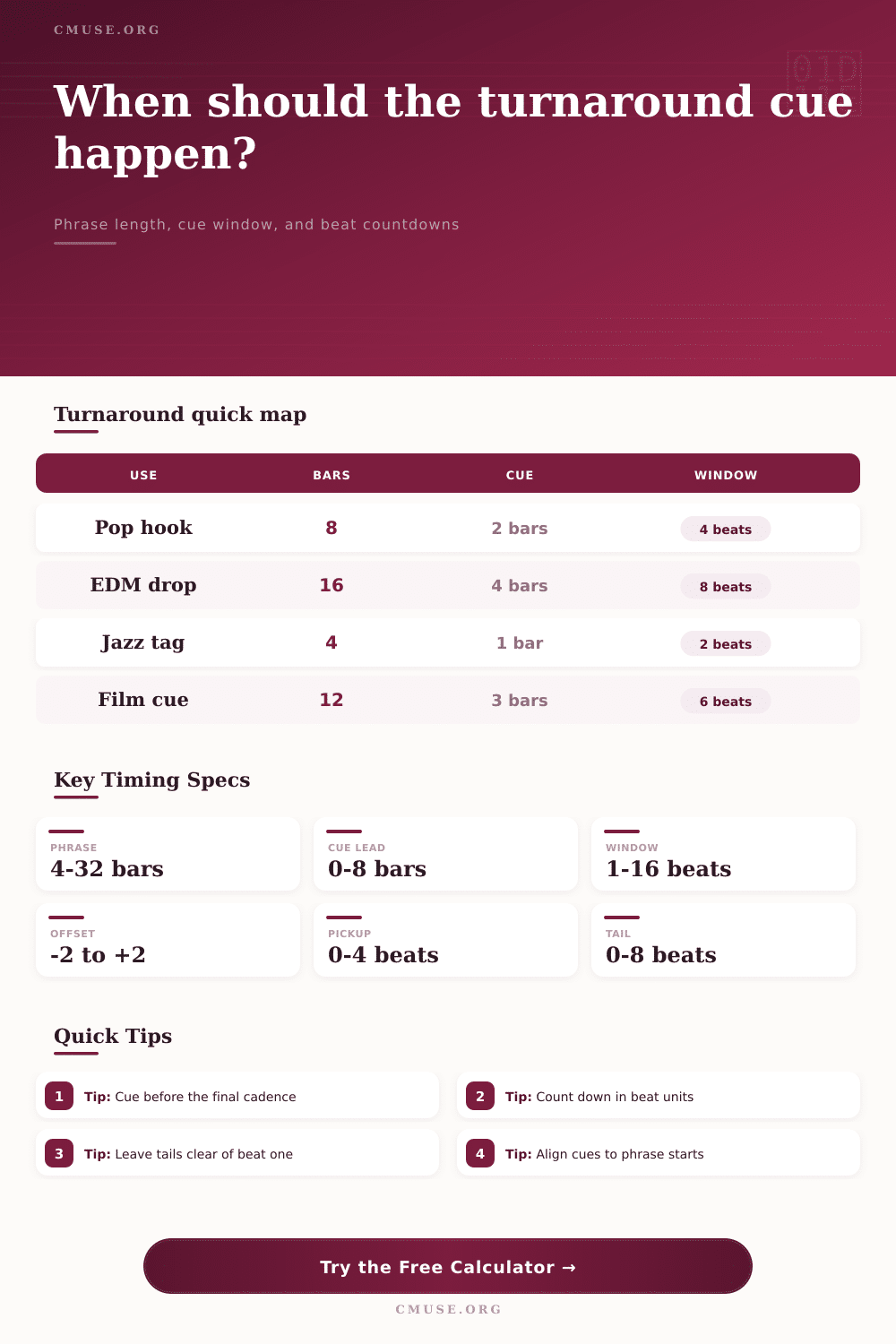
| Pop verse into hook | 8 bars | 2 bars | 8 or 16 beats | Lyric handoff, fill, hook entry |
| Pre-chorus lift | 4 or 8 bars | 1 or 2 bars | 4 or 8 beats | Energy rise before the chorus |
| EDM build into drop | 16 or 32 bars | 4 or 8 bars | 16 or 32 beats | Automation, roll, silence, drop |
| Jazz tag or turnaround | 2 or 4 bars | 1 bar | 2 or 4 beats | Return to head or repeat tag |
| Choir cadence breath | 4 or 8 bars | 1 bar | 4 beats | Breath, consonant, next entry |
| Film cue hit point | Variable | 2 to 4 bars | Seconds plus beats | Hit point alignment |
Use the shortest cue lead that still gives players enough time to react without stealing focus from the phrase ending.
| BPM | Beat Length | 1-Bar Cue In 4/4 | 2-Bar Cue In 4/4 | 4-Beat Window |
|---|---|---|---|---|
| 72 | 0.833 sec | 3.33 sec | 6.67 sec | 3.33 sec |
| 84 | 0.714 sec | 2.86 sec | 5.71 sec | 2.86 sec |
| 96 | 0.625 sec | 2.50 sec | 5.00 sec | 2.50 sec |
| 120 | 0.500 sec | 2.00 sec | 4.00 sec | 2.00 sec |
| 128 | 0.469 sec | 1.88 sec | 3.75 sec | 1.88 sec |
| 144 | 0.417 sec | 1.67 sec | 3.33 sec | 1.67 sec |
| Meter | Quarter-Note Beats Per Bar | Phrase Feel | Cue Counting Note | Common Turnaround |
|---|---|---|---|---|
| 4/4 | 4.00 | Square pop and rock phrasing | Count 4, 8, 16 beats | Last bar or last 2 bars |
| 3/4 | 3.00 | Waltz phrase groups | Count 3, 6, 12 beats | Cadence bar into downbeat |
| 6/8 | 3.00 | Two dotted-quarter pulses | Use dotted-quarter if conducted in two | Last 2 dotted pulses |
| 5/4 | 5.00 | Odd-meter riff cycles | Count the internal grouping | Final group plus pickup |
| 7/8 | 3.50 | Asymmetric phrase pivot | Count 2+2+3 or 3+2+2 | Final group before beat one |
| Countdown Style | Best For | Formula | Example Cue | Why It Helps |
|---|---|---|---|---|
| Beats to downbeat | Click tracks, live counts | Cue beats = lead bars x beats per bar | 16 beats to chorus | Fast and unambiguous |
| Bars plus beats | Charts and rehearsal marks | Bars left plus beat position | 2 bars and 4 beats | Matches score reading |
| Seconds and beats | Film, stems, automation | Seconds = beats x 60 / BPM | 8.0 sec, 16 beats | Matches DAW timeline |
| Conductor wording | Choir, ensemble, pit work | Lead to prep plus entry | Prep 4, in 3-2-1 | Separates prep and entry |
Before the chorus come, the band holds a chord, then the drummer rolls and everything locks into place. It’s like math disguised as feeling. Know that missing even a fraction of a beat on a turnaround will derail the groove. That’s where the turnaround timing calculator do the math for you. And keeping the music tight mean understanding the meaning behind the numbers.
Counting intuitively is in bars. That’s how most of us think as musicians. When you try to align a marker from your digital audio workstation with a cue from the live conductor, the bar become vague. What we really want are specific beat and second. Fewer people recognize the difference between a beat unit and tempo. A 120 BPM can sound easy enough. However, the pulse might be felt as dotted quarters instead of quarter notes in a 6/8 waltz. If what you enter doesn’t align with how the musicians hear the pulse, your cue point won’t be where you want it. The converter handles that part but first, you must know what grid you’re dealing with.
The Simple Math of Musical Timing
So the real trick is knowing when to separate the turnaround window and the cue lead. A lot of times these two ideas gets mixed up. Cue lead refers to how far in advance you signal the change. How much time do you give the players to start a fill or take a breath? Turnaround window is the last bit of space where something can still be played before the next phrase starts. Consider this the runway. If your cue lead is too short than the musicians aren’t prepared. If your turnaround window is too long then the energy flag before the drop. It should of be just enough runway to land, but not so much that you stall the plane.
Consider the pickup, or anacrusis as it’s sometimes called. If your next section begin with a weak upbeat, then you must consider that time. The real entry point is found by deducting the pickup beats from total phrase length; this is what the calculator does. On the face of things, it sounds small but when used on a fast hip-hop loop, a two-beat pickup alters the whole feel of the rhythm. You might think you are cueing on beat one, but the musicians is already moving on the and of four. This mismatch produces a dragging feel that’s notoriously difficult to correct in the mix.
The same goes for release tails. In moddern productions, they are heavily reverberated with delays that stretch out long after the last note is played. If you align your next section to fall on the last note of preceding one, the wet tail will drown the incoming phrase. Muddy. A tail clearance value will allow the atmospheric sound to die away before the incoming rhythm arrives. This provides clean separation. This is particularly important in film scoring, where we need to maintain a clear cut hit point without it being buried under reverb from the previous cue.
Timing strategy vary from genre to genre. In popular music, the hook is often tightly structured in an 8 bars plus 2 bar cue. It is familiar territory with no surprises. On the flip side, the EDM drop may be a 16 bar build with a 4 bar cue so that automation sweeps and risers can do their thing. The jazz tag requires little or no lead time, as the players are all listening to one another rather than the grid. Knowing the conventions will guide your preset selection. It’s not simply about time, it’s about expectation of the performance style.
The table of references on this page shows how these windows move depending off the style and the cue lead. The numbers relate to your own setup. If the music is at a fast pace then there is less time to cue. If it’s a slow ballad then more time can be stretched out. This requires consideration for accuracy but also allows for human reaction time. Human beings do not react instantaneous. They require some sort of auditory or visual cue that happens just before the event.
It’s all about trust. Trust in the math, trust in the conductor, trust in the click track. When everything lines up, it all seems effortless. There is no cue to be heard. It is only a change of momentum. That is what we are going after. Let the music speak for itself, but first get the math correct.