Build Length in Bars Calculator
Plan an EDM, pop, hip-hop, or song build section by converting BPM, time signature, phrase length, pre-drop silence, ramp density, and pickup timing into bars, beats, seconds, and a phrase-safe drop target.
Build model: The calculator treats the build as the complete tension section before the drop or chorus, including vocal pickups, silence, fills, and the final held beat if they occupy grid time.
Calculation Breakdown
Drop Target
Active Motion Time
Riser Events
Automation Points
Micro Lift
Useful for pop transitions, one-shot fills, or fast genre switches where the listener already knows the hook.
Short Drop Build
Common for dubstep, trap, future bass, and second-drop changes that need impact without a long wait.
Club Standard
A balanced EDM rise that leaves room for filter motion, snare acceleration, risers, and a clean phrase boundary.
Long Tension Arc
Best for progressive, festival, trance, and techno arrangements where the build itself becomes a main section.
| Build role | Typical bars | Phrase math | Best use |
|---|---|---|---|
| Turnaround lift | 2-4 bars | 1 x 2 or 1 x 4 | Quick chorus entry, tag, or fill before a vocal hook. |
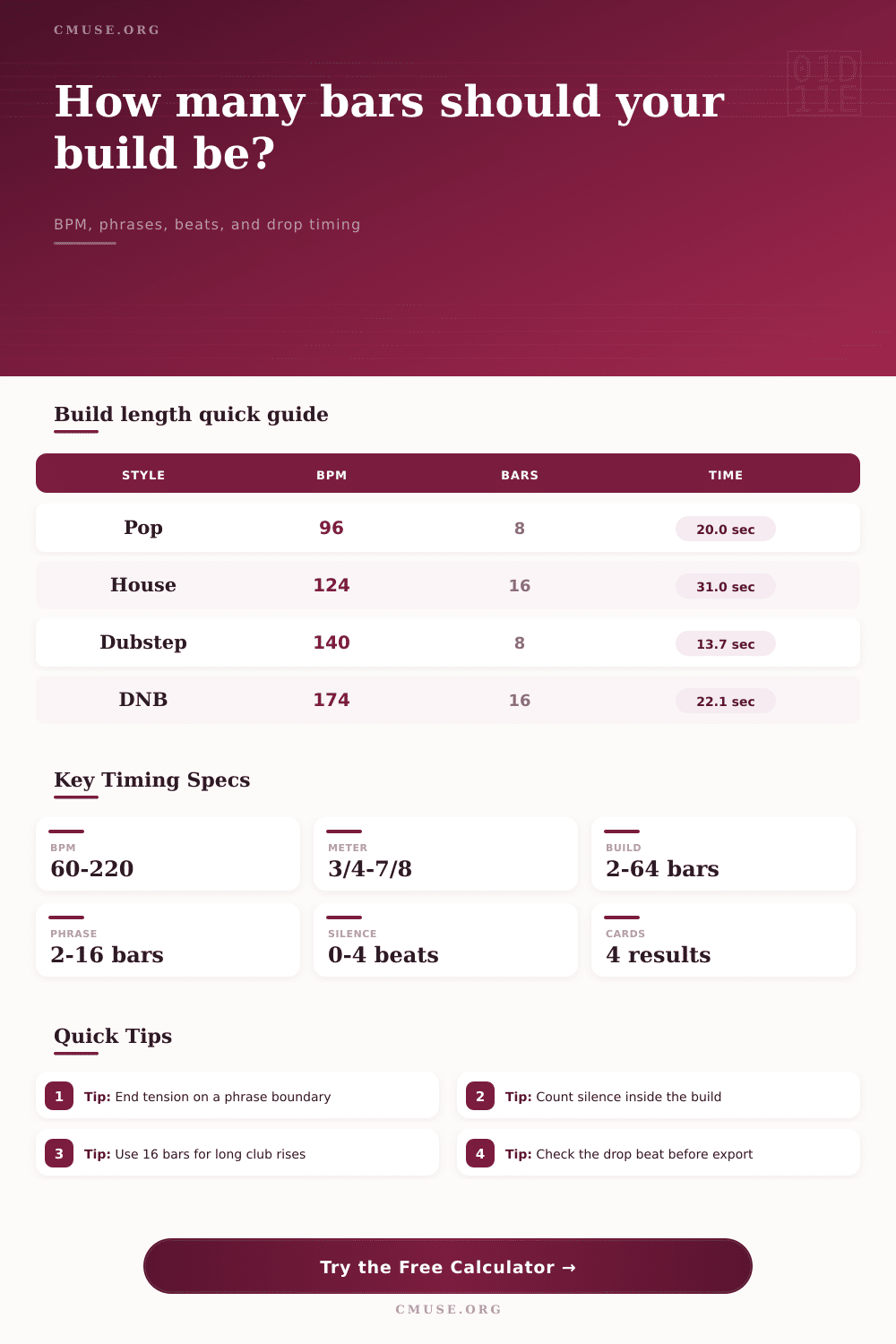
| Short drop setup | 8 bars | 2 x 4 or 1 x 8 | Dubstep, trap, bass house, and pop pre-drop transitions. |
| Standard EDM build | 16 bars | 4 x 4 or 2 x 8 | House, future bass, dance-pop, and most club-ready drops. |
| Extended tension | 24-32 bars | 3-4 x 8 | Progressive, techno, trance, live DJ blend space, and long risers. |
| Epic mainstage climb | 48-64 bars | 3-4 x 16 | Festival edits, cinematic intros, or major second-drop payoffs. |
| BPM | 8-bar build | 16-bar build | 32-bar build |
|---|---|---|---|
| 96 BPM | 20.00 sec | 40.00 sec | 80.00 sec |
| 110 BPM | 17.45 sec | 34.91 sec | 69.82 sec |
| 124 BPM | 15.48 sec | 30.97 sec | 61.94 sec |
| 140 BPM | 13.71 sec | 27.43 sec | 54.86 sec |
| 174 BPM | 11.03 sec | 22.07 sec | 44.14 sec |
| Riser subdivision | Events per beat | Events in 16 bars of 4/4 | Common sound design role |
|---|---|---|---|
| Quarter notes | 1 | 64 | Pumping filter, kick cuts, and wide macro moves. |
| Eighth notes | 2 | 128 | Noise gate, hat lift, and pulse automation. |
| Sixteenth notes | 4 | 256 | Classic snare roll grid and chopped white-noise ramps. |
| Thirty-second notes | 8 | 512 | Fast fills, EDM stutters, and final-bar acceleration. |
| Sixty-fourth notes | 16 | 1024 | Extreme pre-drop rolls, glitches, and very short bursts. |
| Genre context | Common BPM area | Build length tendency | Phrase note |
|---|---|---|---|
| Dance-pop | 95-124 BPM | 4-8 bars | Usually follows vocal phrasing more than DJ phrasing. |
| House and techno | 120-132 BPM | 16-32 bars | Eight-bar phrase blocks help DJs anticipate the drop. |
| Dubstep and bass | 140-150 BPM | 4-16 bars | Half-time feel can make 8 bars feel bigger than it looks. |
| Drum and bass | 170-178 BPM | 16-32 bars | High BPM shortens seconds, so longer bar counts still move quickly. |
| Trance and progressive | 126-138 BPM | 32-64 bars | Long arcs often split into intro, lift, peak, and release zones. |
That said: The most treacherous point in a song is the instant leading up to the drop; you’re holding tension there for minutes, even hours, building up the energy. So you want to handle it carefuly: Too soon after the tension’s released, the payoff is flat. Too late and the listener have stopped paying attention.
It’s less a matter of feel different than math: The calculator above convert your tempo and phrase choices into exact bar counts. No need to guess how many times the tension will break. Producers tend to think in bars; a bar is simply a method of measurement. They should of thinking in phrases. A phrase is like a musical sentence.
How to Time Your Drop Correctly
To end a build on bar seventeen (in 4/4 time) cut the sentence off mid-word. This may feel awkward to the listener but they won’t necessarily know why. Many people miss this because they focus too much on how intense the riser is instead of structure of the transition. The tool helps you line up the drop with natural breathing room of the arrangement.
An eight-bar build at ninety-six beats per minute lasts twenty seconds. Twenty seconds seems like a long time for a pre-chorus in a pop song. There is space to lift the melody and use vocal ad-libs. When these same eight bars is played at one-hundred-forty beats per minute, they are just thirteen seconds long. It is perfect for heavy bass music or dubstep. Because it moves quickly there’s an explosive release possible, so the short length are not a bug but a feature. Trying to stretch the length of a slow-tempo build structure over a fast tempo will result in the collapse off the energy. Match the length with the speed of the music.
The drop after the build is a good example. A lot of producers is scared to leave a beat of space between their buildup and drop because they think it’s a mistake. But it’s a tool. White noise rises, snare rolls, sweeps of noise in gaps (filling them all up can feel busy). A simple stop create a kind of vacuum, pulling energy forward.
Pre-drop silence adds to the overall length of your build. So when you add this silence, be sure to check whether it moves your phrase boundary. Usually it doesn’t, though it do shift the automation curve. You need final hit to land right on the downbeat of the next section. Miss by a sixteenth note and the drums will sound ever-so-slightly off-grid; killing the punch.
A build should have enough bars (a 16-bar build here) to let you sneak things in subtlely but also dense enough to know when it’s better to just go for it. A sixteen-bar build allows for subtle changes like bringing in a second melody line, opening up a filter gradually, or adding an extra reverb tail; but a four-bar build require you to go big or go home. Time is not on your side so maximum pitch bend, maximum snare roll right now.
The software will tell you how many automation points to expect from the settings in the lanes, so it will show you whether you’re being greedy and expecting too much from your DAW at once. You don’t want the number of riser events to exceed the number of beat. Keep the density consistent with the allotted amount of time, otherwise you’ll end up making a real mucky mess.
After all, there’s a reason why we have genre conventions: House music fans expects a rising sixteen bars; Trance fans are used to the long, drawn-out arc of a track with a thirty-two bar rise, it’s just how the genre is constructed. Four bars is common in trap as the energy’s already up; you need a good reason to break the convention here. Throw a thirty-two bar build into an energetic trap track and half-way in you’ll lose that listener. The reference table on the page sets out the normal ranges, so you don’t have to reinvent the wheel.
You don’t see the number of bars, just the emotion, the best builds are the ones you never see. But that emotion is built upon a solid grid and knowing the math will let you play with it. Extend a phrase out two bars for dramatic emphasis. Cut a fill off short for surprise. But you gotta’ know the rules first and then be able to break ’em. Lock into your tempo, start with the norm lengths and let the timing do all the work. When the drop falls at precisely the right place, it’ll hit you harder.