Drop Timing Calculator
Calculate the exact timestamp where a drop lands from BPM, time signature, arrangement bars, pre-drop silence, beat offsets, and DJ cue lead.
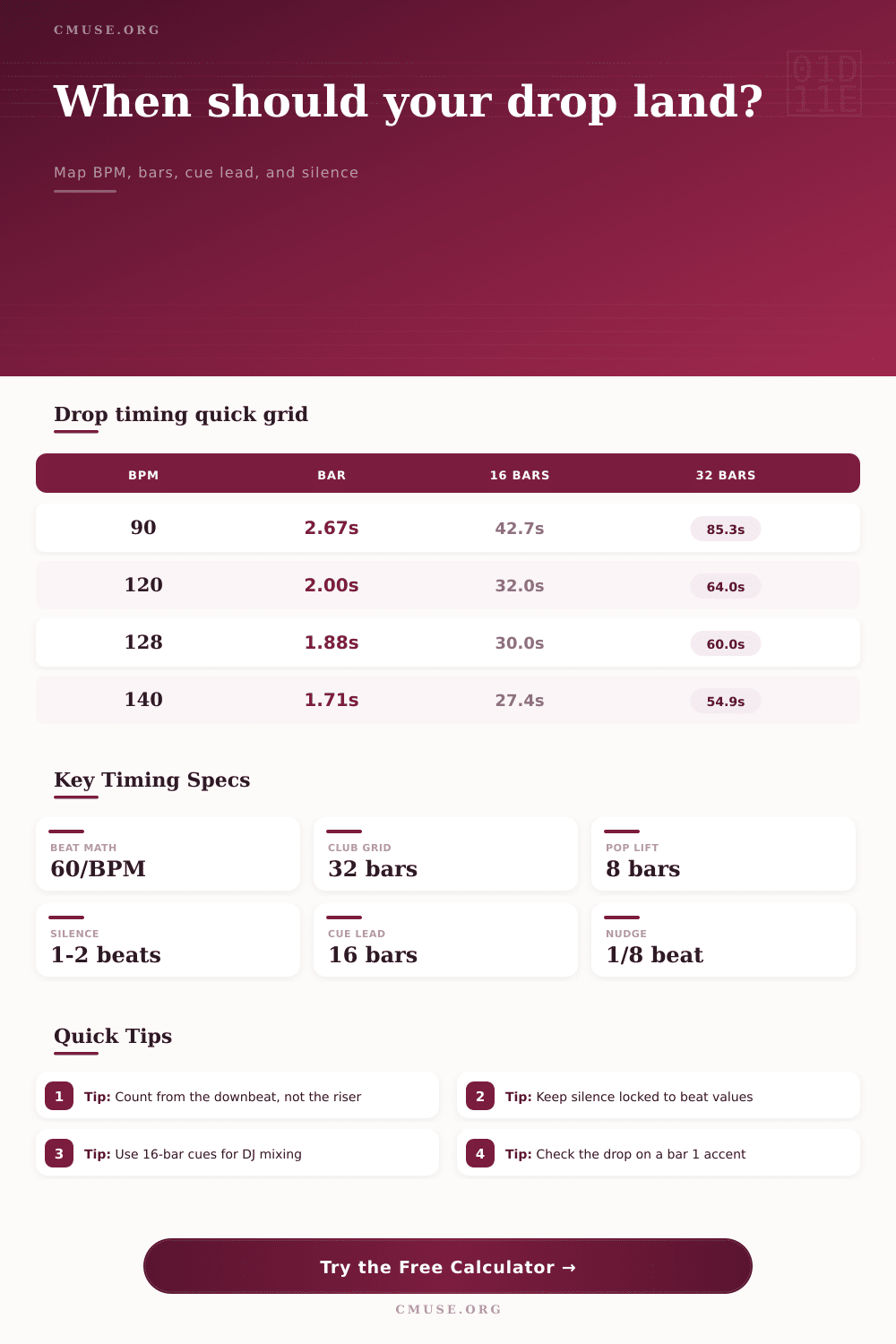
Choose a real arrangement scenario to load practical starting values. Each preset keeps the math transparent: beat duration is 60 divided by BPM, bar duration is beats per bar multiplied by beat duration, and the drop timestamp is the cue start plus all counted bars, silence, and offset beats.
This calculator treats the counted start as a musical downbeat. For a DAW timeline, place the start marker on bar 1 beat 1 of the phrase, enter the bars to the impact, and use the offset field for pickups, crashes, or deliberate late hits.
Timing Breakdown
One Beat
One Bar
16-Bar Phrase
Selected Nudge
| Drop context | Typical count | Timing feel | Audio cue to verify |
|---|---|---|---|
| Festival EDM | 16-bar intro plus 32-bar build | Drop lands on a clear bar 1 after a full phrase build. | Kick, sub, crash, and sidechain release hit together. |
| Radio Pop | 4 to 8-bar pre-chorus lift | Shorter ramp keeps the hook close to the vocal phrase. | Lead vocal pickup should not mask the first chorus accent. |
| Dubstep | 8 or 16-bar build into half-time | Impact often feels strongest after 1 beat of silence. | Snare on beat 3 confirms the half-time grid after impact. |
| Techno | 32 to 64-bar filter ramp | Long tension depends on exact phrase boundaries. | Open hat, ride, or clap return should reveal the downbeat. |
| DJ Double Drop | 16 or 32-bar cue lead | Both tracks must reach their drop on the same beat grid. | Compare waveform transients at the first kick or snare. |
| BPM | Beat length | 4/4 bar length | 8-bar phrase | 16-bar phrase | 32-bar phrase |
|---|---|---|---|---|---|
| 90 | 666.7 ms | 2.667 s | 21.333 s | 42.667 s | 85.333 s |
| 100 | 600.0 ms | 2.400 s | 19.200 s | 38.400 s | 76.800 s |
| 110 | 545.5 ms | 2.182 s | 17.455 s | 34.909 s | 69.818 s |
| 120 | 500.0 ms | 2.000 s | 16.000 s | 32.000 s | 64.000 s |
| 128 | 468.8 ms | 1.875 s | 15.000 s | 30.000 s | 60.000 s |
| 140 | 428.6 ms | 1.714 s | 13.714 s | 27.429 s | 54.857 s |
| 150 | 400.0 ms | 1.600 s | 12.800 s | 25.600 s | 51.200 s |
| 174 | 344.8 ms | 1.379 s | 11.034 s | 22.069 s | 44.138 s |
| Scenario | Common bars before drop | Best cue lead | Drop timing note |
|---|---|---|---|
| Pop chorus after pre-chorus | 4 to 8 bars | 4 or 8 bars | Count from the first pre-chorus downbeat, then allow vocal pickups before bar 1. |
| House or trance main drop | 32 to 64 bars | 16 or 32 bars | Keep the drop on phrase bar 1 so crowd, lighting, and DJ blend all resolve together. |
| Trap or hip-hop beat switch | 8 to 16 bars | 8 bars | Snare-roll subdivisions make small offsets obvious, so check 1/8-beat nudges. |
| Dubstep half-time entry | 16 or 32 bars | 16 bars | One beat of silence often frames the downbeat without losing grid certainty. |
| Cinematic trailer impact | Variable bars | 4 or 8 bars | Use bar math for stems, then place the final hit against picture or marker time. |
| Drum and bass double drop | 32 or 64 bars | 32 bars | Both tracks need matching phrase distance from drop to avoid a one-bar clash. |
| Pre-drop move | Beat value | At 128 BPM | Use when |
|---|---|---|---|
| Micro gap | 1/4 beat | 117 ms | The impact needs a tiny breath but the groove should feel continuous. |
| Snare-stop gap | 1/2 beat | 234 ms | The final fill stops just before the kick and crash return. |
| Classic silence | 1 beat | 469 ms | The crowd can anticipate the hit without losing the downbeat. |
| Fake-out pause | 2 beats | 938 ms | The arrangement deliberately delays the drop inside the bar. |
| Full-bar reset | 4 beats | 1.875 s | A spoken cue, vocal chop, or riser tail fills the empty space. |
| Cue lead | At 120 BPM | At 128 BPM | Mixing purpose |
|---|---|---|---|
| 4 bars | 8.0 s | 7.5 s | Quick drop tease, emergency phrase catch, or short vocal handoff. |
| 8 bars | 16.0 s | 15.0 s | Compact radio edit transition or late intro point. |
| 16 bars | 32.0 s | 30.0 s | Standard club cue for matching phrases before a drop. |
| 32 bars | 64.0 s | 60.0 s | Long blend where drums and bass swap gradually. |
| 64 bars | 128.0 s | 120.0 s | Extended intro or progressive buildup alignment. |
Here’s what I’m talkingin’ ‘bout: You’ve been there. Energy builds, the crowd leans in, the riser gets loud. Then you push that drop button. Then nothing happens for a split second that feels like an eternity. Or maybe you were off by a fraction of a beat and the kick drum stutters. The room falls silent. It wasn’t your mixing prowess. It was the math. Drop timing isn’t an art form; it’s geometry. Viewing the timeline as a grid instead of a vague idea make live performance a well-oiled sequence. After you input your phrase structure and tempo into the calculator, it does the math for you. No need to fumble around with conversions and coefficients.
For most producers, they realizes that 128 beats per minute in a standard 4/4 bar is about 1.88 seconds. But things start getting tricky when you begin piling variables onto each other. What’s the length of the intro bars? How long does it take to build up? How much pre-drop silence should be used? When do you lead into the DJs cue? Each one of these elements will add seconds which add up rapidly. And if you’re off by just half a beat in your head calculation then the drop comes down on the off-beat. Kick goes straight through sidechain compression. Snare clashes with the bassline. It’s all polished up individually but sounds muddy overall.
Why Math Helps Your Drop Sound Good
The inputs are real world musical choices and therefore it’s important to understand them. For DJs the cue lead field is key. Why does the industry standard settle on a 16-bar cue? Because it provides enough time to EQ balance and phase match while not bleeding too far into what came before. Go with a 32-bar cue and you run the risk of killing the energy in your existing mix. Go with just 4 bars and you’re gambling that things will instantly line up. You can see exactly where those cue points hit in relation to their ultimate impact. This turns abstractions like bar counts into real timestamps you can rely on.
The other variable that’s commonly misinterpreted is pre-drop silence. “I need to make the silence longer to increase the tension.” Most engineers believe this. Typically what happens is confusion. Often a one-eighth-note or even a one-beat silence works fine to draw us into the vacuum. Anything beyond that runs the risk of breaking your listener’s internal clock and they’ll be wondering if you made an error or if song has actually stopped. This is laid out clearly in the reference table on the page. It details what different lengths of silence mean in milliseconds at different tempos. Seeing 469 milliseconds feels like nothing when you realize how well it frames a punchy kick-drum.
But what about the drop itself? It could be a subtle dubstep sub-entry or an EDM festival bang. Depends on the length of the arrangement. In a 32 bar drop, you can have breakdowns and variations in the high energy. With an 8 bar pop chorus, you need something that hits hard and quick to keep attention of radio listeners. With this, you are able to define the length of your drop. That way you can get an idea of when the energy’s going out. This is critical to how you plan the next transition. How can you plan a mix without knowing where existing track ends?
In the studio, people sometimes attempt to feel out these timings. They’ll play the track back and guess where the drop is. That’s fine if you’re just listening by yourself. That doesn’t work in a club. Precision bridges the gap between the dancefloor and the DJ booth. Different venues has different amounts of latency. If your track is perfectly on grid, you can adjust your mixer faders to compensate for any delay in the room. Adjusting your mixer fader can account for any delay in the room. But if your track has a bit of rhythmic looseness, nothing you do with your faders will make up for the phasing issue.
Finally, there is the nudge and offset resolution. While all the music may be quantized down to the millisecond in terms of construction, it never is in feel. There’s always some degree of human timing that can be applied via a swing setting or manually adjusting the beat offset. However, this is only possible when you’re aware of exactly what grid is. Otherwise, it becomes a mess rather than a groove. It should of been deliberate.
Finally, the drop is simply the result of all the tension you’ve created. Calculating its exact arrival time ensures the payoff lands exactly where it’s supposed to go. It becomes an effortless flow of sound instead of what might otherwise be a stumble. If you get it right, it doesn’t register at all. Instead, you experience the blow and there you go. It is just as it ought to be.