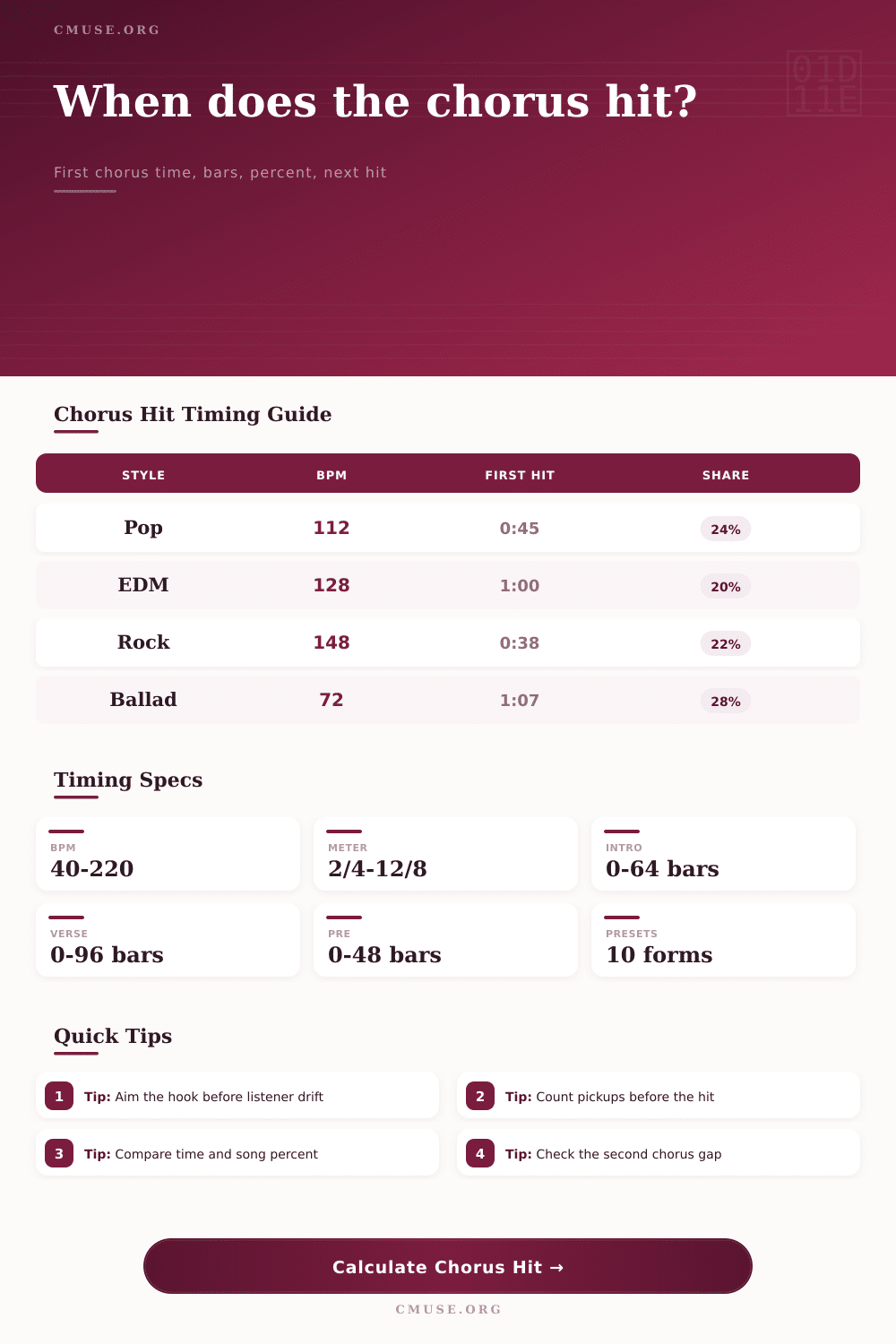
Chorus Hit Time Calculator
Estimate when the first chorus lands, how many bars lead into it, what percent of the song has passed, and how long listeners wait for the next chorus hit.
Preset use: Load a structure close to your song, then adjust BPM, meter, section bars, pickup beats, chorus length and total runtime for your arrangement.
Calculation Breakdown
| Input | Formula Role | What It Changes | Common Check |
|---|---|---|---|
| BPM | Defines beat seconds as 60 divided by BPM. | Moves every bar-based arrival earlier or later. | Use the actual production tempo, not a rounded memory. |
| Meter | Multiplies beat length by beats per bar. | Changes the clock time of each written section. | For 6/8, decide whether BPM means dotted quarter or eighth. |
| Intro plus verse | Creates the main wait before the chorus. | Usually determines whether a hook feels early or patient. | Count silent bars and turnarounds if they are heard. |
| Pickup and hit beat | Offsets the exact musical attack. | Separates chorus downbeat from the first sung or played hook. | Use negative pickup beats for an anacrusis into the chorus. |
| Reference Style | Typical First Hit | Hook Percent | Structural Cue |
|---|---|---|---|
| Mainstream pop single | 0:30 to 0:55 | 15% to 28% | Intro, verse, short lift, chorus. |
| Streaming-forward single | 0:20 to 0:45 | 10% to 24% | Hook tease, compact verse, quick chorus. |
| Rock and country single | 0:35 to 1:10 | 18% to 32% | Riff or intro, full verse, pre-lift or tag. |
| EDM vocal or drop form | 0:45 to 1:30 | 16% to 35% | Intro, verse, build, drop or vocal hook. |
| Ballad and worship form | 0:55 to 1:35 | 22% to 38% | Longer verse space before the first chorus. |
| Progressive or cinematic form | 1:20 to 2:20 | 28% to 50% | Delayed payoff with a larger section arc. |
| Meter and BPM Example | Bars Before Hook | Approx First Hit | Planning Note |
|---|---|---|---|
| 4/4 at 120 BPM | 24 bars | 0:48 | A compact pop route to the first chorus. |
| 4/4 at 96 BPM | 24 bars | 1:00 | Same bars feel slower and more narrative. |
| 6/8 at 72 BPM eighth grid | 20 bars | 1:40 | Check whether the chart is really dotted-quarter based. |
| 3/4 at 144 BPM | 32 bars | 0:40 | Many bars can still move quickly in waltz meter. |
| 4/4 at 150 BPM | 32 bars | 0:51 | Fast rock can wait more bars without waiting longer. |
| Second Chorus Route | Interval Shape | Listener Effect | Use When |
|---|---|---|---|
| Chorus, short post, verse, pre | Balanced repeat | Feels familiar without rushing. | Most radio and playlist singles. |
| Chorus, no post, short verse | Quick return | Keeps the hook dominant. | Very hook-driven pop, rap, punk or dance tracks. |
| Chorus, bridge-like verse | Expanded return | Gives the second hit more contrast. | Ballads, worship, theatrical forms. |
| Chorus, drop, breakdown, build | Long cycle | Makes the next hit feel like a payoff. | EDM, progressive rock and cinematic pop. |
The chorus hits hard with an irresistible tune and punchy words. But then, thirty seconds later, the listener switches off. It is not because they do not like it, but simply because the hook has not landed. Because in this day and age, in the fight for attention, no-one’s got time to wait around for it.
Bringing the chorus to life within the first minute isnt optional. It’s not an aesthetic choice; its a structure requirement. Often, it’s seconds, not years of songwriter’s experience, that determine whether your track will be played again or ignored.
Why Timing Matters in Your Song
But here’s the thing: it’s not as complicated as all that. There is a structure, which is order of sections until they get to the good stuff. There’s a meter (how wide the bar is). There’s a tempo (how fast the beat goes). All you do is put them into the calculator. Enter number of bars for your intro, verse, pre-chorus. Enter your BPM. And your time signature. And just like that! The math gets run for you by the calculator. It converts these vague musical decisions into real time stamps.
How many bars into the song does the first chorus land? Answer: It depends on what you want that answer to be. But that answer matters. Because people judge a song within the first minute. Industry standards indicate that for a hip hop or pop track, the ideal length of time for your first chorus hit are typically in the thirty-second to fifty-five second range, while ballads or rock songs gives you slightly longer, perhaps as long as one minute, ten seconds. But each second matter.
And that’s where most writers trip up: understanding the inputs. Tempo is the engine, but structure is the chassis. Tempo is the engine. How fast does the engine run? A song with a tempo of 90 BPM feel different than a song with a tempo of 120 BPM. But the number of bars stacked ahead of the hook have much more impact on the clock time of the chorus. At 120 BPM, twenty-four bars will get you to the chorus in forty-eight seconds. At 90 BPM, the same twenty-four bars push that arrival time out to a full minute. In rehearsal that may feel like no big deal, but in a playlist, it’s an eternity.
This trade-off is what the tool allow you to visualize. Maybe building tension by adding four bars to your pre-chorus works great for you. But now you see the hook coming down the line past the critical forty-five-second mark when casual listeners’ attention starts to waver. It is a small thing, but it matters.
Also take note of the beat inside a bar and the pickup beats. Even though it’s possible for a chorus to begin technically on bar 29, if the vocal melody doesn’t kick in until beat three of that same bar then we are waiting. These small details can be entered into the calculator as they differentiates between the section change and actual audio payoff. This is important for accuracy. It is not just about when the chord progression changes, but also when the listener hears the hook.
There is also a breakdown on the page of a comparison table that compares across genres. Punk songs will hit the hook nearly instantly and keep momentum going whereas EDM tracks typicaly delay the drop to build up the energy. Another metric to keep an eye on is the second chorus interval. While there might be enough space between verses to develop a story, the distance to the next chorus may make it feel far away from a strong first hit. Your goal is to maintain a reward pattern that keeps the listener interested without being repetitive.
For example, if your initial chorus hits on thirty seconds, then you likely desire your next to make its reappearance somewhere reasonable, again, maybe a minute or so later (depending on your verse length). This is how the calculator displays the gap for you and allows you to find the sweet spot of hook repetition vs. Narrative development.
The bottom line: “You’re creating something for somebody who may have their phone in one hand and is listening to this thing on the commute, at a workout, or just scrolling along. They don’t care about the structure; they’re reacting to it. Do I like it? And if [the payoff] doesn’t come soon enough, then they skip. If there’s no build-up, if it’s too early and it didn’t mean anything, then it has no impact. So that sweet spot is what you go after. It’s not a tool to limit your creativity; its to make sure your creativity lands with the guy on the other side of the speakers. You would of wanted him to get the hook in time to decide whether he wants to skip or not.