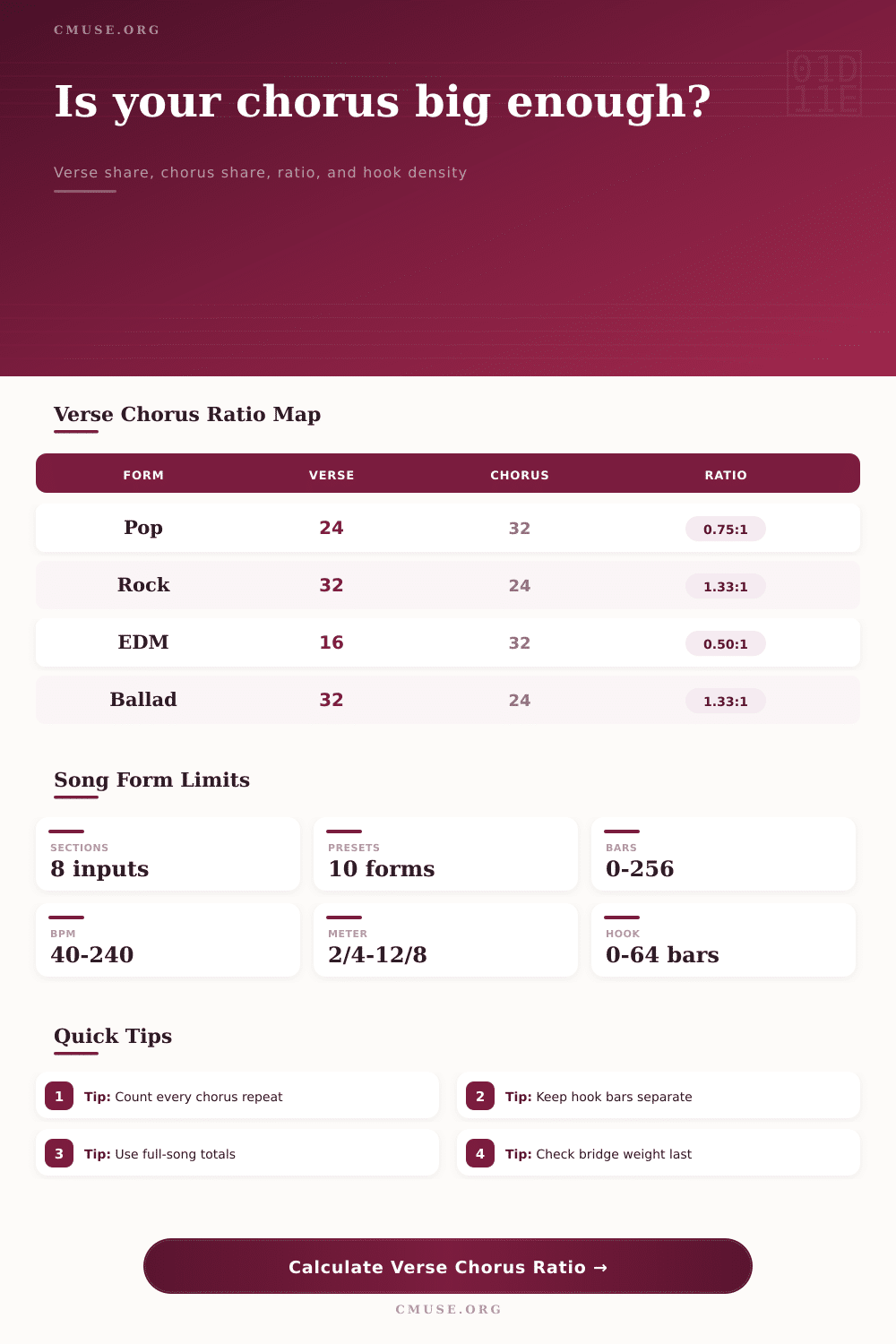
Verse Chorus Ratio Calculator
Measure how much of a song belongs to verses, choruses, hooks, and supporting sections, then compare the balance against common pop, rock, EDM, ballad, and live arrangement forms.
Preset workflow: Choose the closest structure, then edit the bar counts and repeat counts. The calculator totals every occurrence across the full arrangement.
Counting rule: Enter the written length of one section and how many times it occurs. For example, two 16-bar verses means 16 bars and 2 repeats.
Calculation Breakdown
Total bars
Estimated runtime
Support share
Style fit
| Pop form | Typical map | Verse share | Chorus share | Production note |
|---|---|---|---|---|
| ABABCB | Intro, verse, pre, chorus, verse, pre, chorus, bridge, final chorus | 28-38% | 24-36% | Strong when the second chorus arrives before the two-minute mark. |
| Post-hook | Verse, pre, chorus, post, verse, pre, chorus, post, bridge, chorus | 22-34% | 34-48% | Post-chorus bars should count as hook exposure when they carry the title or chant. |
| Short single | Intro, verse, chorus, verse, chorus, bridge, chorus, tag | 30-42% | 32-45% | Small intros and quick verse exits make the chorus feel larger without adding bars. |
| Ballad pop | Verse, pre, chorus, verse, pre, chorus, bridge, double chorus | 34-46% | 24-38% | Longer verses work if the final chorus earns a bigger vocal or harmonic lift. |
| Rock form | Typical map | Verse share | Chorus share | Arrangement note |
|---|---|---|---|---|
| Alt rock | Intro riff, verse, chorus, verse, chorus, bridge, solo, chorus | 32-44% | 22-34% | Riff intros and solos can be support bars unless they state the main hook. |
| Classic rock | Intro, verse, verse, chorus, verse, chorus, solo, chorus, outro | 38-52% | 18-30% | Verse-led forms can still feel hooky when the riff recurs between vocal sections. |
| Pop punk | Intro, verse, pre, chorus, verse, pre, chorus, breakdown, double chorus | 25-36% | 30-44% | A short bridge or breakdown can keep the final double chorus from feeling late. |
| Jam outro | Verse, chorus, verse, chorus, bridge, chorus, solo, outro vamp | 26-38% | 22-34% | Long outro vamps lower hook density unless the vocal refrain continues. |
| Dance form | Typical map | Verse share | Chorus/drop share | Energy note |
|---|---|---|---|---|
| EDM drop | Intro, verse, build, drop, break, build, drop, outro | 10-24% | 36-58% | Count the drop as chorus material when it is the track payoff. |
| Dance pop | Verse, pre, chorus, post, verse, pre, chorus, bridge, final chorus | 20-32% | 38-54% | Post-hook tags make the ratio hook-led even if choruses are only eight bars. |
| Club mix | DJ intro, verse, build, drop, breakdown, drop, outro | 8-20% | 32-50% | Long DJ intros are support bars and can hide the vocal ratio in the full mix. |
| Synthwave | Intro, verse, chorus, instrumental, verse, chorus, solo, outro | 20-34% | 24-40% | Instrumental hooks may belong in hook density even outside vocal choruses. |
| Live form | Typical map | Verse share | Chorus share | Planning note |
|---|---|---|---|---|
| Worship | Verse, chorus, verse, chorus, bridge, bridge, chorus, tag | 18-32% | 34-56% | Bridge repeats often act like hook material when the lyric is chant-based. |
| Hip-hop | Intro, hook, verse, hook, verse, hook, bridge, hook | 38-55% | 24-38% | Long verses can balance well if hooks return on a predictable cycle. |
| Acoustic | Verse, chorus, verse, chorus, bridge, chorus, outro | 36-50% | 22-34% | Small arrangements can tolerate more verse time when the melody changes enough. |
| Set closer | Intro, verse, chorus, verse, chorus, solo, bridge, chorus, tag | 24-38% | 28-44% | Tags and crowd callbacks lift hook density without rewriting the verse count. |
Every songwriter’s experience has included that point in a song where something isn’t quite right. The lyrics are decent. They’re good, but melody is catchy. The production is polished, but arrangement fizzles at the end or drags in the middle. It’s never realy a note that sounds wrong. Most times it is an issue of how the song’s structure are balanced. Did you spend too much time telling the story? Or didn’t you spend enough time bringing home the payoff?
If there isn’t a sense of weight to each section, then the song doesn’t hold your attention. The listener skips past it. This intuition can be quantified using the calculator here. Rather than guessing at whether your chorus is hitting hard enough, you simply input the bar count of what’s actualy there and compare it to industry norms for pop, rock, ballad and EDM form. Basic inputs includes meter, tempo and repeats per section.
How to Balance Your Song Structure
Where the calculator gets real is in its classification of your hooks’ density. Writers typically count a chorus as main event, which is a mistake. An instrumental drop or a post-chorus chant can has the same emotional weight as a vocal chorus. Labeling those right, the tool will tell you if your song really has high hook density or if it’s just full of choruses. It is a small distinction, but it makes a difference for streaming retention.
Take, for instance, the classic structure of a pop song on the radio. When we hear one, our instinct is to think: “If I double the length of the chorus, then it’ll be twice as big.” But more often than not, this isn’t how math works. You can increase the chorus by four bars, sure, but now maybe you need an even-longer pre-chorus to give it a proper build? Well, in doing so, you just made your verse-to-chorus ratio smaller different than what it was originally. The math reveals itself in real time, forcing you to visualize the song as a pie chart.
If your verses take up forty percent of the runtime and your support sections like intros and outros takes another twenty, you are left with only forty percent for the chorus and hook. And then your verses account for another 40%? Then you’re down to 40% for your chorus and hook, which hardly leaves any space for the hook to catch air. Lots of current hits sound faster than they really are, simply because they trimmed off the support bars, making the chorus seem larger without increasing the amount of chorus material at all.
This has a lot to do with genre conventions too. While a riff may propel the energy through verses in a classic rock song, giving those sections a forty-five percent share of the song are not out of place. On the other hand, an EDM track lives or dies by the drop. The drop is the chorus. If you treat your drop as a supporting section, the calculator will say the track is verse-heavy, which is misleading. Each bar needs to be given the right role.
The preset buttons gives you a starting point based off what listeners of tracks like yours expect. Nothing wrong with deviating from these baselines. Just make sure you are doing it intentionally. Dance track doesn’t get away with extended verses. The spike of energy need to happen early and often, but a ballad can take its time because the emotional arc is all that matters.
The difference between a great song and a good one comes down to hook density. Having a big chorus isn’t sufficient. That key phrase or melody needs to be heard often enough for it to lodge itself in the listener’s mind. To do this, the tool looks at core hook bars and repeats. So if your chorus is eight bars long, but just four are the title phrase, you’ll get a lower score on hook density compared to another song that has a chorus of two four bar sections, each made up of all title phrases. Which is why sometimes shorter singles can seem more punchy than longer album tracks; they jam the same amount of hook moments into less space.
Check out the share on support during demo edits. Is your intro/outro/bridge using upwards of thirty percent of the available bars? Chances are the song is meandering. You have only the initial thirty seconds to capture an audience’s ear, so it’s dangerous to use that time with a lengthy intro, especially if it’s not something utterly compelling. This is where the calculator come in handy; it visually shows just how much of the song you’re dedicating to non-hook material. It is a good reality check for overly-arranged tunes.
In the end it all boils down to respect for the listener’s time. If they’re giving up their time for you, you don’t want them to feel like the journey was dragged out in order to get to the goods. They don’t lie, but need to be considered within context. Having a low chorus share isn’t necessarily fatal, does the production lift the energy? Does having a high verse share mean it’s bad? Not necessarily, as long as the story is compelling! It is not necessarily so. Let the tool point you towards that sweet spot. Then use your ear to make the final tweaks.
Math gets you the map. You should of driven the car.