Section Proportion Calculator
Measure how much of a song belongs to the verse, chorus, bridge, intro, solo and ending, then compare the form against common arrangement targets.
Preset use: Load a common song form, then adjust section bars, repeat counts, meter, tempo and comparison profile to match your actual chart or DAW marker map.
Section Proportion Breakdown
Chorus and post-hook material.
Bridge plus solo or breakdown.
Meter and tempo converted to seconds.
Sections with nonzero performed bars.
| Section | Bars Per Pass | Passes | Performed Bars | Share | Timeline |
|---|
| Form Model | Common Layout | Verse Share | Chorus Share | Use Case |
|---|---|---|---|---|
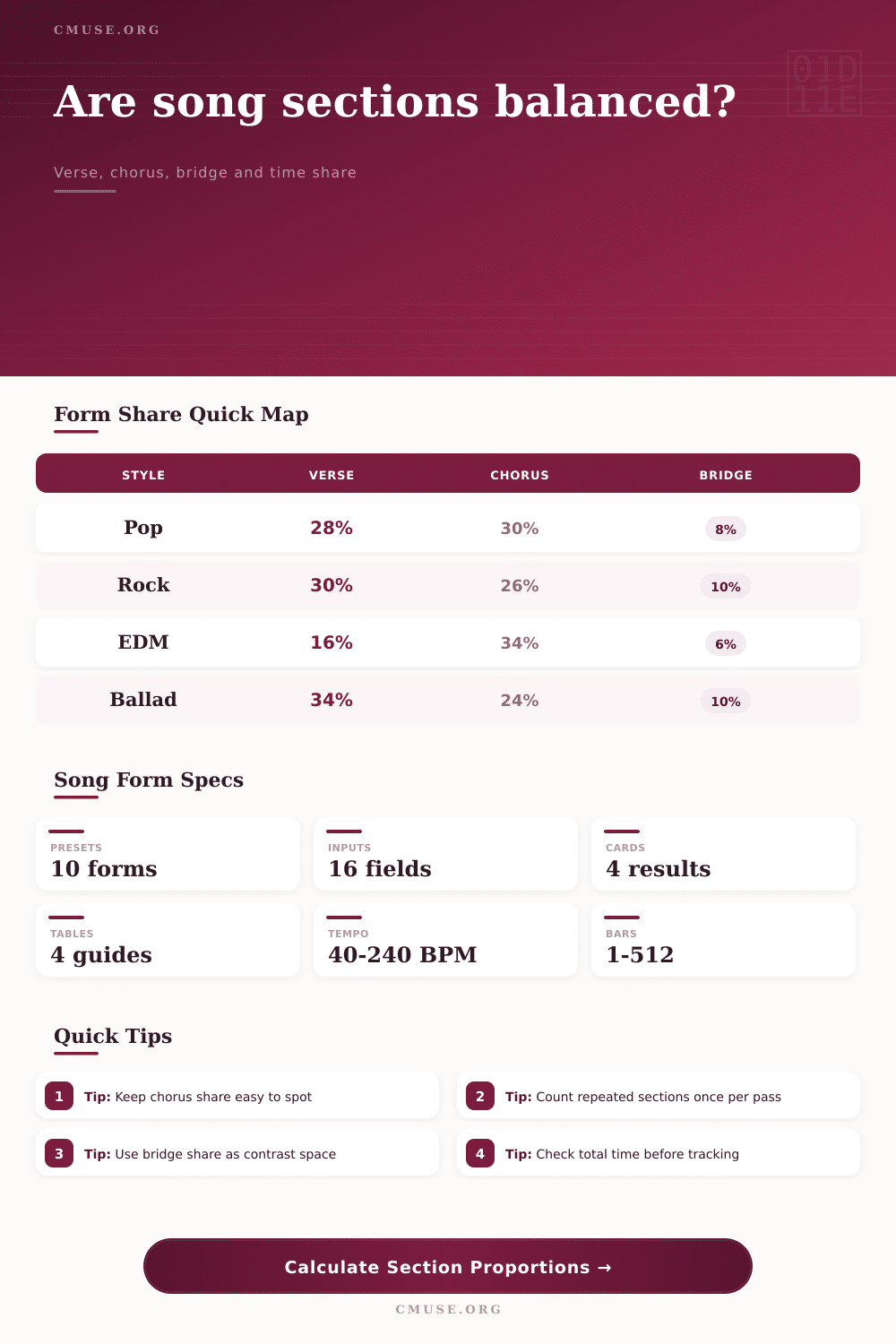
| Verse-chorus pop | I V PC C V PC C B C O | 24% to 34% | 28% to 42% | Hook-forward singles with fast recognition. |
| Rock single | I V C V C S B C O | 26% to 36% | 22% to 34% | Riff identity, guitar solo, and chorus payoff. |
| Ballad | I V PC C V PC C B C O | 30% to 42% | 20% to 32% | Lyric development with slower section turns. |
| EDM drop form | I BLD D V BLD D BR D O | 10% to 22% | 30% to 48% | Drop or hook material carries the main energy. |
| Jazz head-solo | H S S H Tag | 0% to 15% | 12% to 28% | Head statements frame extended improvisation. |
| Section Type | Typical Bars | Typical Share | Proportion Role |
|---|---|---|---|
| Intro | 2 to 8 bars | 2% to 10% | Sets tempo, texture, motif, or key center. |
| Verse | 8 to 16 bars | 20% to 40% | Delivers story, setup, harmonic grounding, or flow. |
| Pre-chorus | 4 to 8 bars | 6% to 18% | Builds tension and prepares the hook entry. |
| Chorus or drop | 8 to 16 bars | 24% to 45% | Holds the most repeated identity of the song. |
| Bridge | 4 to 16 bars | 5% to 16% | Adds contrast before the final return. |
| Outro or tag | 2 to 16 bars | 3% to 18% | Resolves, fades, vamps, or lands the final button. |
| Meter | BPM Reference | One Bar At 120 | 32 Bars | Timing Note |
|---|---|---|---|---|
| 2/4 | Quarter-note BPM | 1.00 sec | 32.00 sec | Short bars make repeats feel quicker. |
| 3/4 | Quarter-note BPM | 1.50 sec | 48.00 sec | Useful for waltz and ballad forms. |
| 4/4 | Quarter-note BPM | 2.00 sec | 64.00 sec | Default for most pop and rock charts. |
| 6/8 | Dotted-quarter BPM | 1.50 sec | 48.00 sec | Two dotted beats often define the feel. |
| 12/8 | Dotted-quarter BPM | 3.00 sec | 96.00 sec | Slow shuffle bars are longer than they look. |
| Preset | Total Bars | Largest Share | Typical Duration | Arrangement Note |
|---|
Weeks were spent painstakingly crafting lyrics that read perfectly on the page, but they is now sagging in the studio because arrangement lacks any kind of spine. This is a common complaint from writers who has given little thought to structure of the track. It should of been considered the engine of the song instead, not an afterthought.
The calculator does the maths. It calculates number of bars performed in each section, converts this into time, and compares amount of verse, chorus, bridge, intro, solo, and outro to typical song structures. In short, it makes you see what you are hearing, even if you cannot measure it yet.
How to Use a Song Structure Calculator
But most folks consider balance to be ensuring that each element of the song receive equal love, which isn’t realy what happens in a lot of great pop songs. The verse becomes almost an afterthought, something that serves as setup for meat and potatoes, and the hook is given primary importance over everything else. If you take a typical verse-chorus form, chances are the chorus will account for upwards of forty percent of the runtime; it’s carrying the load. So if your verse is lingering on setting up the story longer then it should, you’re watering down the payoff when it comes.
Before you begin tracking any instrumentations, you should have a clear idea of how many bar are being allotted to each function. This tool takes care of hard math for you, allowing you to explore creative aspects instead. Simply input number of bars for each section (intro, verse, pre-chorus, chorus, bridge, outro), including their corresponding repetition pattern, and it multiplies out the repetitions in bars. For example, a sixteen-bar verse that repeats once is far less heavy than a sixteen-bar chorus that repeats three times. This is important because the listener experiences duration based off what they hear rather than how it is written down.
By entering your desired time signature and tempo, the calculator translates your bar count into seconds, revealing an exact amount of time for whole form. In today’s streaming music, timing is money, and it might be that an impatient listener bails out before your second chorus hits, if your song is three minutes and forty-five seconds long.
You could play with a preset form such as Radio Rock or Moddern Pop to observe how other genres budget their minutes. For example, a ballad will likely devote a greater percentage to the verse because it need to develop lyrics further. In contrast, a dance genre may spend more beats on the build-up and drop than conventional vocals would spends on verses. They’re not arbitrary conventions, rather they reflect how differently people absorb musical content.
Pay close attention to resulting balance score. It is based on genre-specific target figures pulled from commercially successful releases, and it compares your section allocation against industry norms for style of music you’ve created. If your score is high, then your section ratios matches what is expected of that genre of music. This does not necessarily mean you need to do things that way, but it can show where you might be very different.
If you find that your bridge is too long, it will negatively impact the score because listeners may feel they have lost momentum. Specifically, the contrast share metric measures that middle-eight area to make sure it bring relief rather than becoming a destination in its own right. This is clearly shown on page with a reference table that details common percentage shares/typical bar range per section type.
Outros require sufficient space to resolve tension without extending too far as to sound padded; intros are best kept to two to eight bars to establish mood rapidly. Solo sections tends to stretch out more in jazz or rock. In those styles, the improvisational nature brings its own sense of structure. However, in a pop setting, even a solo should serve the hook rather than diverting attention away from it.
Also pay attention to your choice of tempo and meter. A sixteenth-note shuffle can be fast, but it feels very different than a slower half-time groove with same bar count. This is where the tool realy does help. It converts your chosen beats-per-minute into real-world seconds per bar based on bottom number of your chosen time signature. For example, a track in four-four at a hundred and twenty BPM has a different timing than a six-eight track set to same metronome setting. Knowing this conversion enables you to predict how dense or sparse your own arrangement will feel to a listener who is not reading music.
In the end it’s all about expectation management and pace; how do you make an arrangement feel like it’s moving from point A to B? How does it rise and fall over time? Too much of one thing can be boring, like having too much chorus, and too little of something else won’t work, like not having enough verse; this is where the calculator provides math behind those artistic choices. You can fine-tune length of each section until it seems as if it couldn’t have been any other way. Instead of just trial-and-error editing, you know when to add or cut a certain amount of bars because it knows the song’s groove, rather than guessing what sounds good.
The song no longer has sections that feel “off.” They simply is what they are. There is no wonder, just knowledge.