Volta Bar Count Calculator
Calculate how many bars a repeated section with first endings, second endings, grouped voltas, tags and post-repeat material will actually play compared with the bars printed on the page.
Preset use: Load a real repeat-bracket shape, then edit the common repeated bars, ending lengths, grouped labels, lead-in bars and post-volta bars for your score.
Full Calculation Breakdown
Written bars
Ending bars heard
Core bars heard
Page efficiency
| Printed labels | Performance meaning | Count method | Typical use |
|---|---|---|---|
| 1., 2. | Play common music twice, use a different ending each time. | 2 core passes plus ending 1 and ending 2. | Binary dance, song verse, short strain. |
| 1.-2., 3. | First printed box is reused for labels 1 and 2. | 3 core passes, first box twice, final box once. | Hymn verse or repeated refrain. |
| 1.-3., 4. | Grouped first box covers three passes before the final ending. | 4 core passes, first box three times, final box once. | Lead sheet, theater vamp, folk song. |
| 1., 2., 3. | Three separate boxes with one pass per ending. | 3 core passes plus all three printed endings. | Choral stanza or arranged tag. |
| Common bars | Ending lengths | Labels | Played bars |
|---|---|---|---|
| 8 bars | 2, 4 | 2 | 8 + 2 + 8 + 4 = 22 |
| 12 bars | 2, 2, 4 | 3 | 12 + 2 + 12 + 2 + 12 + 4 = 44 |
| 16 bars | 4, 8 | 4 | 16 x 4 + 4 x 3 + 8 = 84 |
| 32 bars | 8, 8 | 2 | 32 + 8 + 32 + 8 = 80 |
| Setup | Written bars | Played bars | Bars saved |
|---|---|---|---|
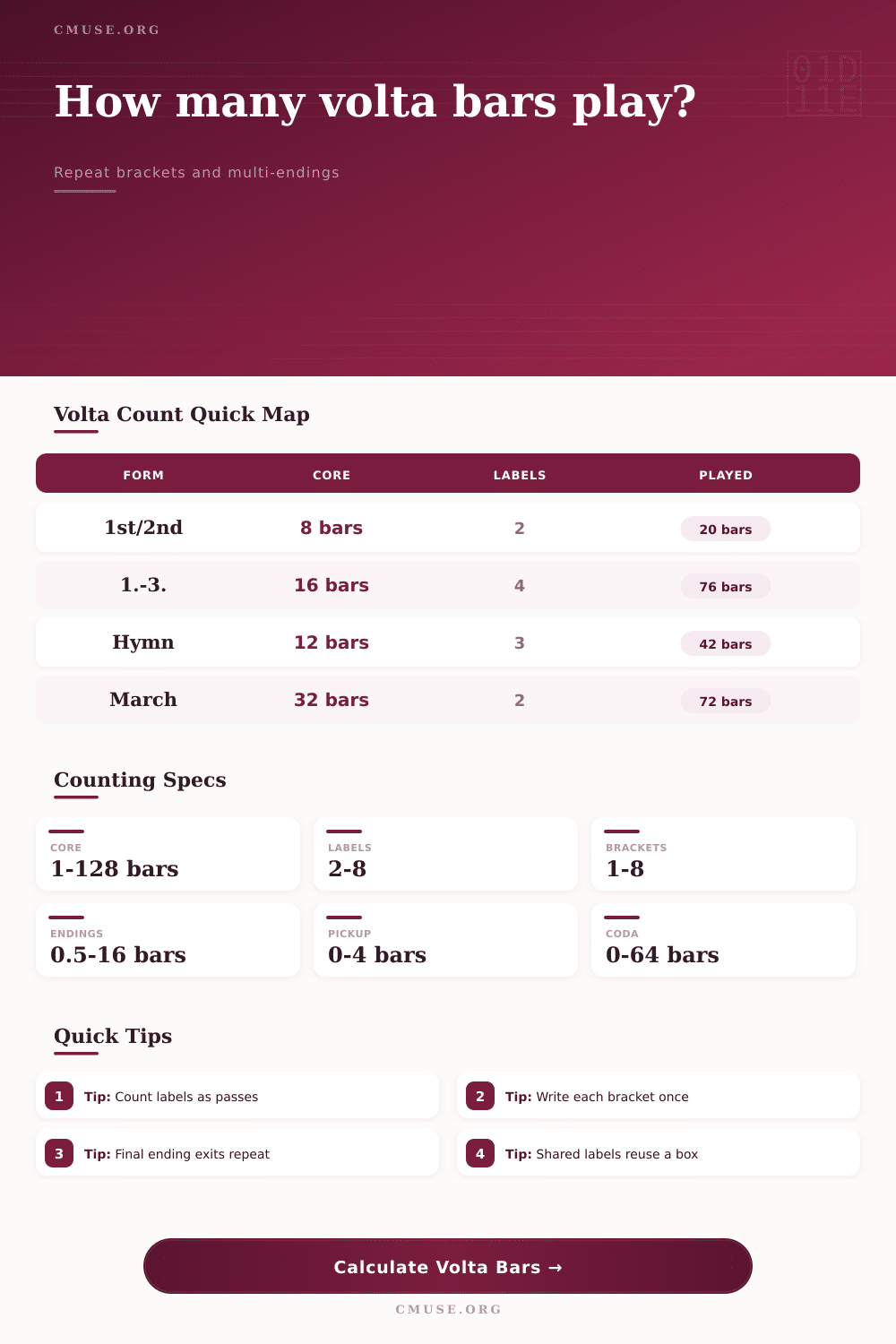
| 8-bar common, 2 endings of 2 bars | 12 | 20 | 8 |
| 16-bar common, 1.-3. and 4. | 28 | 76 | 48 |
| 12-bar common, 3 printed endings | 18 | 42 | 24 |
| 32-bar strain, 2 eight-bar endings | 48 | 80 | 32 |
| Form notation | Best when | Bar-count advantage | Counting risk |
|---|---|---|---|
| Volta brackets | Same middle, different endings. | Saves the common repeated section. | Misreading grouped labels. |
| Fully written out | Players need linear playback. | No compression, easiest count. | Longer score and page turns. |
| Plain repeat sign | The ending is identical each pass. | Saves one repeated block. | Cannot show alternate cadences. |
| D.S. or D.C. | A large return is needed. | Saves a whole earlier section. | Needs sign, coda and ending checks. |
What you might see as a straightforward eight-bar phrase with two endings could, when played through, take up twenty bars of performance time. This is where understanding what a volta bar count mean is important for a musician before starting to learn the piece from sheet music. As a beginner, you may be surprised how much distance there is between written score and music that is played.
The notational shorthand, such as repeat signs, are designed to minimise page turning and paper usage. It also requires player to use brainpower expanding the notation into linear time in their heads. When playing in an ensemble, everyone need to know exactly where beat lands after each jump forward. One miscounted bar can mess up whole section’s timings. There is a pause as performers looks around, waiting for someone else to begin again.
Why Volta Bar Counts Matter
Why does this matter? Notation rules differs between genres. A classical piece in a classical form may have first and second endings. An arrangement of a jazz tune or a theater vamp may has several passes lumped together within a single set of brackets. One label will read 1 through 3 in a box. That tells you there are three passes of common section before moving on. It sounds simple enough, until you find yourself trying to look at only one bracket and keep track of three musical idea in your head.
By simply entering your own labels and letting a calculator do the math for you, it eliminates need to guess and convert. It all alters when we gets into grouped endings. If a composer use one box for labels 1 through 3, it means they has saved space on page. They don’t have to print out this section three times. The reader have to mentally loop back through the music. In large scores, this can saves pages but requires more focus from the reader.
The catch is knowing what you are measuring. Are you counting performed bars or printed bars? These figures rarely match and confusing them will lead to poor tempo estimates. Think about it like this: If you have 12 regular bars then add three endings that are all different, thats 18 bars written down. However, if you play through them, you will have twelve bars followed by the duration of each ending. This repeats once more, bringing us up to 42 bars of real music.
That gives us an idea of density of your piece (the amount of bars written down compared to the amount of bars played). A dense score has lots of information on page. It looks neat but is harder to follow because you need to concentrate more. A sparse score is easy to read but leads to longer scores and more turning over of pages. It’s a question of how difficult the music is and who is going to be playing it.
Other considerations such as tags and pickup measures also alters the number too. You might have a partial bar of a pick-up measure that doesn’t complete a whole bar but still counts towards overall duration of the piece. In close-knit ensembles, this can cause problems if timings are missed out. Likewise a tag or even an end part extends the performance time but does not impact on the repeat structure. It remain part of the last bar tally.
This type of information becomes important when estimating page numbers for a piece of music, or planning rehearsal periods. Tables of reference makes it clear, comparing one form with another set side by side. A simple dance tune is contrasted against a strain of a thirty-two bar march. It shows you how to do more than just count; it helps you predict when your attention should change focus. So even though something appears to be ten bars on paper, you realise it should of last forty seconds in performance time and plan accordingly for stamina.
Learning to count voltas becomes an exercise in developing a trustworthy inner feel for timing, not only of what sounds right but also what sits correctly on the page. Once you grasp the concept of time compression with brackets you begin to read through structure instead of note by note. It transforms a puzzling score into a map from which you can explore expression without having to do any sums.
What was once math becomes music that flows freely. Once the sums are done, your attention is free to concentrate on sounding good together.