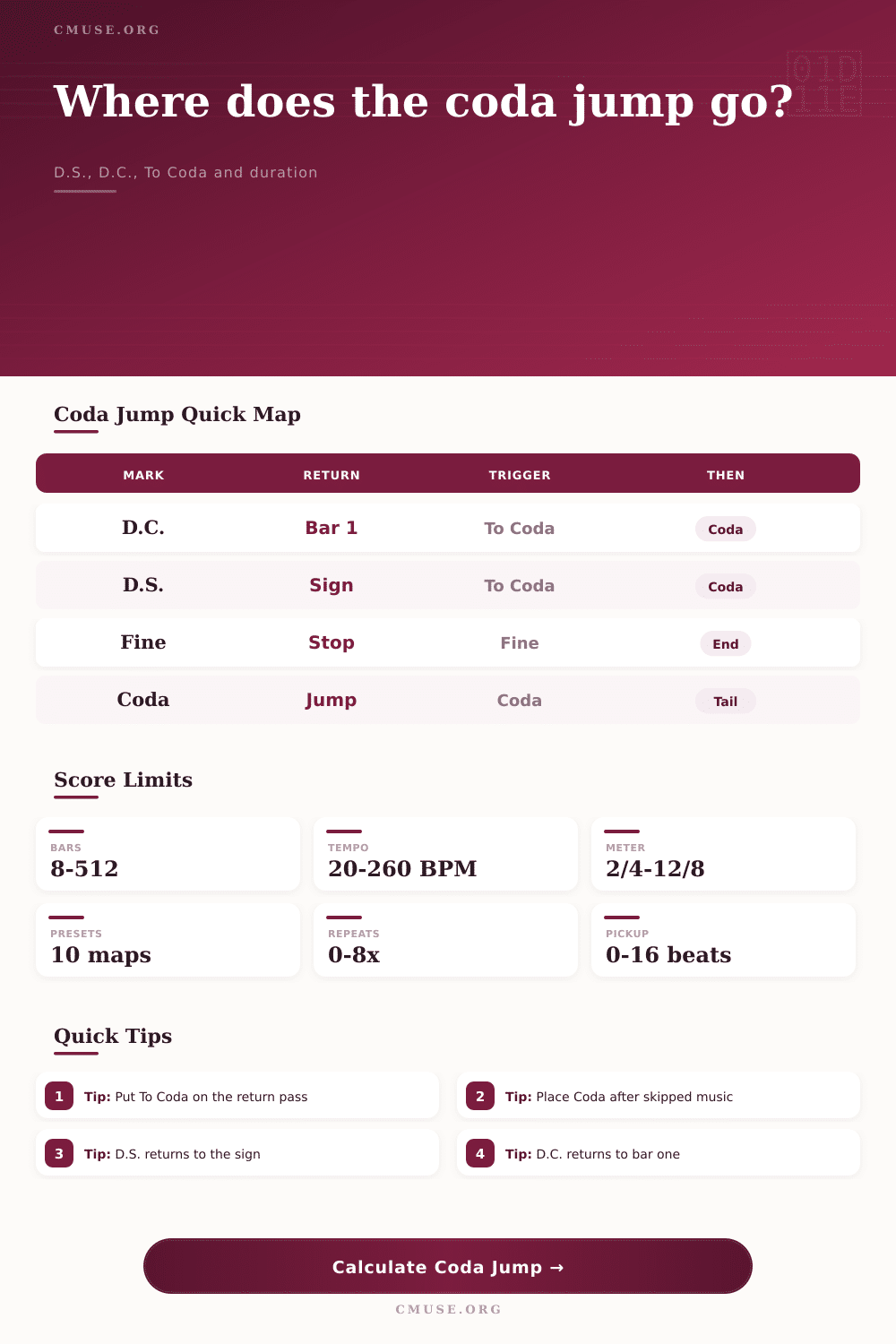
Coda Jump Bar Calculator
Map D.S. al Coda and D.C. al Coda score markings into an exact performed path, skipped written bars, coda entry point and clock duration.
Preset use: Load a real score roadmap, then adjust the sign, To Coda, jump command, coda entry, meter, tempo, repeats and pickup for your chart.
Full Breakdown
| Segment | Written Bars | Performed Bars | Direction | Duration |
|---|
| Instruction | Return Bar | Stop or Jump | Performed Bars | Duration |
|---|
| Marking | Literal meaning | Calculator field | How bars are counted | Common check |
|---|---|---|---|---|
| D.C. | Da Capo, from the head | Navigation instruction | Return path starts at bar 1 | Opening material is replayed |
| D.S. | Dal Segno, from the sign | Segno sign bar | Return path starts at the sign | Bars before the sign are not replayed |
| To Coda | Jump point on return pass | To Coda bar | Count this bar, then jump | Usually appears before the skipped gap |
| Coda | Separate ending section | Coda entry bar | Count from coda entry to score end | Entry should be after To Coda |
| Fine | End point | Fine bar | Stop at Fine for al Fine modes | Can also stop inside a coda |
| Roadmap | Typical written order | Return target | Jump trigger | Use case |
|---|---|---|---|---|
| D.C. al Coda | Music, D.C., replay, To Coda, coda | Bar 1 | To Coda on the replay | Pop endings and hymn descants |
| D.S. al Coda | Music, sign, music, D.S., To Coda, coda | Segno sign | To Coda on the replay | Jazz charts and theater cues |
| D.C. al Fine | Music, D.C., replay, Fine | Bar 1 | Fine stop | Short classical repeats |
| D.S. al Fine | Music, sign, music, D.S., Fine | Segno sign | Fine stop | Lead sheets with a mid-score ending |
| D.S. al Coda e Fine | Sign, To Coda, coda, Fine | Segno sign | To Coda, then Fine | Coda tail that stops before the last bar |
| Instruction | Needs sign? | Needs To Coda? | Needs Fine? | Best printed cue |
|---|---|---|---|---|
| D.C. al Coda | No | Yes | No | After repeat, jump to Coda |
| D.S. al Coda | Yes | Yes | No | Return to sign, then jump |
| D.C. al Fine | No | No | Yes | Return to top, end at Fine |
| D.S. al Fine | Yes | No | Yes | Return to sign, end at Fine |
| D.C. al Coda, Fine | No | Yes | Optional | Coda has its own stop point |
| D.S. al Coda, Fine | Yes | Yes | Optional | Sign return, coda, then Fine |
| Meter | Quarter units per bar | One bar at 90 BPM | One bar at 120 BPM | Coda count feel |
|---|---|---|---|---|
| 2/4 | 2.00 | 1.333 s | 1.000 s | Two-beat march cutoff |
| 3/4 | 3.00 | 2.000 s | 1.500 s | Waltz return count |
| 4/4 | 4.00 | 2.667 s | 2.000 s | Pop and lead sheet default |
| 5/4 | 5.00 | 3.333 s | 2.500 s | Odd-meter cue with full bar count |
| 6/8 | 3.00 | 2.000 s | 1.500 s | Two dotted-quarter pulses |
| 12/8 | 6.00 | 4.000 s | 3.000 s | Slow compound coda release |
Sheet music reads in a straight line. Composers often write pieces where there are loops within the piece. This means performer will have to get their heads around these loops to play without mistakes.
The calculator at the top of the page do the arithmetic for you if you enter the bars that apply to you. That means no more following each repeat sign as you rehearse.
How to Use Sheet Music Loops and Jumps
There is also D.S. These are Al Coda and D.C. The term is al Coda. These both takes you to different places in the score. With Da Capo, you go back to bar one. You replay the entire introduction and first section before checking for the exit.
Dal Segno take you to the sign symbol only. Typicaly this happens after the intro, so you miss any material stated before that. Get this mixed up and you’re way out of count from beginning.
When you get back to either the sign or the head, you go around again. You continue until you reach the To Coda marking which is an important cue point for many players when under pressure. You do not come to rest at this stage but leap ahead in the score to part marked with the Coda symbol.
By doing so, the calculator will tell you exactly how many bars you have jumped. It will then inform you what your new entry point is. Enter these figures into the tool correctly and it will tell you exactly how much of the music you’ve performed compared to how much you’ve skipped.
Knowing the route like this before picking up an instrument makes rehearsals efficient. Everyone should know where they start and finish at a D.S. Al Coda jump. It is an Al Coda jump. There should of been no counting out measures while playing.
The duration card indicate how long the passage lasts. This can be used to help pace longer medleys or suites where timing is critical, especially if you are playing in regular meter like 4/4 at a fixed tempo.
Complex scores often layer these instructions together. To make matters worse, they place their Fine markings within the Coda section as an earlier finishing point. This adds another layer of commands to follow and keep track of alongside others. The table on the page shows how each mark works alongside the others. It makes it clear what would happen, for example, if you hit Fine within the Coda. You effectively skip over last few bars of the written music altogether.
Another trap for players is to think the end of the music is where the paper finishes. That was not always what the composer intended, as they may have wanted a shorter conclusion.
The calculations gets more difficult due to addition of pick-ups and tempo changes. These change the number of bars being played but also actual amount of time it takes to perform them. Pickups that are less than a whole note like a sixteenth note pickup use up seconds of performance time that do not fit neatly into the number of bars. To make up for it, the tool allows you to input the additional beats so your calculated estimate is true to real thing instead of theoretical.
When milliseconds matter like in a studio situation or when you’re trying to sync live music to film cues, this level of detail become important.
Musicians learn to make these jumps over time with repetition until they become second nature. If you’ve been playing the same piece every week for ten years, this method may work just fine. When you’re attempting to read something new an hour before a gig, it’s a total non-starter. In those moments the team stays cohesive and less anxious if they have visualized the roadmap ahead.
There are also pre-set buttons on the tool that provides easy-to-use templates for popular structures such as hymn descants, jazz charts etc. Instead of always having to begin from scratch, there’s a starting point to tweak.
It isn’t about getting by the music, it’s about understanding the architecture behind it. If you can anticipate what comes next then you’re no longer reacting too late to the conductor’s cue. You can anticipate because you know WHY the jump occurs and WHERE it lands. It becomes a place of confidence not confusion. From here you can focus on the dynamics and phrasing rather than hunting for the next measure number. At this point you’re no longer reading the page but hearing the structure.