Metronome Click Count Per Song Calculator
Estimate the exact number of audible clicks in a song, including count-in bars, accented beats, subdivisions, rehearsal repetitions, pickup beats, and silent-bar practice patterns.
Load a real practice scenario, then adjust tempo, meter, subdivisions, count-in, repeat count, and silent-bar training. The calculator treats BPM as the beat unit selected by the denominator, so 120 BPM in 4/4 means 120 quarter-note beats per minute.
For compound meters such as 6/8, choose whether the click is the written eighth-note pulse or the broader dotted-quarter feel by changing BPM and beats per bar to match how the metronome is programmed.
Full Click Breakdown
Classic mechanical BPM span
Typical app tempo span
Common programmable meters
Usual click subdivision range
| Tempo | 2:00 Song | 3:00 Song | 4:00 Song | 5:00 Song |
|---|---|---|---|---|
| 60 BPM | 120 beat clicks | 180 beat clicks | 240 beat clicks | 300 beat clicks |
| 90 BPM | 180 beat clicks | 270 beat clicks | 360 beat clicks | 450 beat clicks |
| 120 BPM | 240 beat clicks | 360 beat clicks | 480 beat clicks | 600 beat clicks |
| 160 BPM | 320 beat clicks | 480 beat clicks | 640 beat clicks | 800 beat clicks |
| Meter | Beat Clicks Per Bar | Downbeat Accents | Best Counting Use |
|---|---|---|---|
| 2/4 | 2 clicks | 1 per bar | Marches, reels, simple two-beat sections |
| 3/4 | 3 clicks | 1 per bar | Waltz, hymn, minuet, and triple-feel pieces |
| 4/4 | 4 clicks | 1 per bar | Pop, rock, funk, jazz, and most rehearsal charts |
| 5/4 | 5 clicks | 1 per bar | Odd-meter grooves grouped as 3+2 or 2+3 |
| 6/8 | 6 eighth clicks | 1 or 2 per bar | Compound ballads, jigs, and dotted-quarter practice |
| 7/8 | 7 eighth clicks | 1 per bar | Progressive riffs grouped as 2+2+3 or 3+2+2 |
| Setting | Click Multiplier | 4/4 Bar Clicks | Use When |
|---|---|---|---|
| Beat clicks only | 1x | 4 clicks | The pulse is stable and the part breathes naturally |
| Eighth-note subdivision | 2x | 8 clicks | Syncopation needs a smaller grid without clutter |
| Triplet subdivision | 3x | 12 clicks | Swing, shuffle, compound feel, or triplet figures |
| Sixteenth-note subdivision | 4x | 16 clicks | Dense funk, drum rudiments, and precise entrances |
| Practice Plan | Base Pass | Count-In | Total Workload |
|---|---|---|---|
| Three pop single passes | 420 clicks | 8 clicks each | 1,284 clicks before subdivisions |
| Eight-bar loop ten times | 32 clicks | 4 clicks each | 360 clicks before subdivisions |
| 6/8 ballad five passes | 360 eighth clicks | 12 clicks each | 1,860 clicks before subdivisions |
| Mute cycle 4 on, 4 off | Half audible | Always audible | Builds internal time without losing form |
So what does a metronome click realy mean? Probably that you should listen to it and play at correct moment. But there is much more to it. A metronome click are a data point in time, a series of separate events that accumulate across a given performance or rehearsal. How many clicks will your piece create if you don’t know? You’ll be flying blind about the real work involved in practicing the piece.
This calculator page take the guesswork out of equation. It converts repeats, accents, pickups, muted bar cycles, counts, subdivisions, tempos, and meters into a realistic number of metronome clicks used to learn a section or song. So no need to do any math, just concentrate on the music.
Why Use a Metronome Click Calculator?
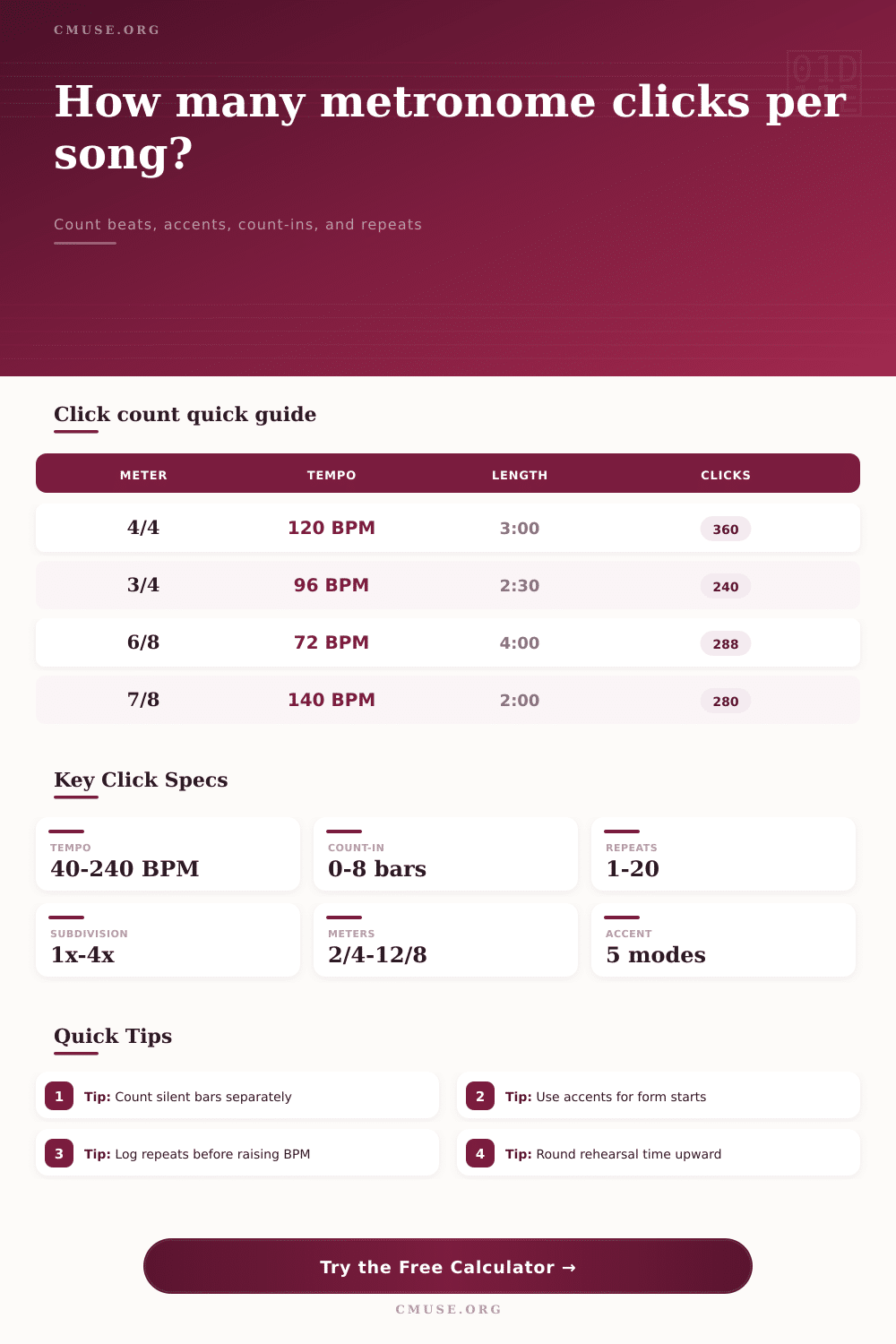
What is the first level of complication? It’s right there: the time signature. Even a simple-feeling pop song in 4/4 time at 120 beats per minute will yield 360 unique clicks during its three minutes. Swap in an odd meter (e.g., 7/8) or a compound one (e.g., 6/8), and the figure become much higher.
How does all that translate into feel? That’s where the reference table on the page come in handy. Just by looking at it, you see how the same perceived tempo can have wildly varying click densities depending on the chosen meter. If your count is based off eighth notes, for example, then 120 BPM in 4/4 is quite different than 120 BPM in 6/8. With that in mind, the tool lets you match up those definitions before starting your counts.
Add another layer into equation with subdivisions. Turning on eighth- and/or sixteenth-note subdivisions doubles/quadruples the click count your brain needs to absorbs. It doesn’t double/quadruple the volume of clicks either; it alters amount of mental work required in the practice session. There may be more clicks per minute, which can make it sound as though you’re playing slowly, yet in fact, there’s more rhythmic information being absorbed in every minute of practice. These elements is multiplied by the calculator for you so that you know exactly how many clicks you’ll be hearing.
It is also here that many musicians undervalue amount of work they put into counting in and repeating sections. Ten runs through a section with a couple of bars count-in on each makes it add up fast. This doesn’t mean these clicks aren’t significant noise; they are part of the rhythmic training.
You can enter mute cycles and pickup beats into the tool as well. This is important when trying out more complex tricks, such as muting the click for some bars to see if you have the feel for it internally. Remove number of bars where there was no sound from the overall count you hear and you will have a better idea just how much help you get by ear throughout the track.
Next comes tempo ramps which add a bit of change to the static counting. So let’s say you want to begin at 100 BPM and increase by 5 beats each time until you reach 120 BPM. You’ll need to calculate how many clicks that takes each time as well as total number of minutes per step. This takes too long and is easy to mess up. As a result, you’re never quite sure if you are actualy on track to achieve what you set out to do.
The calculator will give you an estimate of the total number of clicks and minutes required to complete each step of the ramp so that you don’t accidentally cut your progression short or overextend your session without realizing it.
This is the stream of sounds from which accent patterns add structure. Is it just the downbeats? Is it only backbeats? Are there accents every four bars? These are the ticks that keep you anchored to the form. Knowing how many times a song has an accent make it easier to plan mental checkpoints on a more complex passage. This transforms a sea of identical ticks into a map of familiar landmarks.
The metronome is a very precise instrument capable of being programmed to nearly any desired rhythm. It’s not just for timing; most musicians use it only as such without realizing its potential. Knowing what the count-in, subdivisions and accent settings does to the final number of clicks gives you power over how well you practice. It removes the guesswork and replaces it with measurement.
Next time you have a challenging passage to drill, you’ll know exactly how far away from mastery each click brings you, and that makes all the difference. You should of known this sooner.