Tessitura Center Calculator
Calculate a practical center pitch from full range, comfortable tessitura, most-used note, register weighting, MIDI values, frequencies, and voice or instrument reference ranges.
🎼Vocal and Instrument Presets
🎚Range and Weight Inputs
Full Calculation Breakdown
📊Current Range Spec Grid
🔍Range Comparison Grid
Baritone
🎤Vocal Tessitura Reference
| Voice type | Usual range | Common tessitura | Center guide | Practical reading |
|---|
🎻Instrument Tessitura Reference
| Instrument | Written or sounding range | Common tessitura | Center guide | Practical reading |
|---|
🎛MIDI and Frequency Table
| Point | Note | MIDI | Frequency | Role in calculation |
|---|
🔀Center Offset and Range Balance
| Diagnostic | Current value | Target range | Meaning |
|---|
If you’ve ever been at a concert when a singer reaches a high C, there’s probably a certain thrill in the air. Great note! One thing that it doesn’t reveal to you, however, is how song will fare on the vocalist’s part throughout the length of the song. This is where tessitura comes in.
It is not the range (or at least distance between their lowest and highest notes), but rather the gravitational pull of the music. Where does melodic content live? You’ll know when you’re sitting too high or too low for an extended period because even though each note may be technicaly reachable, the voice become fatigued. The tone cracks under pressure. Finding that gravitational center allow for a strain-free performance rather then a straining one.
Understanding Tessitura
Once you plug in your parameters, the calculator do the rest, removing any guesswork regarding conversion and coefficient factors. This isn’t really a static map, however, so don’t think of it that way; think of it as a weighted average. It’s rare that every note are treated equally in music, but most tools assume they are.
Technically, a tenor aria may fall into the normal range, but if it hovers just barely at the top of the range for three minutes, it’s much more fatiguing than something with intermittent high notes. That’s why the anchor weight input is important, it makes you consider repetition. The melody’s home base pull more on the center then its momentary extremes do.
On the right-hand side of the tool are some sliders where you can set the percentage of use from the lowest extreme to the highest. I like to think of this as a weighted scale rather than a ruler. If the low end of an instruments range is mostly decorative then you can slide slider accordingly. It is the same with the upper end. A choral line that spends much of its time in the lower part of its range are very different from a brief dip down in a soprano line.
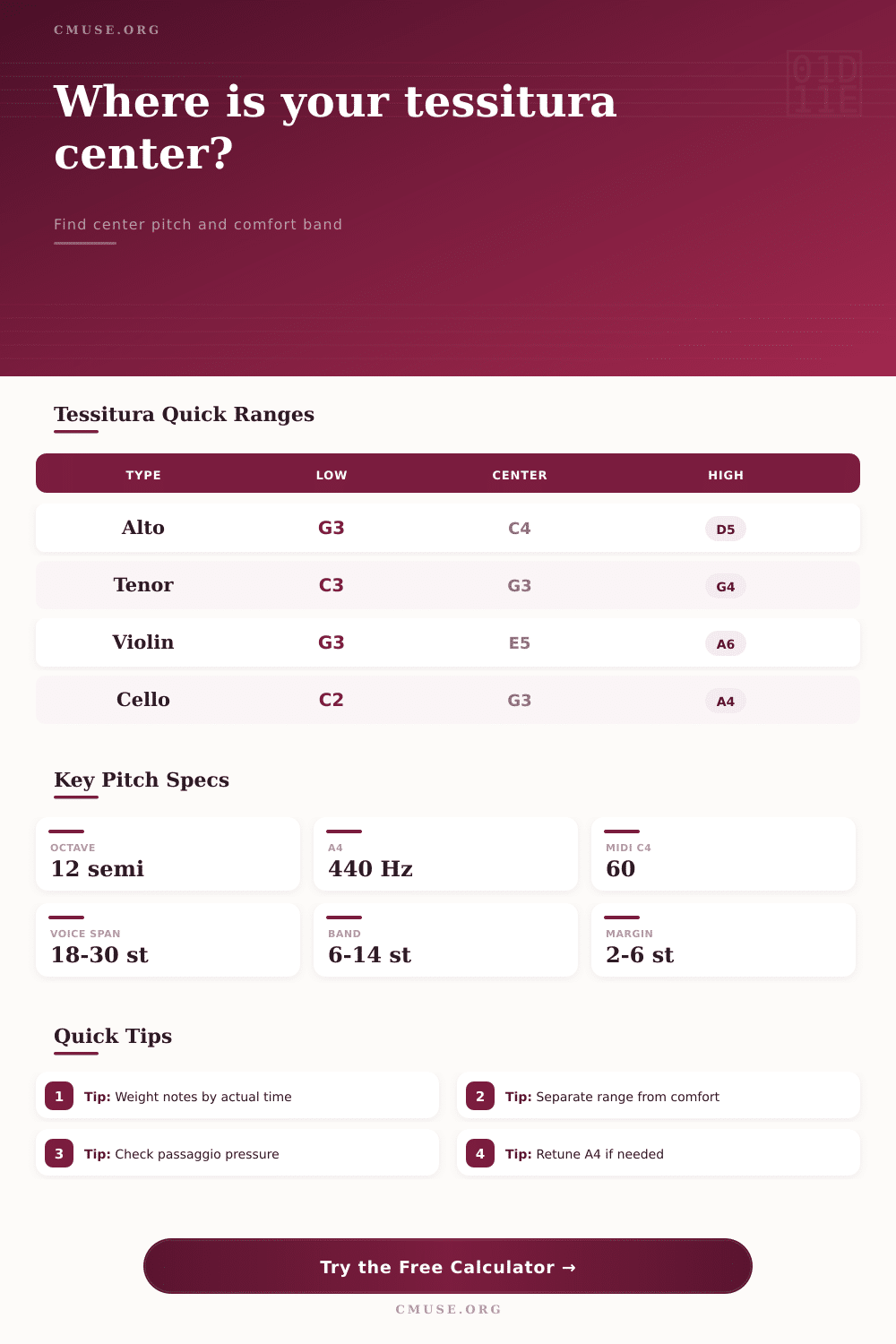
The reference table on the page show how various instruments and voice types tend to find their comfort zone. Cellos feel most alive in their deeper but warmer tones whereas violins ring out with a bright center in the mid-upper range. Knowing where your voice or instrument are most comfortable helps you anticipate endurance issues.
There’s yet another twist, the register shift (passaggio). It can take time and effort to coordinate crossing over into your head voice from your chest voice. Regardless of how easy a note might be in terms of it pitch, it becomes harder if there is a big chunk of the phrase at the point when your voice ‘crosses’ over. To fight this force the calculator enables you to adjust weighting depending on location of the register shift. Struggling to maintain a tone that balances itself on the brink of flipping from mechanism to mechanism are very different from singing in a comfortable register. You shouldn’t of be expending your energy fighting against physics.
It’s also surprising how much the tuning standard plays into this. A half-step shift in A4 tuning can change whether a note feel easy or tight. This allows you to move the reference point for comparison with an accompanying instrument, recognizing that the center is actualy relative to the room where you rehearse or perform as an ensemble. Again it sounds insignificant but when matching a pianist to a part they wrote decades ago for a singer then it makes all the difference.
In essence, locating the center of your tessitura is a journey of self-discovery. It points out where you thrive and where you eke out a living. It’s a way to break through the false measure of how high you sing and begin to weigh the notes that truly pull at your attention. And in doing so, you discover true form of the music.
Not only do you aim for the highs; you can comfortabley live in the middle too. From there you know where weight is and you can practice, transpose, or even arrange confidently without fear. There is no more guesswork, only knowledge. And that breeds confidence which turns a challenging phrase into a show-stopper.