Cover to Original Ratio Calculator
Plan a setlist mix from cover songs, original songs, average durations, medley fragments, anchor placement, set type range, and the target cover share you want to hit.
Mix Breakdown
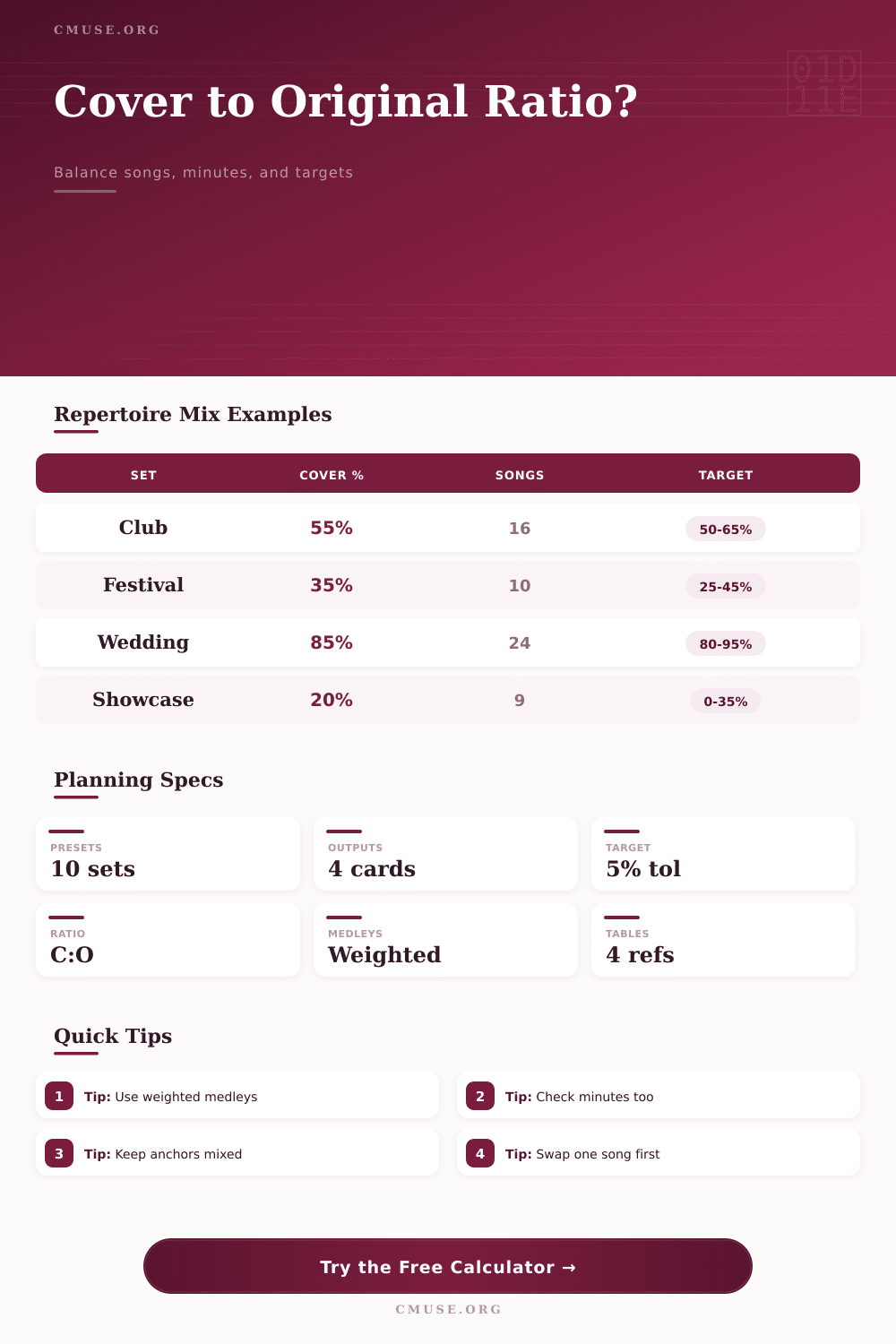
| Set type | Cover share by count | Original share by count | Best ratio check |
|---|---|---|---|
| Club headline or residency | 50% to 65% | 35% to 50% | Weighted count plus duration share |
| Festival discovery slot | 25% to 45% | 55% to 75% | Original minutes should carry the set |
| Wedding or dance function | 80% to 95% | 5% to 20% | Keep originals short and placed after momentum |
| Original showcase | 0% to 35% | 65% to 100% | Use covers as one clear reference point |
| Tribute or theme night | 85% to 100% | 0% to 15% | Originals should fit the theme or be skipped |
| Jazz standards set | 60% to 90% | 10% to 40% | Duration matters because solos stretch standards |
| Planning case | Starting mix | Likely adjustment | Formula cue |
|---|---|---|---|
| Too many covers for showcase | 6 covers, 4 originals | Swap 2 covers for originals | Target covers = total x target% |
| Original-heavy dance set | 8 covers, 7 originals | Add 5 covers or cut originals | Needed covers = target x total |
| Long cover medley | 4 full covers, 6 fragments | Use duration share before changing count | Cover minutes / total minutes |
| Encore changes perception | Closer cover, encore cover | Add an original anchor earlier | Anchor setting informs note |
| Anchor placement | Perceived effect | Use when | Calculator note |
|---|---|---|---|
| Opener cover, closer original | Balanced familiar entry | Mixed crowds need a fast connection | Mixed anchor |
| Both anchors covers | Set feels more cover-led | Dance, bar, casino, and event sets | Cover-heavy anchor |
| Both anchors originals | Set feels more artist-led | Showcase, festival, theater album night | Original-heavy anchor |
| No anchor preference | Ratio carries the reading | Background, rotation, or casual sets | Neutral anchor |
| Output | Formula | Why it matters | Watch point |
|---|---|---|---|
| Count ratio | Weighted covers / weighted originals | Measures repertoire identity | Medley weight changes this |
| Duration share | Cover minutes / total song minutes | Shows actual stage time balance | Long originals can outweigh count |
| Compliance | Actual cover % vs target and set range | Flags off-target programs | Tolerance should be realistic |
| Balance action | Difference from target cover count | Gives concrete swap guidance | One swap changes both sides |
There are twelve songs ready for the gig. Half are originals (three years in the writing and recording), and half are cover songs (radio hits people know by heart). Is it balanced? You think so. But the crowd thinks otherwise or, even worse, they’re bored. More often than not, it’s not that your material isn’t good: It’s that the math of exposure doesn’t add up.
Slot two, cover song. Same weight as slot nine, five-minute original ballad. Your brain counts six and six. Audience? Momentum and minutes. And that is why most setlists fall apart before the first note are even played.
How to Balance Originals and Covers in Your Setlist
Plug in your song lengths and number of songs and let the calculator do the rest. You’ll be spared the guessing that always results in a lopsided show. With the help of the tool, you’re forced to view two versions of reality at once: one is the count ratio, the number of songs you’ve borrowed vs. The songs you’ve created. The other is the duration share, which is the amount of actual stage time that’s yours compared to theirs. They don’t always agree.
A set with four six minute originals and ten three minute covers will come across as cover-heavy on a spreadsheet, yet original-heavy in reality. The tool points out that contradiction, allowing you to determine what version of balance actualy applies in this specific room.
Medleys is overlooked by most musicians until it’s too late. You’ll throw together a quick hook from a classic or even thirty seconds of a transition between two originals and think nothing of it. But you just did something. Treat each fragment as its own song and your percentage of original rises artificially. If you ignore these fragments entirely, you are lying to yourself about the cover load. Fractional weight given to these partials is small change in the input fields but a huge shift in perceived genre.
A jazz standard set might rely on medleys to demonstrate range while still keeping the audience engaged. However, a festival slot usually can’t afford that luxury, because the window to be discovered is short and attention spans are even shorter. There’s no single right ratio; context is the variable.
If you’re performing at a wedding where your job is to get people dancing for forty-five minutes then your cover share will be higher (often above eighty percent), as they want the dance floor packed. If you’re performing an original showcase, you might go nearly all originals if you’ve established enough trust with the local music scene to get away with it. The chart on the page breaks it down by both type of event and genre.
What it provides is a starting point, a range, to shoot for instead of an arbitrary number. That means you’re not shooting for fifty-fifty because it “sounds good.” You’re shooting for whatever keeps your specific audience engaged. In other words, you don’t want to bore them into disengagement with too many familiar songs or make them uncomfortable by throwing so much unfamiliar material their way.
It’s also important where you place your anchors. A good rule of thumb is that the middle experiments is going to feel safer for the audience when the cover frames open and close the set. That said, starting and ending with originals can be a sign of confidence or arrogance, depending on whether they succeed. Because humans aren’t linear beings, there’s a setting on the calculator for this factor.
We remember the beginning and end disproportionately. So if your ratio shows you are playing sixty percent covers, but you open and close with your own music, the audience leaves thinking they heard an original artist who knew how to work a crowd. If you open and close with covers though, then you sound like a tribute act sneaking in some originals.
Swapping one song changes both the numerator and the denominator at the same time. That’s the mathematical advantage of working a set list on paper vs on stage. When you’re cutting a cover song that’s pulling down your original number, it’s less difficult than finding the right original to fit snugly into a short window. With the balance formula, you have some objective guidance around what to swap out, based off how far off target you’ll tolerate being. It will tell you if you should of be cutting songs or adding new ones; for example, if you are five percent off target, it shows whether to add or cut songs.
In other words, you’re removing the emotional connection with tracks you may adore, but that aren’t serving the room. You’re curating an experience, not archiving a catalog. The goal is not purity; the goal is flow.
The originals are the conversation; the covers are the handshake. Get the ratio correct and you have people in the room long enough so that the conversation matters. Get it wrong and they’re gone before the hello.