Tempo Variety Score Calculator
Score a playlist or live set by BPM range, tempo standard deviation, energy contour, transition jumps, and genre target fit.
♫Playlist and Setlist Presets
🎼Tempo Variety Inputs
Tempo Variety Results
📊Current Set Spec Grid
🎶Tempo Variety Reference Table
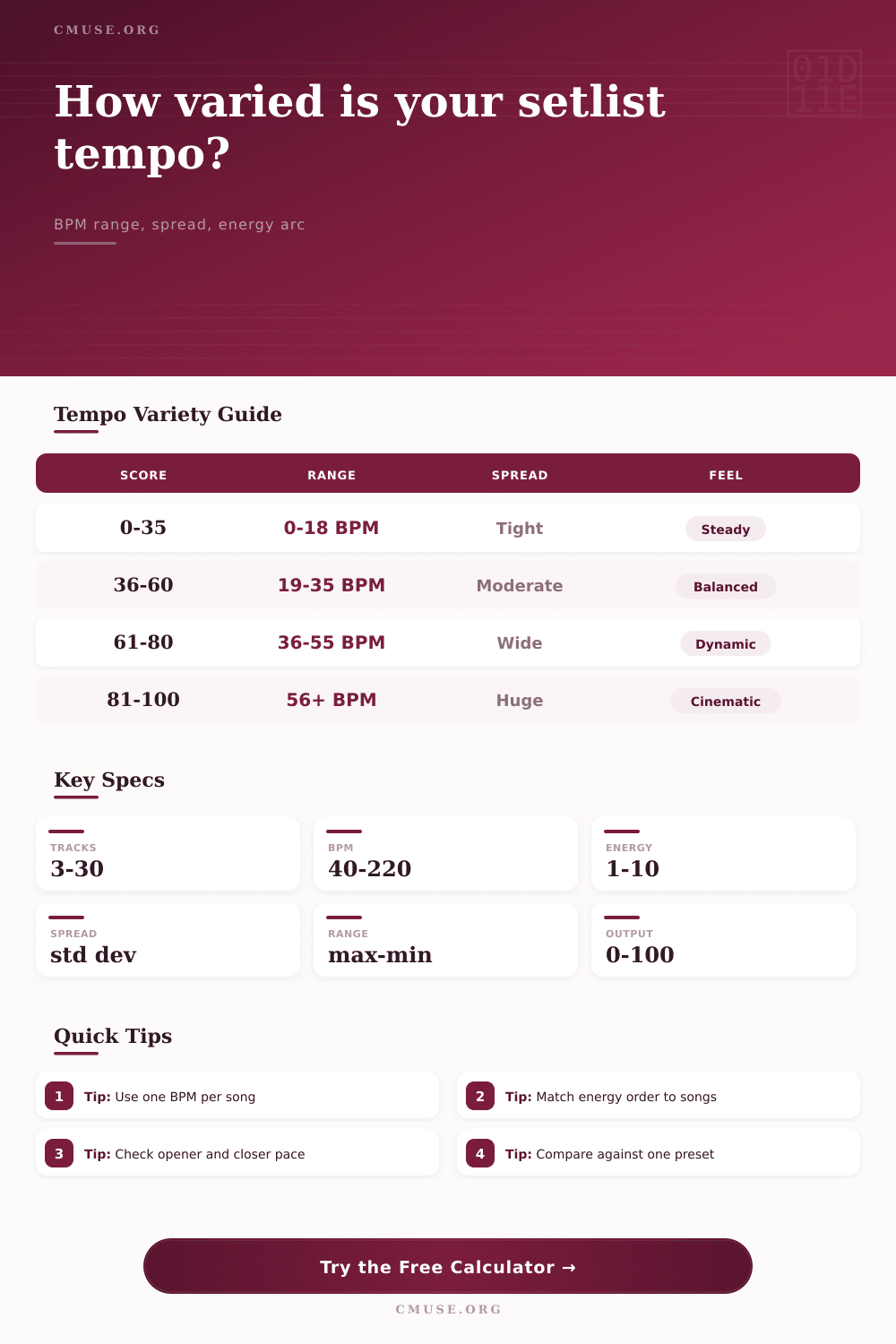
| Variety band | BPM range | Std dev target | Setlist use |
|---|---|---|---|
| Very tight | 0-18 BPM | 0-7 BPM | DJ blend, meditative flow, consistent dance pocket |
| Balanced | 19-35 BPM | 8-13 BPM | Pop, worship, acoustic, songwriter showcases |
| Dynamic | 36-55 BPM | 14-22 BPM | Rock, indie, jazz club, mixed festival pacing |
| Cinematic | 56+ BPM | 23+ BPM | Cue reels, theatrical sets, contrast-driven programs |
🎙Genre Tempo Reference Table
| Reference | Common BPM center | Useful range | Variety note |
|---|---|---|---|
| Acoustic and folk | 82 BPM | 60-115 BPM | Use meter changes and ballad relief to avoid one-speed pacing. |
| Pop and indie | 104 BPM | 85-125 BPM | Alternate mid-tempo songs with clear lifts above 115 BPM. |
| Rock set | 122 BPM | 90-150 BPM | High contrast can work if ballads are placed intentionally. |
| House and dance | 124 BPM | 118-132 BPM | Score can be lower because groove continuity matters more. |
| Jazz club | 118 BPM | 70-180 BPM | Wide spread feels natural when swing feel and density vary. |
| Metal sprint | 162 BPM | 120-210 BPM | Breakdowns and half-time sections can tame jump severity. |
📝Formula Reference Table
| Metric | Formula | Weight | Interpretation |
|---|---|---|---|
| BPM range | highest BPM - lowest BPM | 30% | Captures broad contrast between slowest and fastest songs. |
| Tempo spread | population standard deviation of BPM list | 35% | Rewards a set where many songs differ, not just one outlier. |
| Energy fit | average energy plus energy-BPM correlation | 20% | Checks whether tempo motion supports perceived intensity. |
| Jump control | 100 - average excess adjacent jump penalty | 15% | Protects against abrupt pacing unless contrast is selected. |
🔎Preset Setlist Comparison Grid
💡Tempo Pacing Tip Boxes
“Tempo variety keeps your setlist from feeling like a routine instead of something alive. When most musicians create a list they think about the lyrics and chord progressions. They don’t consider the physics of the rhythm. Tempo is physical. It determines how you dance and what your heart rate do. A flat line in beats per minute result in an energy curve that becomes predictable, and audiences will eventually tune out. You want contrast so you can keep their attention. Too much chaos and you destroy your momentum.
This is where you look at your song list not as a group of separate songs but as one living thing that breathes together. How do you find this balance? You input your list of BPMs and energy levels into the calculator, which then calculates everything for you (no more second-guessing if it feels like you’re pacing well).
How Tempo Variety Keeps Your Setlist Alive
Four different factor go into this score; it’s scored from zero to one-hundred. First is Range, or the variation between your slowest and fastest songs. That accounts for the overall contrast. You’ve got a ballad at sixty BPM followed by a metal sprint at one-eighty? Huge range there. But that could be misleading on its own. One outlier song can pump up the number while providing little variety to the remaining song.
In real life, what matters more is Standard Deviation, which report how far apart all your tempos are from each other around their average value. If most of your songs tend to vary greatly from one another, then you have a high standard deviation. Which makes for a truly dynamic experience as opposed to a few big peaks in the middle of boredom.
Another wrinkle is energy mapping. Rate every song on a scale of one to ten for energy level. This lets the tool check whether your chosen tempos lines up with how energetic you want the songs to be. In general, a slower build tends to pair nicely with a gradually rising tempo, while an up-and-down wave shape could call for alternating slow and fast passages. Audiences don’t think about it; they just feel it. So when a piece gets faster but doesn’t “weigh as much,” listeners will sense something is off. The formula gives that correlation significant weight: If the tool detects discrepancies between expected and actual energy levels, it flags them so you can tweak either the energy goal or the song sequence.
Variety is important too but so is the genre context. On one hand, we have a jazz club set which by nature has quite wide ranges in BPM as the feel and density of swing can differ greatly. On the other hand, a house music DJ focus less on contrast and more on maintaining a continuous groove. And that’s where the table below (on the page) makes things clear. For a genre whose main goal is flow over surprise, a narrow range is ideal for the dance floor.
Interpreting the final score comes down to understanding who you’re trying to serve. If you want to achieve a steady, hypnotic trance state then a low variety score may not be a negative at all. It’s just an issue if it contradicts the expectations of the genre. The last part of the puzzle is transition pacing. A dramatic change in lighting and a pause make nearby BPM jumps exciting, while mixing them together without a break makes them jarring.
The calculator penalizes abrupt transitions unless you tell it you’re using a contrast-driven style. This style keeps your music from getting accidental whiplash and killing the momentum. Take another look at your adjacent jumps manually as well. Occasionally, a little tweak to the song order will smooth out a rough edge without altering the overall variety.
All in all, then, it’s about telling stories through rhythm; leading listeners on a journey that takes them into the tension and out again. You can use the tool to check your first draft of structuring, then you should of rely on your ears for the final touches. Numbers are there as a framework, but the feel belongs to you as you shape it. Having scored a great setlist will need intuition to deliver it. Use the maths at the beginning, but finish with the music.”