Doors to Downbeat Calculator
Build a live schedule backward from the headliner downbeat, including door time, opener start, changeover block, scan window, and curfew clearance.
Calculated Doors to Downbeat Plan
| Venue Format | Capacity Band | Common Doors Lead | Useful First-Act Hold | Planning Note |
|---|---|---|---|---|
| Cafe or small room | 50-150 | 30-60 min | 20-35 min | Door math is usually governed by seating and bar settle rather than scanner speed. |
| Listening room | 150-350 | 45-75 min | 30-45 min | Keep the first act visible enough for patrons who arrive exactly at show time. |
| Standing club | 350-900 | 60-90 min | 35-55 min | Use the scan formula when sellout percentage climbs above 80 percent. |
| Ballroom or hall | 900-2500 | 75-120 min | 45-70 min | Multiple lobbies or VIP routes can make the entry factor more important than capacity. |
| Seated theater | 500-3500 | 75-105 min | 45-60 min | Late seating policy may require a longer room-settle value. |
| Festival stage | Open field | 0-30 min | 0-20 min | Use stage-ready lead instead of normal doors when audience entry is already active. |
| Support Bill | Opener Sets | Changeovers | Block Before Headliner | Formula View |
|---|---|---|---|---|
| No opener | 0 | 0 | 0-10 min | downbeat equals first act; doors depend on entry window. |
| One local support | 25-35 min | 15-25 min | 40-65 min | one set plus one final changeover before headliner. |
| Two-band club bill | 60-80 min | 35-50 min | 95-130 min | two sets plus two changeovers, then downbeat. |
| Three-support tour | 90-120 min | 60-90 min | 150-210 min | changeover discipline decides whether doors can stay realistic. |
| Festival flip | 0-45 min | 10-25 min | 10-70 min | published grid often fixes downbeat more than doors. |
| Changeover Type | Typical Minutes | Best Fit | Risk Signal | Calculator Input |
|---|---|---|---|---|
| Solo or DJ support | 8-15 | Shared lines or playback rig | Longer if backline must clear from center stage. | 10-15 min |
| Small band on shared backline | 15-25 | Club support with line-check at doors | Patch changes can steal the first five minutes. | 20 min |
| Full band no shared backline | 25-40 | Tour support with separate drum kit | Risers, wireless, or keyboard worlds need protection. | 30-35 min |
| Theater opener to headliner | 25-45 | Quiet seated room with fixed curtain | Soft goods and announcement cues may extend the reset. | 30-40 min |
| Festival rolling change | 10-25 | Preset deck and line-check offstage | Short flips require locked input lists before doors. | 15-20 min |
| Downbeat Check | Slack After Set | Status | Typical Action | Schedule Impact |
|---|---|---|---|---|
| Comfortable | 20+ min | Clear | Keep published downbeat and preserve encore hold. | Low pressure after headliner starts. |
| Tight but usable | 5-19 min | Watch | Shorten speeches, announce house curfew, keep walk-on crisp. | Small delay can erase the cushion. |
| At curfew | 0-4 min | Exact | Lock set length and remove optional holds. | No room for late downbeat. |
| Over curfew | Negative | Conflict | Move downbeat earlier or trim headliner set. | Published schedule needs revision. |
House lights go down, room gets silent. The first note rings out and audience explodes. Every promoter live for that instant of connection. But too many times throughout day, they sell themselves short by making poor mathematical decisions earlier in the show.
Door estimates is usually a combination of past experience, hunches, and gut feelings. This method is bad for everyone because it doesn’t consider how fast scanners scan ticket or how bottlenecks happens in lobbies. You need a system to reverse engineer the event.
Plan Your Show Backward From The End
You want headliner to start right on time, with no one waiting outside to get in once opener ends his set. It runs the math for you in the calculator above, but how you plan shifts based off what you input.
Begin with downbeat itself. Because it is a fixed time, it serves as your anchor point. Everything else flow backward from it. Let’s say headliner requires a full hour and a half and curfew is strict. Before anyone enters door, you’ve already lost half the night. Does your proposed schedule fit inside those walls? That’s where people goes wrong. They build forward from doors open rather than backward from lights out.
But once you know entry behavior, the rest are math. If people is holding tickets for assigned seats (as in a seated theater), it’s a lot harder to get them through door versus someone walking up to a standing club with no ticket. To model that, we use both capacity and expected attendance as variables: How many bodies must be processed?
Next, add in speed of your staff and number of scan lanes you have. Four scanners running at 15 tickets per minute is a very different scenario than two scanners doing ten per. Instead of assuming magic happen at the door, the formula factors in that throughput reality.
Then there’s the settle time when audience enters venue and finds its seats. That’s usually overlooked by rough sketch. Twenty minutes may seem like a lot, but factor in bathroom runs, bar lines and then there’s music. Every support band claim a portion of the clock. Add up all that time plus changeover times between the acts.
And that is when things get difficult. Bands rarely end on cue; stage hands almost never move fast enough to fill gap between set changes. If you want some breathing room, you should of put down half an hour on your calculator and then watch a drum kit dissapears into thin air in five, followed by tangles of cables for another ten.
Most importantly, the last block of time (the one leading into headliner), is the absolute make-or-break segment on stage. Any lag here mean the headliner will forever be delayed. To provide some additional safeguard against that, tool includes an additional line check buffer specifically for this changeover, giving band room and sound before walking onstage. Trim this area to gain five minutes somewhere else and you’ll rue the day the lead singer approaches mic to find silence.
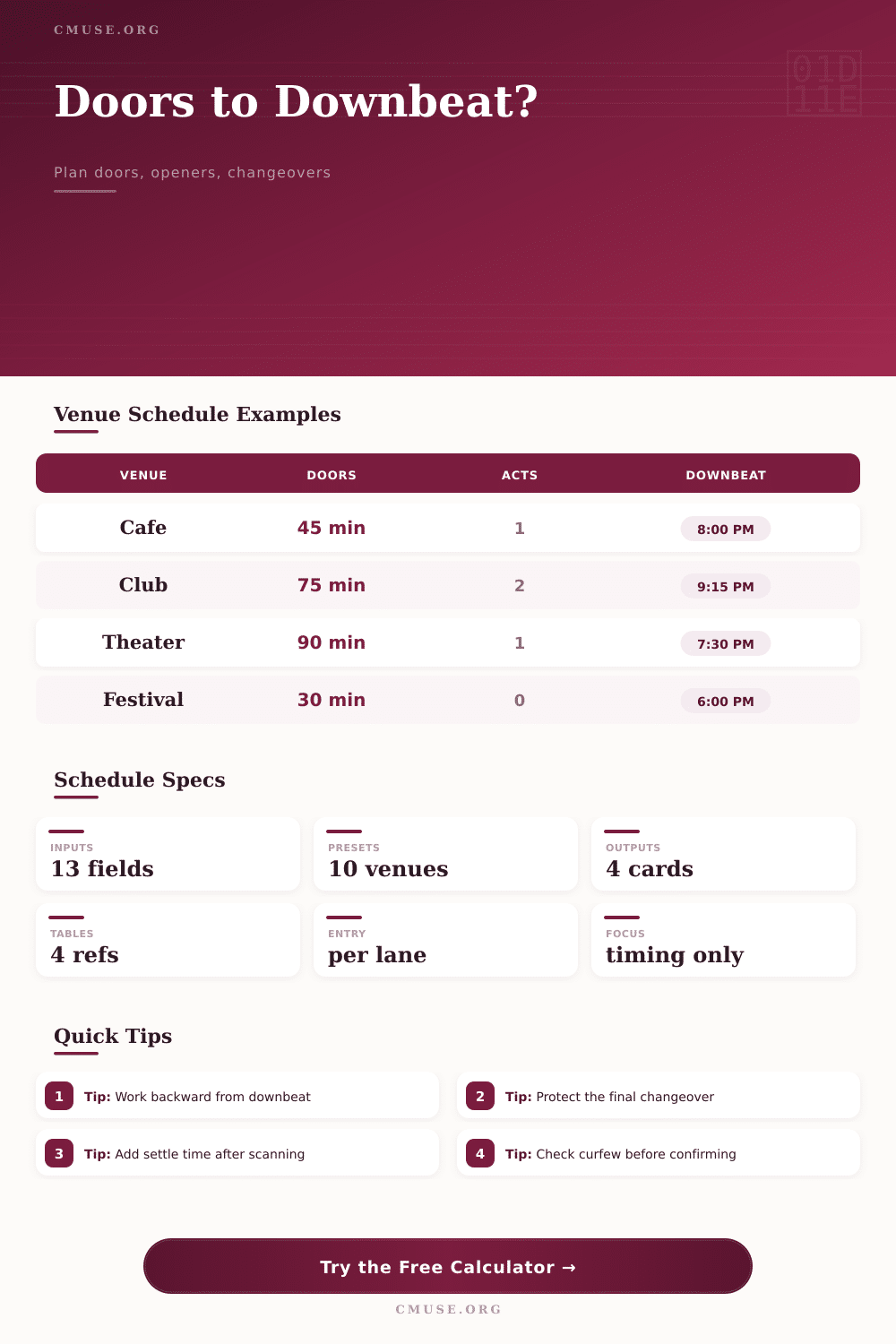
The reference tables on page explain that a festival stage follows a different logic than a corporate music block. For festivals, it doesn’t matter what time doors are because they’re a rolling entry. Instead, it’s when next band wants the deck. For a cafe show, it’s less about scanner throughput and more about flow of seats. And if you know which bucket your event fits into, you can adjust the defaults instead of trying to force each show in the same mold.
In the end, though, an effective schedule doesn’t feel like one to the audience. They don’t notice space between acts or think they’re showing up at the wrong time. You’ll notice that when you check the schedule backstage or while you are livig it in. Instead, you want a show where first act begins as scheduled, last chord sounds, and everything happens before city warden knocks on the door. When planned backward from the final note, it means the music begin when it’s supposed to and ends precisely when it has to.