Extension Cord Gauge Calculator
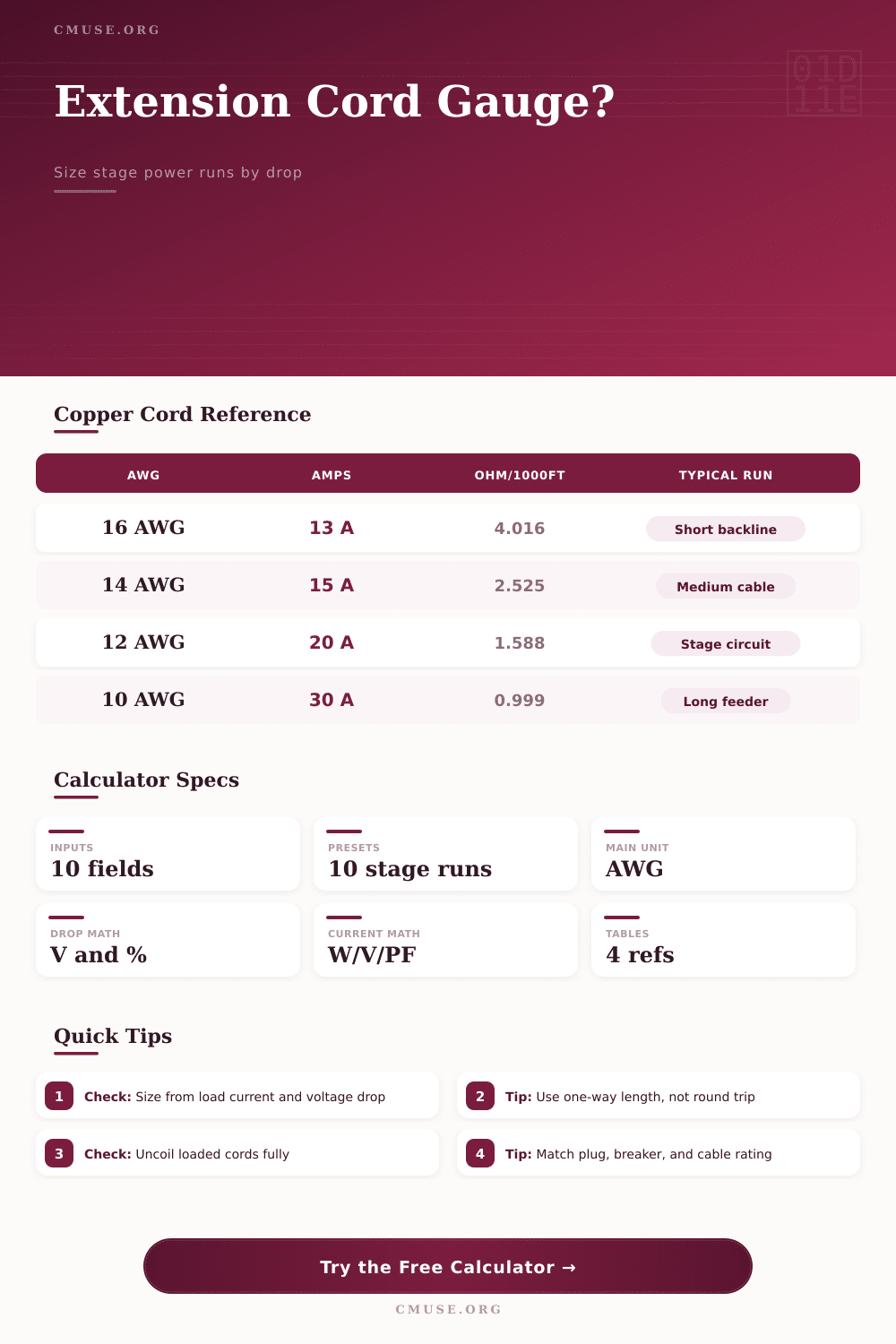
Size stage and studio extension cords by load current, one-way length, conductor resistance, voltage drop, and usable amp rating.
🔌 Stage Power Presets
⚙ Cable And Load Inputs
📋 Cable Spec Comparison
📊 AWG, Current, And Drop Tables
| Gauge | Ohm/1000 ft | Base Amps | Derated Amps | Selected Load |
|---|
| Gauge | Drop Volts | Drop Percent | Meets Drop Limit | Delivered Voltage |
|---|
| Load Watts | At 120 V PF 0.90 | At 120 V PF 1.00 | At 230 V PF 0.90 | Useful Context |
|---|
| Gauge | Max Length | Length Margin | Formula Check | Current Status |
|---|
⚠ Stage Safety Notes
By now I’m sure you’ve experienced gear failure during a gig. The mixer makes a warble noise, the amp quits running, the lighting board flashes intermittently. One person swaps out extension cord for a heavier duty model. That fixes it, only to have it go out again later or even melt the cable.
There are no free lunches when it comes to voltage drop. It’s the law of physics, where distance and resistance comes into play. Unless you select the proper conductor (gauge) size, the juice won’t make it to the load. Calculators such as the one above simplify math for you by recommending a specific gauge based off the load draw and run length.
Why Thick Cords Are Important
It’s important to remember that copper wire resists electrical current. The longer the wire, and the smaller in diameter it becomes, the more resistance there will be. So if you have a long thin cord, and plug a high wattage load into it, then voltage at end of the cord will be lower than what came from wall.
Because sensitive audio equipment relies on a stable supply of electricity, the power supplies inside these pieces of gear is designed to take an unvarying stream of AC and turn it into DC. Any variation in that stream causes the converters to either overheat and shut off or to simply not work at all. That’s why when you put in your distance, the calculator factors in one way only. Because current has to go down the cord and back again. Technicians often do this manually by measuring the round trip. But with this tool they don’t have to, since it does that doubling behind the scenes.)
It gets even more complicated when you bundle cords. Ampacity drops with heat. Because tightly packed coils and tape impede convection, heat from resistance build up and must be released. By choosing an ambient condition from the calculator, you can apply a derating factor to its capacity.
What’s twenty amps on an exposed, twelve gauge wire? Eighteen if it’s stacked in your warm trunk, sixteen if it’s bundled under a carpet. Plan accordingly, assuming worst case scenario for ventilation. Melting insulation and breaker tripping isn’t worth it; go heavy on the cord.
These calculations also take into account power factor. Because most moddern electronics don’t pull their current in phase with the voltage wave (that’s how switching power supplies work), more current need to be drawn to achieve the same amount of wattage. For example, if you ignore power factor and assume a perfect one-to-one ratio between watts and amps, you will underestimate the load on your cord. You can adjust the tool for that inefficiency so that actual current rating of your selected gauge is enough.
While that may seem like splitting hairs in a fast back-of-the-napkin calculation, when you’re squeezing maximum juice through residential wiring it counts. So what type of extension cord? It depends on length, load, and heat levels. Use lightweight cords for a short run to your guitar amp, but use heavy duty (SJTW or SOOW types) for a long feed based off your main distro.
Safety margin recommendations is based on keeping gear cool and working. No code minimum here; we’re talking about keeping things reliable. Uncoil those cables, respect their resistance, and let the numbers speak for themselves so the music doesn’t stop due to power issues. You should of used heavier gauge if you want to avoid trouble.