Amp Current Draw Calculator
Estimate the wall current for guitar amps, bass heads, powered speakers, subs, and stage racks using output watts, amplifier efficiency, voltage, power factor, crest factor, and circuit headroom.
Stage power estimate
| Amplifier or stage load | Typical 120 V draw | Typical 230 V draw | Planning note |
|---|---|---|---|
| 30 W tube combo such as AC30 style | 1.4-2.2 A | 0.7-1.1 A | Heaters and transformer idle dominate clean passages. |
| 85-100 W tube guitar head or combo | 2.5-4.5 A | 1.3-2.4 A | Current rises quickly when output stage is driven hard. |
| 300 W all-tube bass amplifier | 5.5-8.5 A | 2.8-4.5 A | Large heater load plus low efficiency makes this a heavy branch load. |
| 500 W Class D bass head | 1.8-3.8 A | 0.9-2.0 A | Efficient supply, but bass peaks still need startup and program headroom. |
| 12 inch powered PA speaker | 1.5-4.0 A | 0.8-2.1 A | Use manufacturer nameplate current for exact venue paperwork. |
| 18 inch powered subwoofer | 4.0-9.0 A | 2.1-4.7 A | Low-frequency program material has the biggest current swings. |
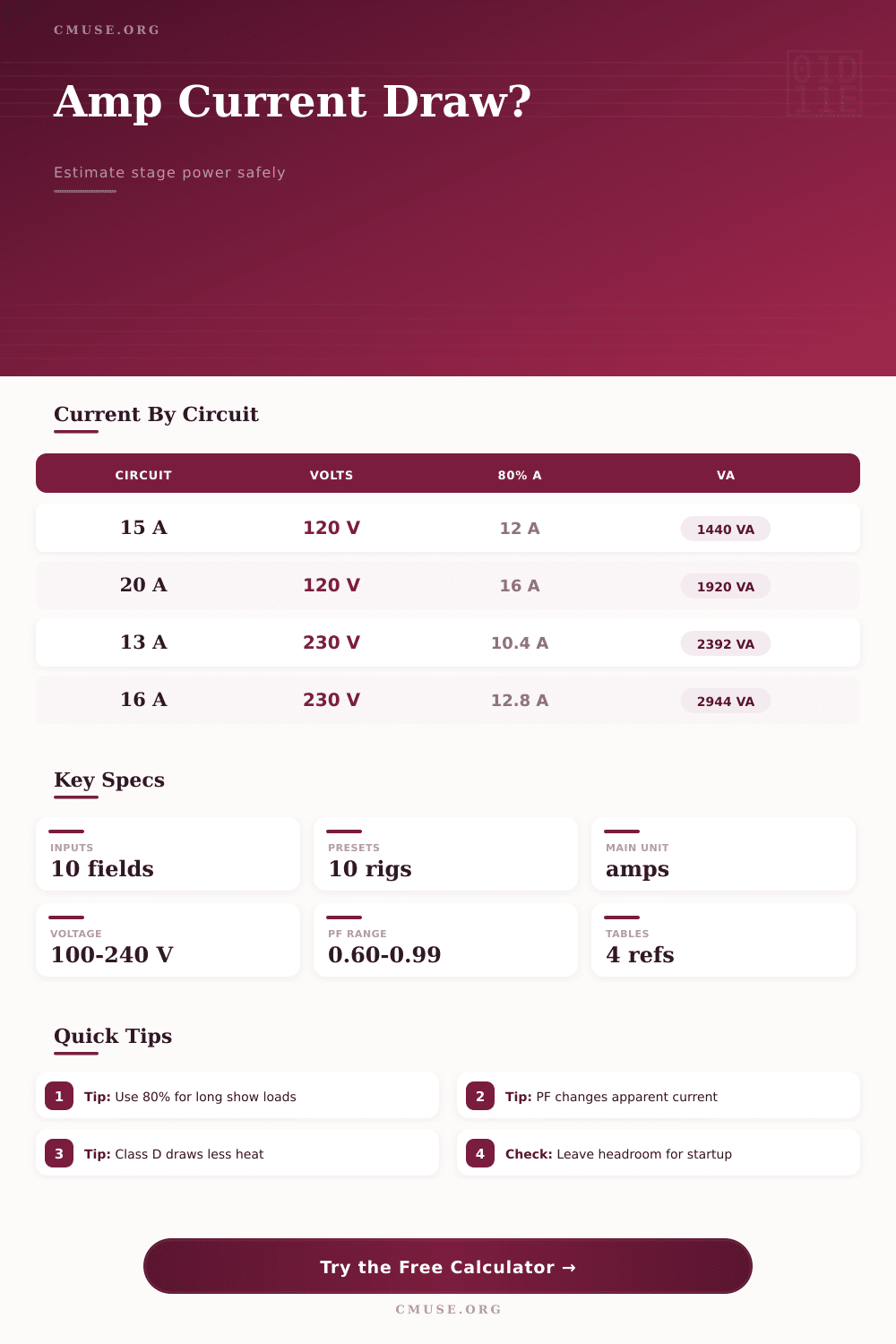
| Branch circuit | Nominal volts | 80% planning amps | 80% apparent power |
|---|---|---|---|
| 15 A North American receptacle | 120 V | 12.0 A | 1440 VA |
| 20 A North American receptacle | 120 V | 16.0 A | 1920 VA |
| 30 A stage distro branch | 120 V | 24.0 A | 2880 VA |
| 13 A fused UK style outlet | 230 V | 10.4 A | 2392 VA |
| 16 A EU or stage connector | 230 V | 12.8 A | 2944 VA |
| Power factor | Real watts | Apparent VA | 120 V current |
|---|---|---|---|
| 0.60 older transformer supply | 600 W | 1000 VA | 8.3 A |
| 0.72 common tube backline estimate | 600 W | 833 VA | 6.9 A |
| 0.85 switch-mode supply without strong PFC | 600 W | 706 VA | 5.9 A |
| 0.95 active PFC powered speaker | 600 W | 632 VA | 5.3 A |
| Extension cable planning | Suggested load | Typical use | Power note |
|---|---|---|---|
| 16 AWG, short 25 ft run | Up to 10 A | Pedalboards, one combo, light rack | Avoid high subwoofer loads on long thin cable. |
| 14 AWG, 50 ft run | Up to 12 A | Typical 15 A backline branch | Good default for guitar amps and powered tops. |
| 12 AWG, 50-100 ft run | Up to 16 A | 20 A branch or compact PA stack | Lower voltage drop helps amplifier rails stay stable. |
| 10 AWG, long stage feed | 20 A plus | Distro feeder or high-current sub line | Use listed connectors and venue-approved distro only. |
| Voltage scenario | Effective volts | Running current | Startup surge estimate |
|---|---|---|---|
| Calculate to fill | - | - | - |
| Selected circuit | Usable limit | Load percent | Remaining current |
|---|---|---|---|
| Calculate to fill | - | - | - |
| Rig section | Real watts | VA at selected PF | Amps at selected volts |
|---|---|---|---|
| Calculate to fill | - | - | - |
- Nameplate current is the best source when the amplifier lists it.
- If only watts are known, estimate real watts first, then divide by power factor and volts.
- Tube amp heater and idle draw can matter as much as clean audio output.
- Plan long sets around 80% of the branch circuit rating.
- Keep subwoofers and backline heaters off the same shared strip when possible.
- Voltage sag increases current, heat, and nuisance breaker trips.
A breaker trip can happen to you when you are out alone; it’s personal, the lights go off and audience continues applauding as you stand in darkness while your rig sits lifeless. Stage power is magic tap-water to most musicians, never-ending, always available. This attitude leads to clicking off good songs instead of chords at the end. Knowing how much is being drawn makes all the difference between safe, encore-through-the-night performance versus blown fuse. The calculator above can do it for you, but it’s good to have an idea of what exactly is drawing all that juice.
It’s tempting to assume that more volume mean more wattage; after all, that’s how we think about most things. It’s not quite so simple with amplifiers. This is especially true for tube amps, which use plenty of electricity simply to keep their tubes warm while sitting idle. Even if the input jack isn’t plugged in, the amp is still drawing current for its idle wattage and tube heaters. Don’t make the mistake of relying solely on your perceived volume output, this will greatly under-estimate your actual power demand.
How to Stop Tripping Circuit Breakers on Stage
The equation changes completely with moddern Class D amplifiers, which are extraordinarily efficient at turning electrical energy into sound waves. These types of amplifier draw far fewer amps off from the outlet while producing equal amounts of perceived loudness, creating less waste heat in the process. An old tube guitar amp putting out half the watts of a five hundred watt bass head may very well be pulling more current. It’s not just about how hard you turn up your volume knob; it’s all about what kind of technology is inside it.
There’s another hidden variable called power factor that trips up a lot of stage techs. It refers to an appliance’s ability to use the amount of electric it asks for from the grid. Linear transformers in older equipment has poor power factors, meaning they ask for more apparent power than they’re actually consuming in sound and heat. That difference make it appear as if the circuit breaker is seeing a heavier load than the nameplate watts would indicate. Active PFC circuits on newer switch-mode supplies correct this by getting the ratio closer to one. When you combine vintage tube gear with modern digital processing, you’re dealing with two different electrical personalities on the same wire.
A second issue is voltage sag. This causes inconsistent performance because low voltage requires more current draw, since watts equals volts times amps. A heavy bass guitar or subwoofer delivering a thumping kick on a chorus can temporarily pull down the voltage for all devices connected to that branch circuit. The result is your tube amp pulling harder to compensate, and if you’re pushing the total load up against the safety threshold, that spike frequently sends it over the edge, tripping the breaker right when the music climaxes.
To account for this change, we should of step away from those static numbers. And it’s laid out quite clearly in the reference table on the page which explains how various circuits hold up when they’re under load. In short, stay below 80% of your breakers’ capacity for continuous music. This leaves some headroom for surges at start-up caused by transformers. It also accounts for voltage drop and the sheer unpredictability of the live show.
Truth is, a fifteen amp circuit in North America is actualy just twelve amps of good faith. You can stuff three heavy tube heads and a subwoofer into one strip and you’re asking for trouble. The best offense for touring engineers is separation: Put the subs on a separate line if you can. The backline and monitors should shares a line, keeping the combined draw under the calculated headroom. Use a multimeter to check the actual voltage at the wall prior to load-in (cable runs vary widely from venue to venue). One club that worked might not work another; older panel boxes and longer lines can kill what flies in one club.
If we begin to think of power as a shared resource, it begins to shift our thinking about plugging in to the board and what goes into our van. Instead of a convenience, every daisy-chained strip and extension cord becomes a possible bottleneck. It’s not enough to simply make some noise, but to ensure the noise continues with minimal interruption. Respect the limitations of the grid, and the power will return the favour by being there when needed most. It is more reliable than any additional wattage we can eke from an overloaded circuit.