Sandbag Counterweight Calculator
Size stand and boom counterweight from load moment, bag lever arm, backdrop wind force, and a target safety factor for studio and stage rigging checks.
🎥Real Stand, Boom, And Backdrop Presets
⚖Load, Lever, Stand, And Bag Inputs
Counterweight Result
📊Live Rig Numbers
🏗Stand Comparison Grid
🧱Sandbag Weight Reference
| Bag Weight | Typical Use | Moment At 1.5 ft | Moment At 2.0 ft |
|---|---|---|---|
| 15 lb shot or half bag | Small light stand, low backdrop foot, cable-side trim | 22.5 lb-ft | 30 lb-ft |
| 20 lb small saddlebag | Travel photo stand or compact LED boom | 30 lb-ft | 40 lb-ft |
| 25 lb standard saddlebag | C-stand legs, backdrop uprights, common grip package | 37.5 lb-ft | 50 lb-ft |
| 35 lb heavy saddlebag | Combo stand, junior boom, wider crossbar support | 52.5 lb-ft | 70 lb-ft |
| 50 lb large stage bag | Stage base, truss foot, outdoor reserve when rated hardware allows | 75 lb-ft | 100 lb-ft |
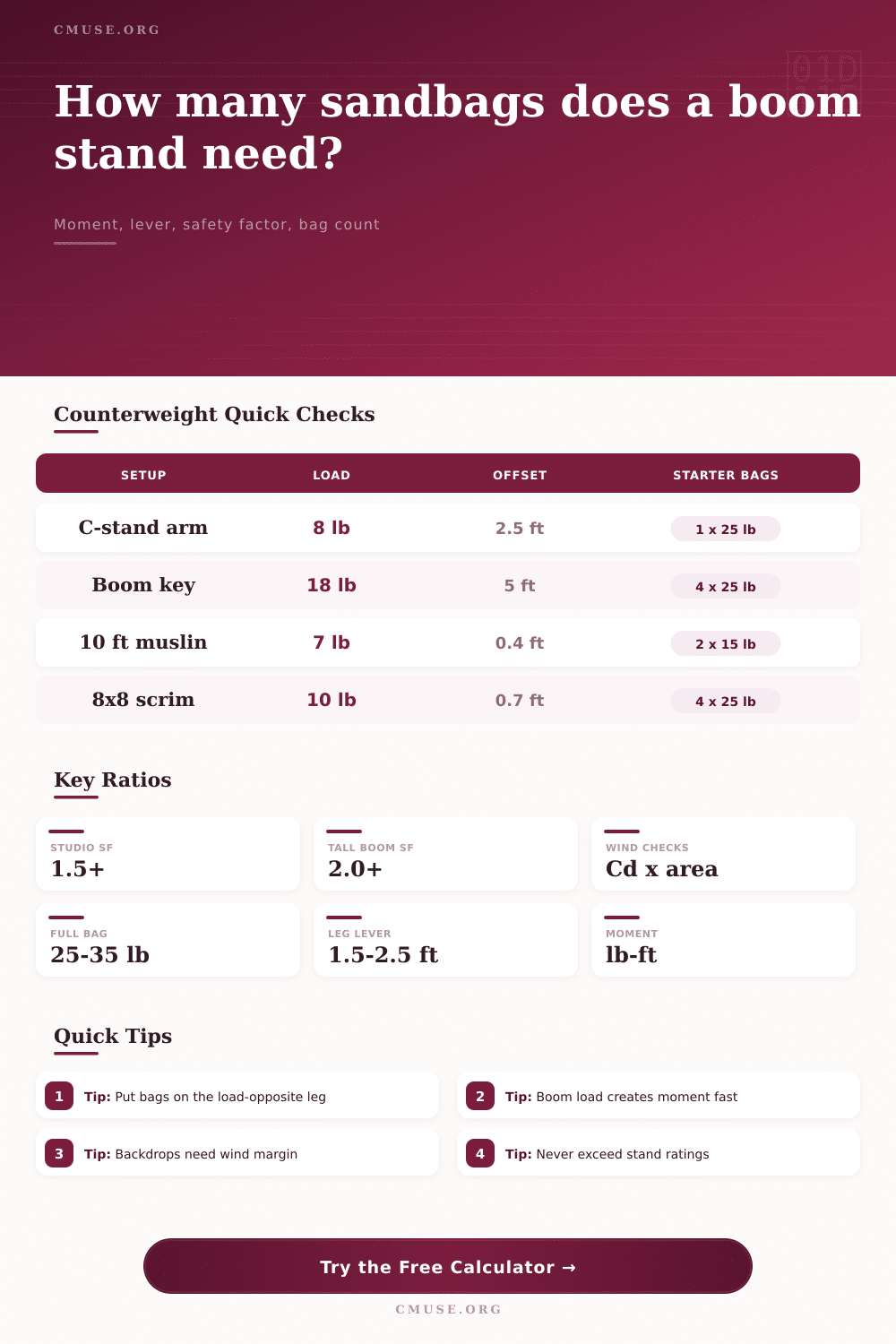
📐Common Stand And Boom Starting Points
| Rig | Load And Reach | Usual Bag Plan | Watch Point |
|---|---|---|---|
| C-stand arm with flag | 4-8 lb at 2-3 ft | One 25 lb bag on the load-opposite leg | Keep the arm over the high leg when possible. |
| Junior boom with hair light | 8-12 lb at 3-4 ft | Two 25 lb bags or one 35 lb plus leg bag | Check boom clamp slip and cable pull. |
| Combo stand with key light boom | 15-25 lb at 4-6 ft | Four 25 lb bags or heavier stage ballast | Use a stand rated for the combined fixture and boom. |
| Backdrop crossbar | 5-20 lb near centerline | One 15-25 lb bag per upright indoors | Side pull and wind can dominate fabric weight. |
| 8x8 frame or silk | 8-15 lb plus sail load | Two 25 lb bags per stand in calm air | Even light air can exceed the fabric weight moment. |
🌬Backdrop And Wind Force Table
| Air Speed | Pressure Formula | Force On 40 sq ft Cloth Cd 1.0 | Rigging Meaning |
|---|---|---|---|
| 0 mph | 0.00256 x V^2 = 0 psf | 0 lb | Indoor still-air weight check only. |
| 5 mph | 0.00256 x 25 = 0.064 psf | 2.6 lb | Noticeable on tall paper or muslin. |
| 10 mph | 0.00256 x 100 = 0.256 psf | 10.2 lb | Often more moment than the fabric itself. |
| 15 mph | 0.00256 x 225 = 0.576 psf | 23.0 lb | Needs major ballast and supervision. |
| 20 mph | 0.00256 x 400 = 1.024 psf | 41.0 lb | Usually beyond casual stand-and-bag setup. |
📌Placement And Safety Factor Guide
| Check | Preferred Reading | Why It Matters | Action If Low |
|---|---|---|---|
| Bag lever arm | Bag center beyond 1.5 ft on C-stand, 2 ft on combo | Moment rises directly with distance. | Move the bag outward on the load-opposite leg. |
| Safety factor | 1.5 indoors, 2.0 for tall booms, 2.5+ around people | Reserve covers bumps, tilt, and imperfect placement. | Add bags, reduce reach, or lower the stand. |
| Payload rating | Load plus boom below manufacturer rating | Bags stop tipping, not tube bend or clamp failure. | Move to a higher-rated stand or reduce fixture weight. |
| Fabric area | Wind input included for open doors, fans, or exterior work | Wind moment uses force at height, so tall cloth is punishing. | Reduce sail area, add tie-offs, or strike the fabric. |
⚠Counterweight Safety Notes
Ever extended an arm on a C-stand only to have it begin to wobble, then tip over? That silent danger is familiar to any photographer, grip, or gaffer. When using sandbags, we may assume them to be just dead weight… Just anchors to add some stability. But gravity doesn’t care about our intentions. It’s all about leverage.
Knowing that will change the way you think of each stand in your arsenal and what makes a setup fly vs. It is safe. Moment (another word for turning force) are at the heart of it. Two feet away from the center column with ten pounds of gear suspended from it generates twenty foot-pounds of torque attempting to tip the stand. Entering the offset and the load into the calculator above does the math for you. By taking care of conversions and coefficients, it saves you the hassle of doing mental math. And no need for calculus, either.
How to Keep Your Stand Safe and Stable
But in order to use it, you should of know distance is more important then weight when it comes to tipping over. That light thing hung one foot nearer to the stand body is more stable than adding a ten pound bag to the base. The tendency to look at weight rather than shape leads people astray here.
What about the boom arm? When the tool asks how long your boom is, it knows that a lot of weight are in the arm itself. Usually, center of gravity will be half-way down the arm when it’s unrigged. That’s important because a heavy light fixture at one end becomes a big lever with the light legs providing some counterbalance to the rig.
Add a backdrop and things change again. Unless rigged so they hang still, fabric isn’t very weighty. But add wind and it puts forces on the muslin screen that can exceeds those of gravity itself. Because outdoor locations or open studios can bring their own variables that an indoor shoot doesn’t have to contend with, the calculator features a field for drag coefficients and another for sail area. Moving air in your scene is not something you can just overlook.
The connection between theory and practice involve safety factors. For example, you can choose a safety factor like 1.5 for calm interiors or more if it’s a busy set. Don’t think this reflects any lack of faith in your calculations. It considers factors like floor bounce, accidental bumping by actors, and just plain old human error. Balancing on the edge of failure (a safety factor of 1) is never a good idea.
The chart shows how different bag sizes affects your reserve at differing distances. Ideally, you want some kind of buffer zone where you have a bit of leeway before it all collapses.
The last variable is placement. The bags should go on the leg away from the load and as close to the edge of the center column as you can get without going over. Putting a bag alongside the upright isn’t doing much for leverage. Spread those bags out.
If you’re working on a weak floor check its rating. Sandbags won’t make a stand tip but they won’t hold a clamp in place when stressed nor will a tube bend up either. These details matter, and you need to know and respect your hardware limits.
Rigging lights shouldn’t be dangerous; it should be second nature. Understanding that rigging is about both weight and moments means you can calculate rather than guess. Your gear will remain on the floor. You’ll go quicker setting out and worry less about balance. You also won’t need to simply add weight the next time you notice a wobble. Shorten the arm, move the load or adjust the geometry then top off with bags as necesary.