Flight Case Volume Calculator
Size the instrument cavity, protective foam, external shell volume, and loaded weight allowance for music and audio flight cases.
Inside dimensions equal the protected item plus clearance, side foam, bottom foam, and lid foam. Outside dimensions add shell wall and extrusion allowance to each face.
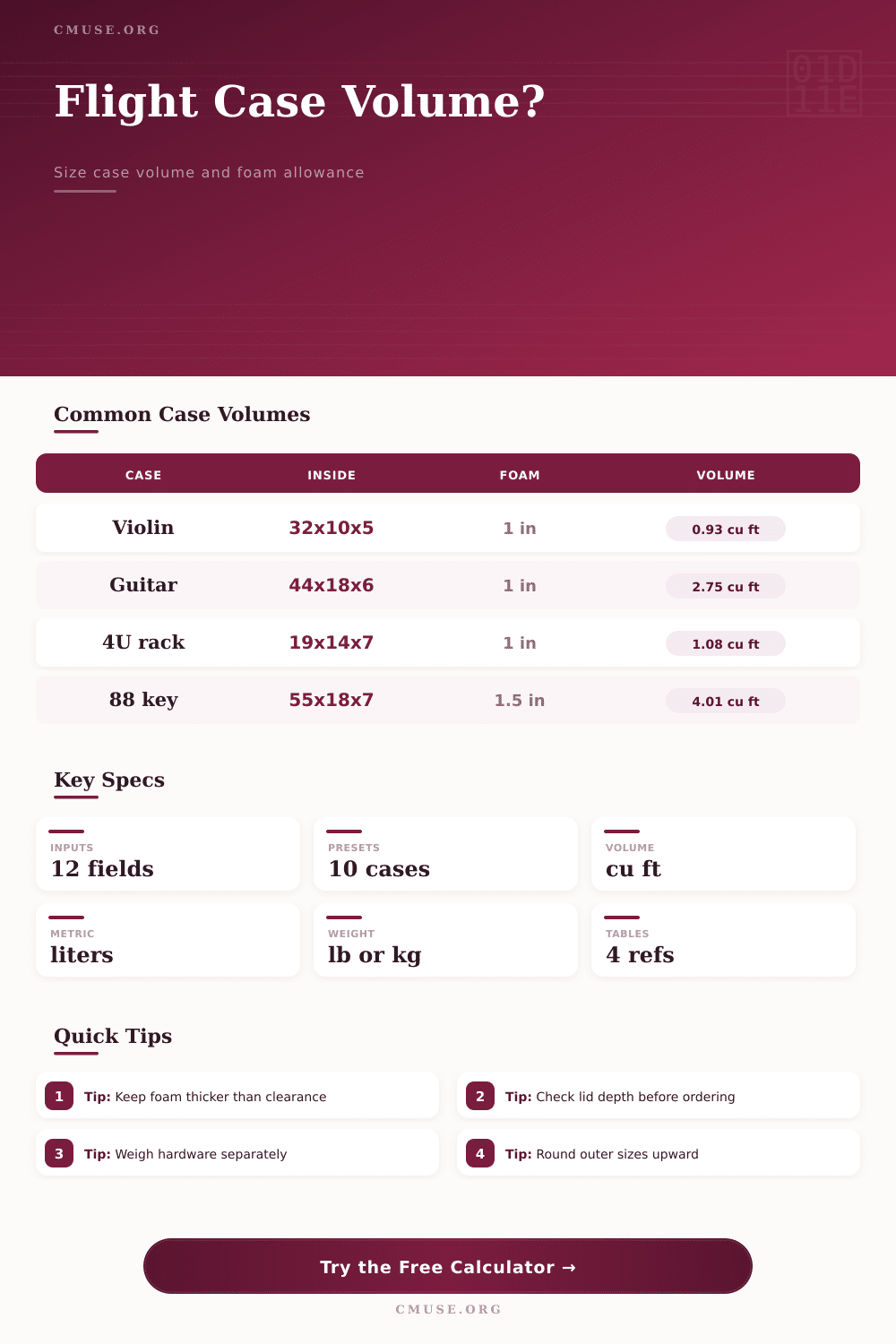
| Case type | Typical protected item | Usual foam pack | Internal case volume | Common handling note |
|---|---|---|---|---|
| Oblong violin | 31 x 9 x 4 in body and bow zone | 0.75-1 in side, 0.5 in lid | 0.85-1.10 cu ft / 24-31 L | Keep neck support blocks out of bridge pressure points. |
| Dreadnought acoustic guitar | 42-44 x 16-17 x 5 in | 1 in side, 1 in bottom, 1 in lid | 2.5-3.1 cu ft / 71-88 L | Measure body depth at bridge area, not only the rim. |
| Long scale electric bass | 46-48 x 14-15 x 2.5 in | 1 in side, 0.75 in bottom, 0.75 in lid | 2.3-2.8 cu ft / 65-79 L | Headstock length usually drives the case length. |
| 88-key stage piano | 52-55 x 14-16 x 5-6 in | 1.5 in side, 1 in bottom, 1 in lid | 3.8-4.8 cu ft / 108-136 L | Wide cases may need wheels even when volume is moderate. |
| 2U rack case | 19 in rack width, 3.5 in height, 12-14 in depth | Rail shock space plus 0.5-1 in lid foam | 0.75-1.00 cu ft / 21-28 L | Rear connectors and lid depth often set total depth. |
| 4U rack case | 19 in rack width, 7 in height, 14-18 in depth | Rail shock space plus 0.5-1 in lid foam | 1.2-1.8 cu ft / 34-51 L | Loaded rack mass can exceed volume expectations. |
| DJ controller | 25-29 x 14-16 x 2.5-4 in | 1 in side, 0.75 in bottom, 0.75 in lid | 1.5-2.1 cu ft / 42-59 L | Knobs and faders need lid clearance, not compression. |
| Foam material | Density used | Best fit | Volume behavior | Calculation note |
|---|---|---|---|---|
| Polyethylene plank 1.2 | 1.2 lb/ft³ / 19 kg/m³ | Light guitars, violin, accessories | Low foam weight, lower support | Good when the case shell provides most stiffness. |
| Polyethylene road case 1.7 | 1.7 lb/ft³ / 27 kg/m³ | General instrument and audio cases | Balanced displacement and support | Default density for many flight case inserts. |
| Firm polyethylene 2.2 | 2.2 lb/ft³ / 35 kg/m³ | Mixers, pedals, compact electronics | More foam mass per cubic foot | Useful when narrow supports must resist crushing. |
| EVA high support | 3.0 lb/ft³ / 48 kg/m³ | Heavy controllers and modular synths | Highest insert mass here | Reduce volume where not needed to control case weight. |
| Polyurethane acoustic foam | 1.5 lb/ft³ / 24 kg/m³ | Light cushioning, accessory lids | Compresses more than PE or EVA | Do not count compression as structural clearance. |
| Outside length range | Typical music case | Volume range | Weight risk | Dimension check |
|---|---|---|---|---|
| Under 24 in / 61 cm | Microphone kit, DI, compact pedal case | Under 1.0 cu ft / 28 L | Usually hardware-heavy rather than volume-heavy | Confirm handle does not add to rack shelf depth. |
| 24-36 in / 61-91 cm | Violin, mixer, DJ controller, snare | 1.0-2.5 cu ft / 28-71 L | Foam and hardware can equal item weight | Measure protruding knobs and bow compartments. |
| 36-48 in / 91-122 cm | Guitar, bass, small keyboard, speaker | 2.5-5.0 cu ft / 71-142 L | One-person lifting limit becomes important | Add side foam before comparing vehicle openings. |
| 48-60 in / 122-152 cm | 88-key piano, long bass, lighting bar | 4.0-7.5 cu ft / 113-212 L | Caster allowance often matters | Round up outside length and include wheel plates. |
| Over 60 in / 152 cm | Oversize keyboard or multi-item trunk | Over 7.5 cu ft / 212 L | Volume, shell area, and handling all compound | Split items if loaded weight is the limiting factor. |
| Spec choice | Typical dimension effect | Volume effect | Weight effect | Use when |
|---|---|---|---|---|
| 0.5 in total clearance | Adds 1 in to each cavity dimension | Small but noticeable on long cases | No direct weight except larger foam shell | The item has hard knobs, jacks, or bridge points. |
| 1 in side foam | Adds 2 in length and width | Strong effect on guitar and keyboard cases | Moderate PE insert weight | Standard instrument touring protection is needed. |
| 1.5 in side foam | Adds 3 in length and width | Large external jump on wide equipment | Higher foam and shell estimate | Heavy electronics or rough handling are expected. |
| 0.5 in wall/extrusion | Adds 1 in to outside length, width, height | External volume rises on all axes | Moderate shell and hardware allowance | Typical molded or lighter road case build. |
| 0.75 in wall/extrusion | Adds 1.5 in to outside length, width, height | Important for vehicle and storage fit | Higher panel, corner, and latch mass | Touring plywood, recessed latches, and casters are used. |
Physics books don’t teach this lesson. A full flight case of gear on the back of a truck will teach you more then you bargained for. Weight isn’t simply mass; it’s panic times momentum.
When audio techs and musicians pack their mixers and guitars in a case, they worry about how things fit inside, forgetting to account for extra space taken up by protective padding. This results in otherwise reasonable loads becoming lumpy shapes that stress car tops and airline check-in counters.
How to Measure Your Case Correctly
Once you’ve entered your dimensions into the above calculator, it’ll perform calculations, so you don’t need to know anything about conversions or coefficients. It’s bridge between “it all goes in” and “this thing takes up all this room.”
First measure length at the end with the longest note of your instrument/device. If a cable is attached or a knob is sticking out, include those in your measurement along with height of the bridge and other parts. And remember to allow some breathing room (air clearance) just in case your instrument vibrate against the foam. It seems like such a minor thing on paper, but expansion of material in the trunk as temperature changes can cause damage if the instrument is touching the foam.
Now we know how much overall space we need for our instrument. Now we will determine how thick we want the foam to be on all walls of the case. Typically we have side foam run thicker than lid foam. Because generally speaking, most instruments gets dropped laterally and less often vertically. Generally 1 inch of polyethylene foam on the bottom and sides is sufficient. This amount absorbs shock without making case unnecessarily heavy.
Density of the foam is important, too. For example, a light-weight plastic plank made from low-density polyethylene may weigh less per cubic-foot, but it doesn’t stand up to heavier equipment like rack units and synthesizers. Heavier-duty EVA foam are more rigid and thus offers better equipment protection, but at a price, increased weight.
To account for that, the calculator lets you choose your foam type(s) and estimates their weight based off total displacement (the This is the amount of space inside your case minus your gear’s footprint. Amount of space inside your case minus your gear’s footprint). Don’t count those accessory cut-outs/pockets, and your weight will be overstated.
This is where accuracy makes the difference between meeting airline size limits vs. You might be hit with an oversized fee. The same holds true for shell construction. Molded ABS shells is significantly lighter with thinner walls compared to plywood laminate cases which need thicker walls along with heavier aluminum extrusions. The increase in structural integrity adds about two inches to each dimension (length, width & height) outside of the case. And it doesn’t sound like much until you attempt to get the case into a typical rack shelf or jammed into a packed van.
Just look at external volumes for any type of case you’re considering and see if it will go up stairs, thru doorways or on narrow storage racks. The table on the page breaks it down and makes it easy to see why a piano case with 88 keys may have wheels though it has what appears to be a medium internal volume.
Most estimates don’t account for hardware allowances. That adds considerable weight beyond volume. Corner guards, latches, handle recesses, caster plates, etc. Many heavy rack cases assigns 16% of their total weight just to hardware. A compact molded case may be able to handles only 5%. Failure to account for this cushion will result in an estimate that’s great on paper, but too heavy for practical handling.
When possible, always weigh the empty shell by itself. If you can’t do that, use the density estimates from a standard ATA build or aluminum. These decisions involve transport logistics. Lifting capability is determined by weight; storage fit comes down to volume.
You may have a perfect-fit case for your car’s trunk but it’s too heavy to carry safely alone. Alternatively, you may have found a lightweight case, but it bulges because of extra foam padding. This makes it hard to jam into tight shelves. It strikes a balance between fitting into an external envelope and getting maximum inside capacity.
When designing storage space, plan for slightly larger outer dimensions. Handles and wheels project past the main shell and snag on edges where you least expect them. This isn’t rocket science, but it is geometry applied toward protecting valuable equipment.
This is not about spending money on some magical material, but on making sure your box has the right thickness so instrument floats safely rather than rattling against hard sides. The right density of shell will keep your box strong yet compact. A few minutes of careful measuring up front can save you from having to reorder at great expense later.
Once you know what all the pieces add up to, you get it. Padding adds height, hardware takes away, and then there is space for your instrument. Each pound has an impact, each inch matter. Your instrument won’t bounce around anymore when you carry it. It’s not a crap shoot. It’s a calculated move.
And when you do that, it’s no longer a bother, it’s peace of mind. That peace of mind is priceless. It is worth much more then the few minutes it takes to enter your dimensions into software created specifically to do just that.