Cable Weight Total Calculator
Estimate total cable mass, finished length, connector allowance, case payload, and remaining load buffer for touring trunks, studio looms, broadcast runs, and PA cable packs.
Cable Load Results
| Cable type | Typical OD | Weight per ft | Weight per m | Planning note |
|---|---|---|---|---|
| Standard balanced mic cable | 6.0 mm | 0.030 lb | 0.045 kg | General XLR and TRS studio lines |
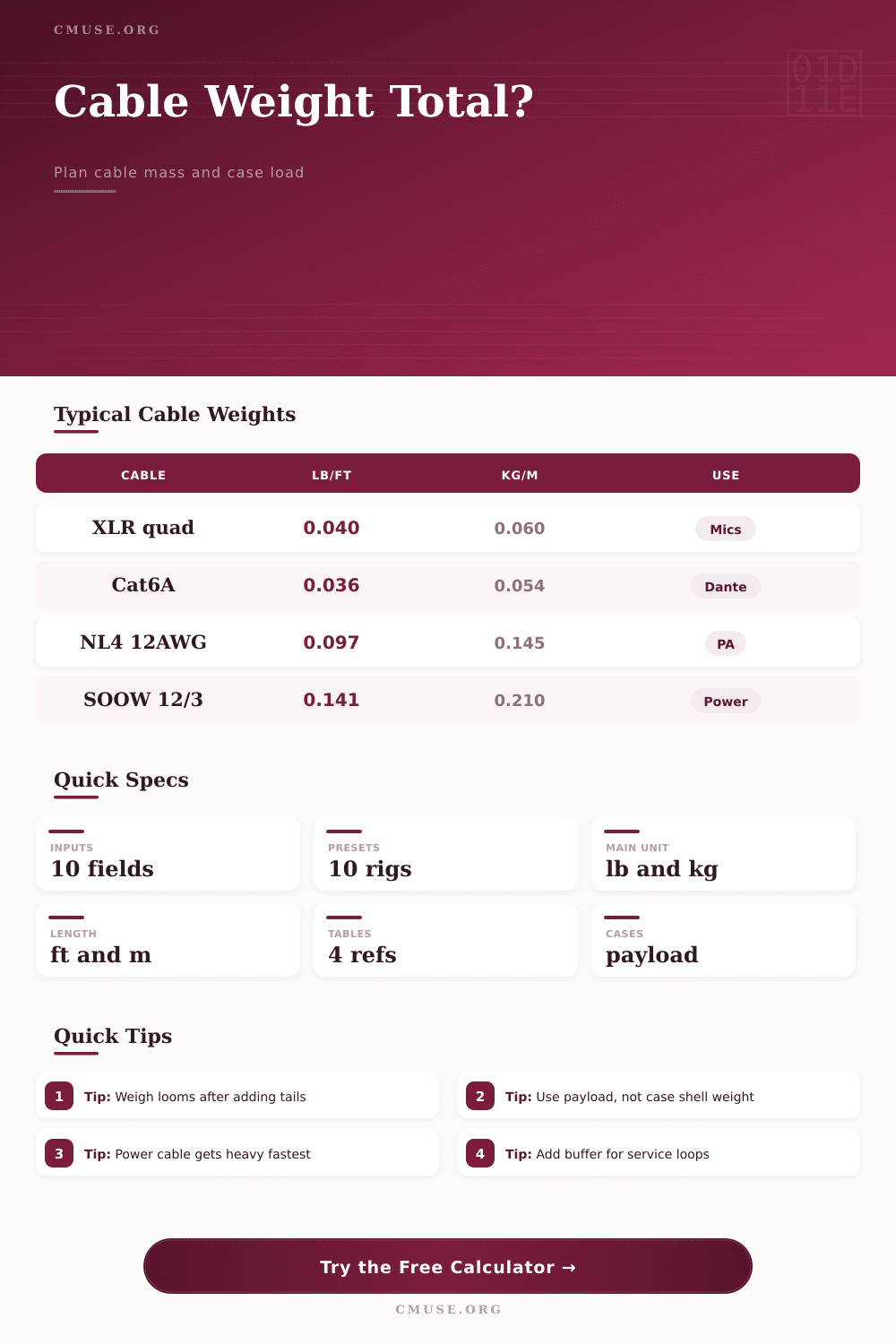
| XLR star-quad mic cable | 6.5 mm | 0.040 lb | 0.060 kg | Heavier quad geometry for noisy stages |
| Instrument or TRS patch cable | 5.8 mm | 0.024 lb | 0.035 kg | Short pedalboard and backline runs |
| AES/EBU digital audio cable | 6.0 mm | 0.032 lb | 0.047 kg | 110 ohm balanced digital audio |
| Cable type | Typical OD | Weight per ft | Weight per m | Planning note |
|---|---|---|---|---|
| 12 AWG 4-conductor NL4 speaker cable | 11.5 mm | 0.097 lb | 0.145 kg | Common amp rack to passive box trunk |
| 14 AWG 2-conductor speaker cable | 8.0 mm | 0.054 lb | 0.080 kg | Short wedge and small PA speaker runs |
| 12/3 SOOW stage power cable | 10.5 mm | 0.141 lb | 0.210 kg | Very heavy per foot compared with signal cable |
| 10/3 SOOW feeder cable | 13.5 mm | 0.215 lb | 0.320 kg | Use separate trunks for longer power drops |
| Cable type | Typical OD | Weight per ft | Weight per m | Planning note |
|---|---|---|---|---|
| Shielded Cat6A EtherCON cable | 7.5 mm | 0.036 lb | 0.054 kg | Dante, AES67, AVB, and control networks |
| RG-6 style 12G SDI coax | 7.0 mm | 0.044 lb | 0.065 kg | Camera and video world lengths add up quickly |
| 110 ohm DMX 5-pin cable | 6.2 mm | 0.034 lb | 0.050 kg | Lighting data and stage control lines |
| 24-pair analog audio multicore snake | 20.0 mm | 0.437 lb | 0.650 kg | One cable can exceed a small trunk by itself |
| Connector set | Pair allowance | Best matching cable | What it includes |
|---|---|---|---|
| XLR male plus female pair | 82 g / 0.18 lb | Mic, AES/EBU, DMX | Two metal shell connectors with boot strain reliefs |
| TRS or instrument plug pair | 50 g / 0.11 lb | Instrument and patch cable | Two straight plugs with barrel shells |
| NL4 speakON pair | 104 g / 0.23 lb | 12 AWG speaker cable | Two locking speaker connectors |
| EtherCON shell pair | 92 g / 0.20 lb | Shielded Cat6A | Two ruggedized RJ45 carriers |
| BNC pair | 28 g / 0.06 lb | SDI coax | Two crimp BNC connectors |
| Edison power plug pair | 110 g / 0.24 lb | SOOW stage power | Plug and connector body pair |
| Cable family | Mass behavior | Coiling concern | Use when planning |
|---|---|---|---|
| Mic and line-level audio | Low to moderate per foot | Connector count can rival short-cable jacket mass | Many short channels in one trunk |
| Network, video, and control | Moderate per foot with rugged shells | Large coil diameters protect data performance | Long camera, Dante, or lighting control runs |
| Speaker cable | High copper mass per foot | Stiff coils reduce case packing density | Amp racks, passive PA, wedges, and subs |
| Stage power cable | Highest mass in common small-format packs | Separate power cases keep signal trunks liftable | Backline drops, distro tails, and utility circuits |
| Multicore snake | Very high mass concentrated in one run | Fanout hardware and tails add localized load | Analog split, monitor world, and festival patch |
| Loadout | Typical cable pack | Base length | Expected mass before case |
|---|---|---|---|
| Small rehearsal vocal PA | 8 XLR star-quad lines | 200 ft / 61 m | About 10 lb / 4.5 kg |
| Club drum input loom | 12 XLR star-quad lines | 420 ft / 128 m | About 22 lb / 10 kg |
| Dante stage rack kit | 8 rugged Cat6A lines | 600 ft / 183 m | About 27 lb / 12 kg |
| Four passive speaker runs | 4 NL4 12 AWG cables | 200 ft / 61 m | About 23 lb / 10.5 kg |
| Stage power drop pack | 6 SOOW 12/3 extensions | 600 ft / 183 m | About 88 lb / 40 kg |
It’s load-in time and you grab one of those stage trunks and wonder why you ever thought you should of being doing this for a living. Ahh. We’ve all been there. Fortunately, we also know the answer: You should always know what’s in the box before attempting to hoist it out of a truck.
Knowing cable weight isnt simply a matter of purchasing length. Multiple factor are involved, such as conductor gauge, jacket thickness, connectors, and tape. These is all part of a complicated formula. If you forget them, it will cost your crew in broken trunks and back pain.
Why Knowing Cable Weight Is Important
The number one reason people begin their calculations is by counting the length: “I’m buying 12 mic cables; they’re all going to be 50 feet.” And that’s where the calculator does the work for you. You’ll see we ask for lots of things, and it’s this that saves your back: Why? You need to understand it.
The first thing you choose is the construction of the cable. Not all black rubber are the same. A typical balanced mic cable is roughly six millimeters across; it’s light. But maybe you’re sending it out on stage, and the RF environment is heavy, so you go for some star-quad cabling. This have four conductors twisted together to improve noise rejection. That increases the size of the cable, bulk; and also increases its mass. That added copper shielding are heavier per foot, and that means a manageable case becomes a hazard when repeated over hundreds of runs.
And then there’s the connector allowance. Most people don’t factor this into their estimate because an XLR pair is more than just plastic. There is metal shells, strain reliefs, boots, backshells, and all that adds up quickly. And if you’re using heavy speaker cable, the NL4 connectors alone will be more than a hundred grams each for a pair. Once you select your connector type, the tool automatically factor that in. But it helps to realize that at both ends of every cable, you’re holding dead weight that doesn’t carry any signal. You still have to lift that dead weight.
Stage power drops with SOOW wiring, and power cable is a beast all to itself. A three-conductor, twelve gauge power cable weigh over four times than an equivalent length of mic cable weighs. And if you stuff lengthy power tails in the same trunk as your precious audio snakes, you’re begging for trouble. The density shifts the center of gravity, and the stiffness makes coiling inefficient. Coiling becomes inefficient. It’s basic stagecraft to separate power from signal, yet folks continue to do it until someone throws out their back or a truck get damaged.
Loose over-under coils have more volume than tight ones. This means packing style matter, as a tape-and-zip tie dress or pre-bagged cable take up more room because they will move slightly when traveling. You’re hauling its structure as well with bagged cables or taped looms with fanout tails; that adds a little handling factor to the weight estimate. Printed labels, velcro ties and tape may be inconsequential, but on a full drum loom or a big multicore snake, they add some measurable kilos. It allows you to input an allowance for dressing material as a percentage, and that’s smart planning.
And then there are service loops, because you don’t run cables dead tight on a stage, either. You want slack to allow things to move, so you can make repairs, and reposition gear without having to uncoil the whole run. Ten percent is standard slack for normal stage work; at festivals where there’s some unpredictability about layout, they may require fifteen or twenty percent to account for the chaos. The additional length doesn’t go to waste. It’s insurance, but it’s insurance that comes with weight. And you pay for that slack in every lift.
Consider your case payload as a budget. You have a number of items you’d like to haul in one trunk, but there is only so much you can fit in that space before it becomes too heavy to move by yourself. Once you’ve accounted for all your connectors and cables, the tool will show you how many pounds you have left, and if you’re anywhere near capacity, its time to stop running more.
Because a lighter case is cheaper in the long term (not to mention safer and faster) different than a heavy case + hospital bills for your crew, split the load. Plan the mass, not the pack, weigh your looms when adding their tails, and check the payload vs. Shell weight, it’s simply good logistics and you’ll be walking out of that venue with your gear…and your spine…intact.