Watt to Perceived Loudness Calculator
Convert amplifier watts into power dB, estimated listener SPL, perceived loudness change, and target wattage from speaker sensitivity and distance.
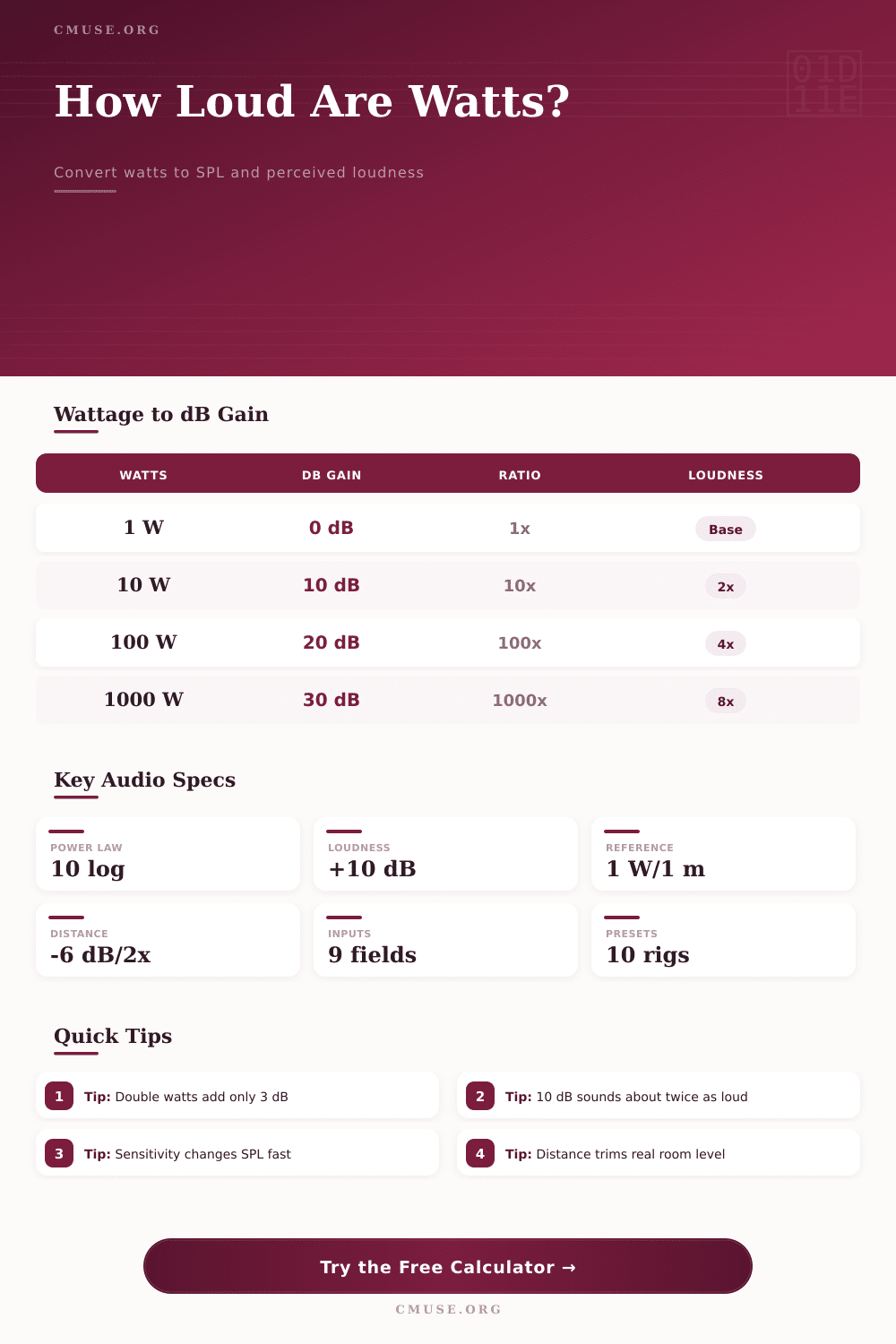
| Power per Speaker | dB Above 1 Watt | Power Ratio | Approx Perceived Loudness |
|---|---|---|---|
| 1 W | 0.0 dB | 1:1 | Reference loudness |
| 2 W | +3.0 dB | 2:1 | About 1.23 times as loud |
| 5 W | +7.0 dB | 5:1 | About 1.62 times as loud |
| 10 W | +10.0 dB | 10:1 | About twice as loud |
| 25 W | +14.0 dB | 25:1 | About 2.64 times as loud |
| 50 W | +17.0 dB | 50:1 | About 3.25 times as loud |
| 100 W | +20.0 dB | 100:1 | About 4 times as loud |
| 500 W | +27.0 dB | 500:1 | About 6.5 times as loud |
| Speaker Sensitivity | 1 W at 1 m | 10 W at 1 m | 100 W at 1 m |
|---|---|---|---|
| 84 dB bookshelf / low efficiency | 84 dB SPL | 94 dB SPL | 104 dB SPL |
| 87 dB compact hi-fi | 87 dB SPL | 97 dB SPL | 107 dB SPL |
| 90 dB typical hi-fi | 90 dB SPL | 100 dB SPL | 110 dB SPL |
| 93 dB efficient cabinet | 93 dB SPL | 103 dB SPL | 113 dB SPL |
| 96 dB stage wedge / guitar cab | 96 dB SPL | 106 dB SPL | 116 dB SPL |
| 99 dB PA top / horn-loaded system | 99 dB SPL | 109 dB SPL | 119 dB SPL |
| Listener Distance | Free-Field Loss | Same as Power Change | Practical Note |
|---|---|---|---|
| 1 m / 3.3 ft | 0.0 dB | Reference point | Sensitivity rating distance |
| 2 m / 6.6 ft | -6.0 dB | Quarter acoustic power | Typical nearfield-to-sofa step |
| 3 m / 9.8 ft | -9.5 dB | About one-ninth | Common living room seat |
| 4 m / 13.1 ft | -12.0 dB | One-sixteenth | Small venue front rows |
| 8 m / 26.2 ft | -18.1 dB | About one-sixty-fourth | Back of a small room |
| 16 m / 52.5 ft | -24.1 dB | About one-256th | Outdoor and hall checks |
| dB Change | Power Ratio | Approx Loudness Factor | What It Usually Feels Like |
|---|---|---|---|
| +1 dB | 1.26 times power | 1.07 times | Barely noticeable in quick A/B tests |
| +3 dB | 2 times power | 1.23 times | Clearly louder, not twice as loud |
| +6 dB | 4 times power | 1.52 times | Strong increase with obvious headroom change |
| +10 dB | 10 times power | 2 times | Common rule for twice as loud |
| +20 dB | 100 times power | 4 times | Large jump, roughly four times as loud |
| -10 dB | One-tenth power | Half as loud | Typical attenuator half-loudness target |
Low-Sensitivity Hi-Fi
Typical Stereo Pair
Guitar Cabinet
Compact PA Top
| Use Case | Typical Listener SPL | Peak Headroom | Calculator Field to Watch |
|---|---|---|---|
| Quiet practice or editing | 65-75 dB | 3-6 dB | Estimated listener SPL |
| Comfortable music listening | 75-85 dB | 6-10 dB | Watts for target + headroom |
| Loud rehearsal room | 90-100 dB | 6-10 dB | Distance and speaker sensitivity |
| Small club reinforcement | 95-105 dB | 10-12 dB | Audience loss and speaker count |
| Outdoor fill check | 90-100 dB | 10-12 dB | Free-field distance loss |
One of those pesky bits of audiophile folklore is myth that adding more amplifier power to your system will result in a lot louder sound. If you think your system is lacking a bit in terms of loudness, all you have to do is pick up an amp with double the watts. Actualy, things are not that simple, they are much more interesting.
Things like sound pressure level operates along the same logarithmic rules as dBs instead of arithmetic ones. This means doubling your amplifier power increase your listening by roughly three dB, which is noticeable for sure, but doesn’t feel like a revolution at all. Just enough to move the needle on perceived volume.
Why More Amp Power Does Not Mean Louder Sound
Once you know your distance and your speaker’s sensitivity… Which is maybe the most misunderstood spec of all in high fidelity audio; the calculator up top do the work for you. It saves you from having to guess what real world power you actually need. Sensitivity is a speaker specification that tells you how well driver can convert electrical energy into acoustic energy. Even when driven by the same amplifier, a speaker rated at 90dB/watt will sound noticeabley quieter than one rated at 95db/watt. Raw power has a lot less to do with it then efficiency.
You may find that with inefficient speakers you’ll want 100-watts to produce a pleasing volume level. In contrast, an amplifier driving efficient horn loaded driver might achieve the same volume level using only 10-watts. That’s staggering when you consider impact on amplifier strain and heat dissipation.
The other major factor in the equation is distance. Because sound travels through space, it spreads out, and with each doubling of the distance traveled, sound lose some energy. Specifically, it loses about 6 dB per doubling of distance. So if you’re sitting twice as far from speaker as someone else, you’ll be hearing roughly half their sound pressure level. That’s why people in the back of a club can hardly make out the bass line while folks in the front row is getting blown away.
Fortunately, the tool also takes into account this free-field loss. However, keep in mind that while there may be no gain in an open outdoor space, a wall or corner can bounce sound back at you to provide a bit more gain. Not only are you purchasing power, your purchasing sufficient output to make it all the way across your room.
Another wrinkle is that we don’t hear volume in a perfectly linear manner; it’s not that simple. For example, you typically have to increase power (generally) by ten times to hear a doubling of perceived loudness. So if you’re using one watt, it will feel like a huge difference when you switch up to ten watts but then moving from ten watts up to twenty watts isn’t going to seem like such a big leap. You can see it all spelled out nicely in a table on the page for easy comparing.
If you are just listening casually, most folks greatly overestimate their headroom needs. A moderately efficient speaker driven by a 50-watt amp can fill your living room with plenty of dynamic punch without causing distortion or clipping. Getting confused between average listening levels and the occasional peak transient demand can create the illusion that kilowatts is needed.
Simple wattage charts do not account for the final outcome which is dictated by room acoustics as well. Thick carpets and heavy curtains will absorb energy. Hard surfaces reflect energy instead, which keeps the SPL level high for a longer period of time. You may find yourself listening in a very dead room and craving more power due to absorption. Or you could be sitting in a reflective small bathroom where a tiny bookshelf speaker sound quite loud and boomy. It’s a small thing, but it matters when setting your expectations.
Don’t chase specs blindly. Look at your actual environment and consider how far you sit from the drivers. In short, watts are only part of a complex puzzle involving distance, efficiency and human perception. Pursuing higher-wattage could of been a vanity project with diminishing returns over time. Modest amplifiers, if matched with a sensitive speaker pair, is going to nearly always beat an underpowered “monster” amp running inefficient cabinets. It’s about dynamics and clarity; it isn’t about pure brute force.
Once you get a feel for how many decibels fit the layout of your listening space, you won’t have to guess anymore, you’ll begin listening to the music.