Tube Matching Tolerance Calculator
Grade a matched pair or quad from real idle-current and transconductance readings, then compare the set against practical guitar amp and hi-fi tube tolerances.
Tube Match Results
| Match window | Current spread | Best use | Practical reading |
|---|---|---|---|
| 3% or less | About 1.2 mA at 40 mA | Critical stereo or low-hum push-pull | Excellent if gm is also close |
| 5% | About 2 mA at 40 mA | Premium pair or quad | Very good shared-bias match |
| 10% | About 4 mA at 40 mA | Common matched guitar amp set | Usually acceptable in many amps |
| 15% to 20% | About 6 to 8 mA at 40 mA | Emergency spares or separate bias controls | May increase hum or uneven clipping |
| Tube family | Typical max plate dissipation | 70% idle at 400 V | 70% idle at 450 V |
|---|---|---|---|
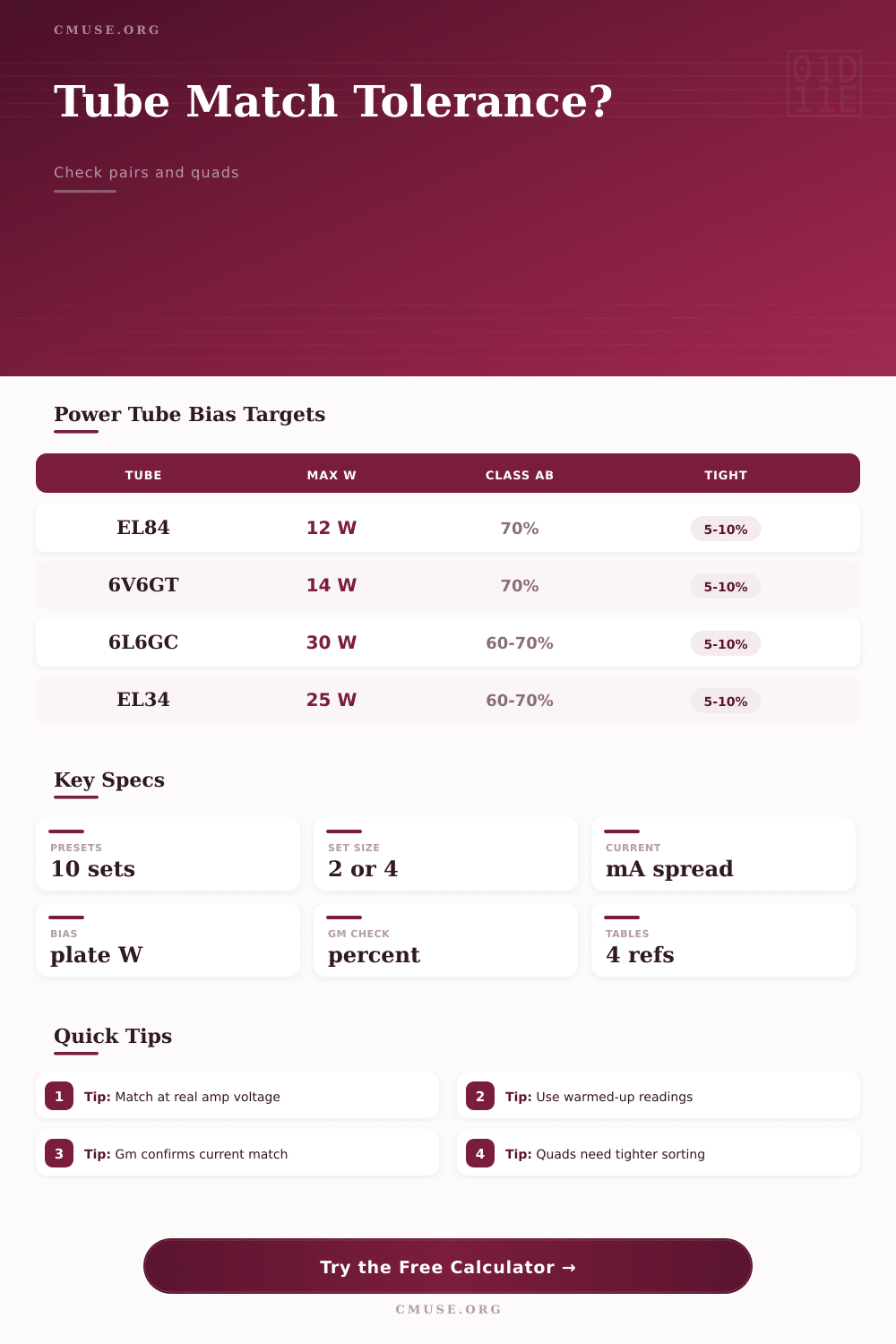
| EL84 / 6BQ5 | 12 W | 21.0 mA | 18.7 mA |
| 6V6GT | 14 W | 24.5 mA | 21.8 mA |
| 6L6GC | 30 W | 52.5 mA | 46.7 mA |
| EL34 / 6CA7 | 25 W | 43.8 mA | 38.9 mA |
| KT88 | 42 W | 73.5 mA | 65.3 mA |
| Tube | Typical role | Current match priority | Gm match note |
|---|---|---|---|
| EL84 | Small cathode-biased combos and quads | High in hot-running amps | Close gm helps keep chime balanced |
| 6V6GT | Lower-power American combos | High with one shared bias feed | Useful for smooth breakup balance |
| 6L6GC | Medium and large fixed-bias amps | High for quads | Check gm when current looks close |
| EL34 | British-style fixed-bias output stages | High under shared bias | Uneven gm can skew drive feel |
| KT88 / 6550 | High-power bass and hi-fi amplifiers | Very high due to large current | Gm spread matters for clean headroom |
| Method | What it measures | Strength | Watch for |
|---|---|---|---|
| Cathode current probe | Plate plus screen current | Fast in-amp comparison | Reads a little higher than plate-only current |
| Transformer shunt | Plate current | Direct fixed-bias reading | Requires careful high-voltage practice |
| Mutual conductance tester | Gm under tester conditions | Good for sorting tube strength | May not match real amp voltage |
| Curve tracer | Current across operating points | Best full behavior match | Needs matched test setup and warm-up |
When it comes to matching output tubes, that’s not simply looking for a pair of equal numbers on a screen. That’s making sure your amplifier is going to stay stable at high volume levels. How the valves functions together determines the clarity of a given chord. There isn’t any magic to this; it’s all about physics and current flow. While the calculator do the math for you, knowing what it’s telling you is where the value lies.
The most quickly testable measurement is idle current, which can be measured by simply placing a probe on the cathode lead of the tube. A large difference between two tubes indicates that the bias circuit has to compensates and work extra hard to bring them into balance. Unequal pushing manifests as even-order harmonics that cancel out and odd-order ones that survive. Usually this mean loss of headroom or a perceived harshness. Close tolerances in current keep things clean up to the point when you want them distorted.
How to Match Output Tubes
Gm = Transconductance, This is the number describing a tube’s gain potential. It describes how much plate current vary by the amount of grid voltage. A meter on the hot chassis cannot measure this but rather a special tester, as a result many ignore it. But two tubes might have the same idling current (say, forty milliamps), yet have dissimilar gm numbers. That means they’ll react differently to signals sent to their grids. One will go into clipping before the other and the sound will be muddy and uneven. To tell the difference between a good performing set and a set that simply looks matched, you check the gm.
The bias scheme tells you how close of a match you need for a particular amp based off the reference table. In a cathode-biased combo, the resistors provides a naturally adjustment for minor imbalances. Because the circuit will force it toward equilibrium, looser matching is fine. Fixed-bias amps are not so forgiving; they apply a precise amount of negative voltage to each grid and each tube should takes its share. One tube might overheat and another might starve if the tubes is not evenly matched in a fixed-bias amp wired with a single bias pot.
A quad introduces more complexities, since it’s tougher to get four matching tubes then two. For quads, the calculator looks at the maximum difference between any pair of tubes in a given set to determine its grade. So if A & B match exactly while C & D are very different, then the entire set will suffer. You’re constrained by the outlying tube. That’s why you’ll see quads sold for a premium at high-end shops. They reject so many pair until they find one whose four behave alike.
Always take your readings once the tubes are warm. The nature of cold tubes is different than the nature of hot tubes; their characteristics shifts as they warm up. If you measure too soon you’re just building false confidence into a match that’s going to fall apart later. Give the tubes time (a minimum of 15 minutes) to come to temperature and then pass judgment on their character. You should of waited longer if they’re still cold.
Consistency is key when it comes to matching. Instead of having individual components fighting to push harder, the power stage act as one unit. A proper match prolongs the life of tubes while retaining the original tone that the designer intended. While loose matches might appear to function initially, usually they bring unwanted hum, noise or failure. Think of the amp more like an instrument that sounds cohesive instead of a group gone wild. Use quality tube, test them correctly and use those numbers to achieve maximum performence.