Tube Plate Dissipation Calculator
Estimate idle plate watts, bias percentage, target current, screen heat, and rating margin from real amplifier voltage and current measurements.
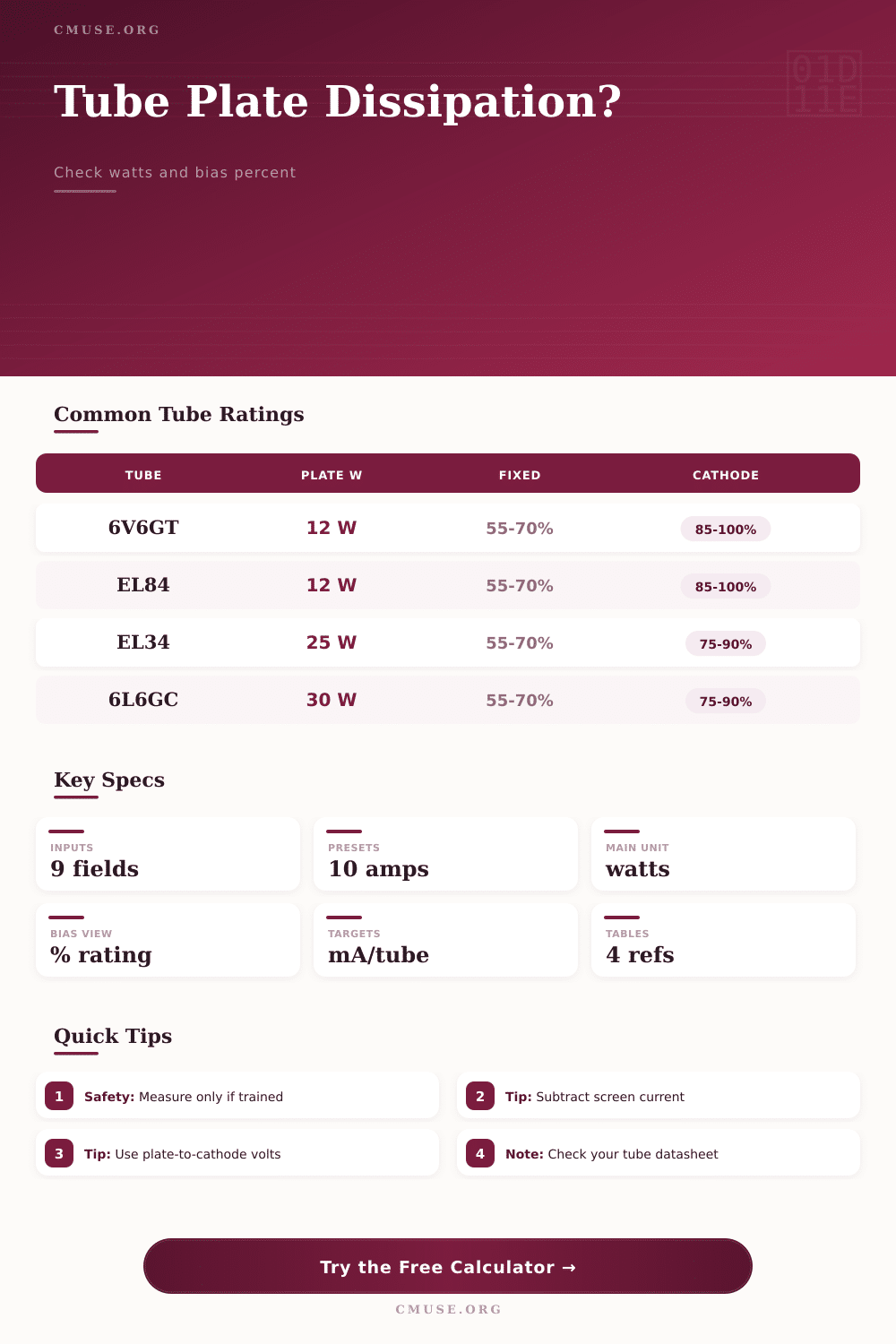
| Tube type | Common max plate dissipation | Typical screen max | Useful note |
|---|---|---|---|
| 6V6GT | 12 W | 2 W | Classic data-sheet value; some later 6V6 variants are rated higher. |
| 6V6GTA / robust 6V6 | 14 W | 2.2 W | Common modern and later-design rating; confirm the exact tube sheet. |
| EL84 / 6BQ5 | 12 W | 2 W | Small power pentode often run hot in cathode-biased guitar amps. |
| EL34 / 6CA7 | 25 W | 8 W | Large power pentode; 70% fixed-bias target is 17.5 W per tube. |
| 6L6GC | 30 W | 5 W | Beam power tube; 70% fixed-bias target is 21 W per tube. |
| 5881 / 6L6WGB | 23 W | 3.5 W | Use the lower rating instead of assuming 6L6GC capability. |
| KT66 | 25 W | 3.5 W | Often biased similarly to an EL34 by dissipation percentage. |
| KT88 | 42 W | 8 W | High-dissipation beam tetrode; check screen limit in ultralinear stages. |
| 6550A | 35 W | 6 W | Classic 6550 ratings are often 35 W; some newer sheets specify 42 W. |
| 7591A | 19 W | 3.2 W | Compact hi-fi output tube with high transconductance. |
| Bias target zone | Fixed-bias push-pull | Cathode-bias guitar amp | Reading meaning |
|---|---|---|---|
| Cool idle | 50% to 58% | 70% to 82% | Lower idle heat, often cleaner crossover margin must be checked by ear and scope. |
| Common target | 58% to 68% | 82% to 95% | Frequently used range for guitar output stages when voltages are stable. |
| Hot fixed bias | 68% to 75% | 95% to 100% | Less rating margin; watch red-plating, screen heat, and wall-voltage rise. |
| Above rating | Over 100% | Over 100% | At idle this exceeds the selected plate rating before signal is applied. |
| Measurement method | Current includes | Calculator correction | Formula used |
|---|---|---|---|
| Plate-current probe | Plate current only | No screen subtraction | Plate W = (plate V - cathode V) × plate mA / 1000 |
| Transformer shunt | Plate current only | No screen subtraction | Plate W = plate-to-cathode V × shunt mA / 1000 |
| 1 ohm cathode resistor | Plate plus screen current | Subtract entered screen mA | Plate mA = cathode mA - screen mA |
| Cathode-bias resistor | All tube cathode current | Subtract screen mA per tube | Total cathode mA = cathode V / resistor ohms × 1000 |
| Scenario | Tube set | Example volts and current | Approx idle result |
|---|---|---|---|
| Blackface Deluxe-style fixed bias | 2 × 6V6GT | 420 V, 20 mA plate | 8.4 W, 70% of 12 W |
| Tweed Deluxe-style cathode bias | 2 × 6V6GT | 350 V plate, 22 V cathode, 40 mA cathode | 11.9 W, 99% of 12 W |
| EL34 fixed-bias pair | 2 × EL34 | 460 V, 35 mA plate | 16.1 W, 64% of 25 W |
| 6L6GC fixed-bias pair | 2 × 6L6GC | 450 V, 36 mA plate | 16.2 W, 54% of 30 W |
| KT88 ultralinear pair | 2 × KT88 | 500 V, 55 mA plate | 27.5 W, 65% of 42 W |
| 6550A quartet bass amp | 4 × 6550A | 540 V, 42 mA plate | 22.7 W, 65% of 35 W |
If you’ve ever owned an amp, you know that the smell of burning output tubes is a warning signal you never want to ignore, generally, it’s a bad sign for any amplifier owner. Running your valves hot mean they are exceeding the temperature needed to work reliably, which means you have been running them hotter then the manufacturers designed.
Checking plate dissipation helps protect your investment in high-end gear. It is also about finding the best balance between headroom, tone, and long life for your playing style.
What Is Plate Dissipation?
For most guitar players, biasing is a dark art; we take our guesses based on hazy rules-of-thumb or go by our gut feeling of current levels. Enter the calculator up top, which runs the numbers for you: translating raw current/voltage readings into easily understood watts and percentages. No more guessing…just see if it sounds good for what you want to hear.
Now let’s talk about what plate dissipation actualy is. Basically, the “high voltage” DC sits on the plate before it gets converted into an audio signal by passing through output transformer. As those electrons impact the metal surface of the plate, it cause heating… A process called dissipation. The datasheets for each tube list a maximum rating which is typically in the range of 30 watts (a 6L6GC) or less (twelve watts for a 6V6GT). Running them higher than this on a regular basis will not only greatly reduce tube life, but also damage there internal structure.
The rub is largely knowing precisely what is being measured when you perform your bias check. For a cathode-bias amp, the readout of current is the sum of the current flowing onto the screen grid plus the current flowing onto the plate. If you do not factor in the screen current, then you’re inadvertently assuming more work is being done by the plates than is actualy happening. That’s the mistake folks make so frequently.
Fortunately, the tool take all those measurement details into account. After you choose your bias mode and input your voltages, it will take screen current into account (if applicable) and subtract it from the plate value. That’s important because a few milliamps can be the difference between being able to run at sixty percent of rated power versus pushing up towards seventy-five.
If you’re working with a fixed-bias amp, the plate current is measured directly and tends to be simpler to work with. With cathode-bias designs, though, there’s that little extra step involved in taking screen current into account, hence the importance of a trustworthy reference. In this case, the calculator does all the heavy lifting and presents you with numbers that represent actual plate stress, not total cathode flow.
One more note: Why are we biased toward being conservative? And what’s wrong with running tubes at max dissipation to wring every drop of juice from them? Nothing, I suppose. But it usually results in harsh distortion and little to no headroom before you’re into the clip zone.
For most guitar amps, a sweet spot for fixed bias runs around fifty five to seventy percent of rated maximum. That gives you some warmth while still offering some life expectancy in the tubes. They get that glowing saturation but don’t cook the elements too soon. However, cathode biased amps often run closer to the limit (as high as 90% and up) because the bias point shifts as signal levels change and tubes ages.
The chart on the page will help you see how close you are operating to the safe side of things for different kinds of tubes. There are other variables to consider as well, such as what I’ll call the hidden ones: screen dissipation. Although we think of the plate dissipating most of the heat, the screen too can radiate some amount of heat. That can be quite a bit, particularly for beam power and pentode tube. So if you have a lot of current and high screen voltage, not only might your tube be hot on the plate, but it may be overheating itself from both ends at once.
The calculator factors in the total load on the tube (the total heat) so that you get a better sense of thermal overload. This makes the point that when we talk about bias, we’re not talking about just a single number; we’re talking about a systems check of how your amplifier functions compared to all its parts in an idle state.
Also, there are differences in behavior between new tubes and older ones. Some old tubes were rated for only fifty-five percent dissipation, whereas some of the more robust moddern variants might be comfortabley at sixty-five or even seventy. You can dial up the max rating on the calculator to suit whichever tube you have. This is important because it gives you a better result. It won’t push you into some generic average number that may not reflect what’s really in your chassis. With this, you’ll be able to customize it to what’s actualy in your box.
The bottom line, however, is that when you know what numbers to expect from your gear, you’re in charge of how it sounds and how long it lasts. You will no longer ask yourself if your amp is on the verge; you will just know exactly where it stands. It doesn’t matter whether you’re restoring an old blackface style combo or designing a high-gain boutique head. The rules don’t change. Look up the voltages, make sure your currents are correct, and pay attention to those thermal limits.
The scent of a tube burning is a warning sign you never want to ignore. By keeping your heat under control, not only will your amps perform reliably, but also consistently deliver your sound while protecting your ears instead of exposing them to smoke each time you hit the switch.