Power Scaling Percent Calculator
Convert an amplifier power-scaling setting into actual watts, dB change, estimated listener SPL, RMS voltage/current, and perceived loudness compared with full power.
Power Scaling Results
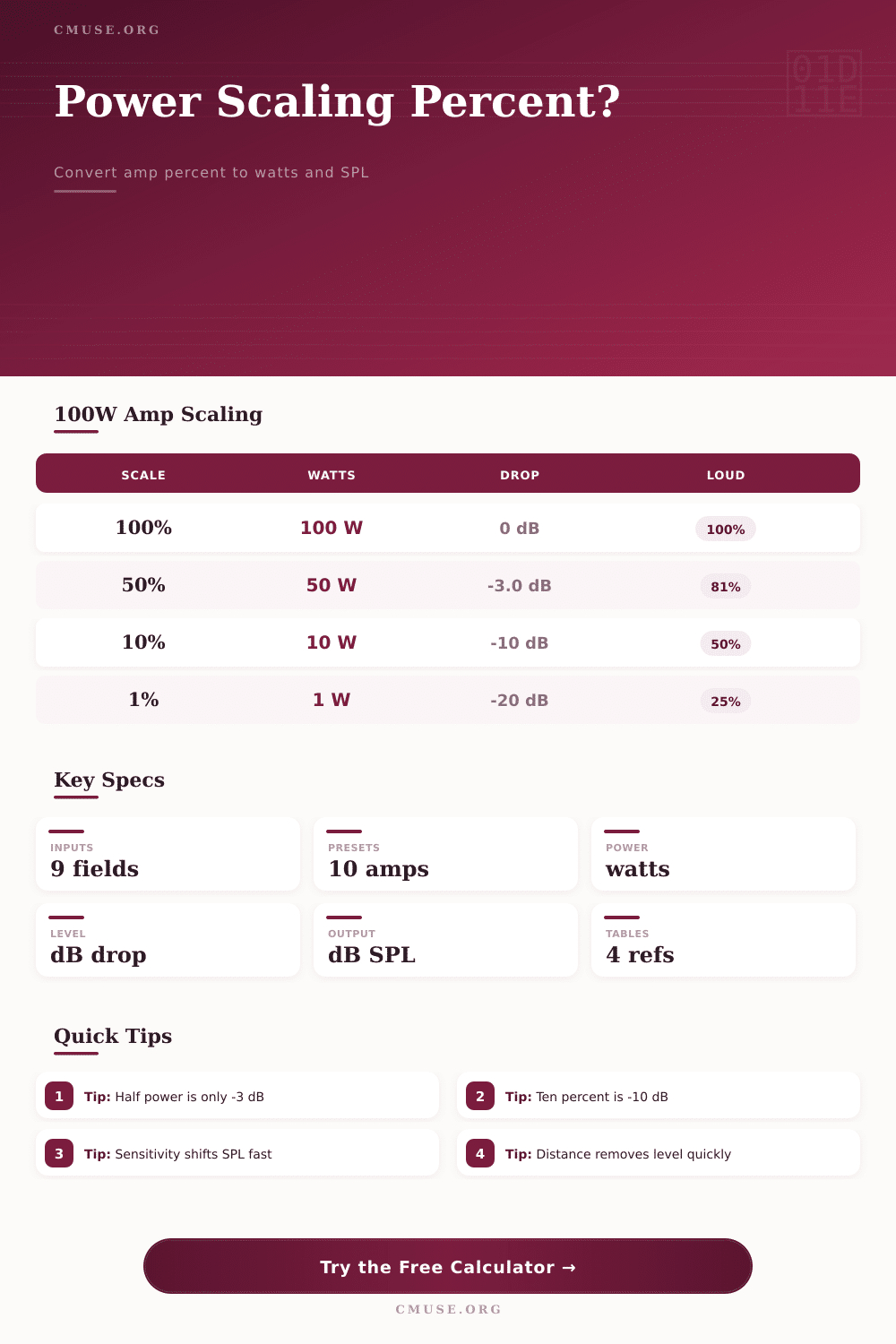
| Scaling Setting | Power Ratio | dB Change | Voltage Ratio | Perceived Loudness |
|---|---|---|---|---|
| 100% | 1.000 of full power | 0.00 dB | 100.0% | 100% reference |
| 75% | 0.750 of full power | -1.25 dB | 86.6% | About 92% as loud |
| 50% | 0.500 of full power | -3.01 dB | 70.7% | About 81% as loud |
| 25% | 0.250 of full power | -6.02 dB | 50.0% | About 66% as loud |
| 10% | 0.100 of full power | -10.00 dB | 31.6% | About 50% as loud |
| 5% | 0.050 of full power | -13.01 dB | 22.4% | About 41% as loud |
| 1% | 0.010 of full power | -20.00 dB | 10.0% | About 25% as loud |
| Full Amp Power | 50% Setting | 25% Setting | 10% Setting | 1% Setting |
|---|---|---|---|---|
| 5 W practice amp | 2.5 W | 1.25 W | 0.5 W | 0.05 W |
| 15 W combo | 7.5 W | 3.75 W | 1.5 W | 0.15 W |
| 30 W combo | 15 W | 7.5 W | 3 W | 0.3 W |
| 50 W head | 25 W | 12.5 W | 5 W | 0.5 W |
| 100 W stack | 50 W | 25 W | 10 W | 1 W |
| 200 W monitor amp | 100 W | 50 W | 20 W | 2 W |
| SPL Reference | Typical dB SPL | Power Change Needed | Notes For Amp Scaling |
|---|---|---|---|
| Quiet practice at the listener | 70 to 80 dB | Often less than 1 watt with efficient guitar speakers | Distance and speaker sensitivity dominate the result. |
| Long rehearsal reference | 85 dB | About -10 dB from 95 dB | Common benchmark for extended sound exposure caution. |
| Loud acoustic instrument | 90 to 95 dB | Needs 10 times power for each +10 dB | A scaled amp can still reach this with efficient cabinets. |
| Small club guitar level | 100 to 105 dB | +3 dB requires double power | Speaker compression may reduce real output. |
| Very loud stage level | 110 to 115 dB | +10 dB requires 10 times power | Hearing protection is strongly relevant at these levels. |
| Threshold of pain reference | 120 dB | 100 times power above 100 dB | Not a sensible sustained target. |
| dB Difference | Power Ratio | Voltage Ratio | Approx Perceived Loudness |
|---|---|---|---|
| -20 dB | 0.01x power | 0.10x voltage | About one quarter as loud |
| -10 dB | 0.10x power | 0.316x voltage | About half as loud |
| -6 dB | 0.25x power | 0.50x voltage | About two thirds as loud |
| -3 dB | 0.50x power | 0.707x voltage | Slightly quieter, not half as loud |
| +3 dB | 2x power | 1.414x voltage | Clearly louder |
| +10 dB | 10x power | 3.162x voltage | About twice as loud |
If you’re like most of us, you’ve probably heard someone say an amplifier sounds half as loud when turned down to half power. Most folks assume that watts is all that matter with audio equipment. Unfortunately, this is far from true. Instead, our perception of volume is something that happens on a logarithmic scale different than a straight line. That’s where the disconnect occur. This is why so many musician buy bigger amplifiers then they really need, as they follow the numbers instead of how much louder it actualy sounds in the room.
You don’t need to try and guess what volume reduction you’re creating when you scale back an amp’s power with this handy dandy calculator (above) that takes care of math for you. Simply input your rated power number along with your scaling percentage, and it translates these more abstract numbers to something real: volts, db. If you’re dropping an amp down to 50% of their rated power then you’re cutting about three db of output, which is all but imperceptible in a mix. You’ll think it’s maybe a bit quieter, but nowhere near as loud than half, because we require about ten decibels increase to register something as being twice as loud. If you want to create a ten db decrease, then you’d be cutting your power to just 10% of full out.
Why Your Amp Doesn’t Get Half As Loud At Half Power
For studio engineers or gigging musicians, speaker sensitivity is an important consideration. Using the exact same sized amplifier, which has been scaled down, if the first cabinet you plug into rates a hundred decibels per watt while the other is only rated at ninety-seven decibels, it will be noticeable louder. The tool takes all of these variables into account so you can adjust how much your speakers contribute to volume before distance affects the sound. In real world situations, this is significant as a fifty-watt amp with efficient cabs often out performs a hundred-watt amp with less efficient cabs.
The other factor that’s equally critical to all of these formulas is distance. As sound radiates outward it disperses its energy; therefore, the farther you are from source the weaker the sound becomes. For example, if you are standing three meters away, the SPL hitting your ears is substantialy lower than what leaves speaker cone. To account for this distance reduction, the calculator considers how far you sit from speakers; whether you’re on stage or sitting in the control room, giving you a reasonable idea of what you’ll be hearing. It also accounts for the walls surrounding the speaker. A speaker positioned in a corner will receive some sound reinforcement increasing the overall level and boosting the bass response. Without considering these conditions, you can make poor buying choices. You might assume greater power is required when it could simply been placed differently or use a different type of cabinet designed for the application.
The electrical backbone behind these sound results is voltage and current. In this case, if you reduce the power, the voltage reduces by a consistent proportion (RMS). Knowing this can help explain why some tubes stages/amps/pedals behaves differently with your amp at lower levels. It is not just about gain staging but also about how they drive output stage and transformer. The table on that page lays this out clearly and shows what the correlation is between voltage reduction at a given percentage, such as 10%. And it’s not just about volume but also tone.
Tube amplifiers often sound best when mildly saturated. This could of mean driving a lower wattage amp harder than the raw numbers suggest. There are common errors like neglecting speaker power compression itself. During sustained loud passages, high excursion driver lose efficiency as they heat up. This moderate to heavy compression loss can be factored in by the tool to give you a more realistic representation of what’s going on beyond the peak ability versus just the peak capability. It also saves you from being disappointed when you buy something that appears to be killer on paper but fails in reality.
At its core, power scaling is all about nuance and control over brute force. If you know that a 10% volume setting sounds like half as loud, you can accurately tune your volumes while maintaining clean sound. This avoids the need to turn the master up until it distorts. It moves away from “how much” does this amp make towards “what does it do with what it makes”. And if you know where the power’s going, you don’t really need any more.
A lot of times the distinction between a good tone and a great tone depends on this sort of knowledge-based power management. Once you understand how your perception of loudness relates to decibels and watts, you no longer need headroom because you are no longer chasing a number. Instead, you’re sculpting sound. That change in mindset is far greater than anything your amp can provide through additional wattage.