Cable Capacitance Rolloff Calculator
Estimate total cable capacitance, pickup resonance, RC cutoff, and high-frequency loss for passive guitar, bass, and instrument cable chains.
Calculated Cable Rolloff
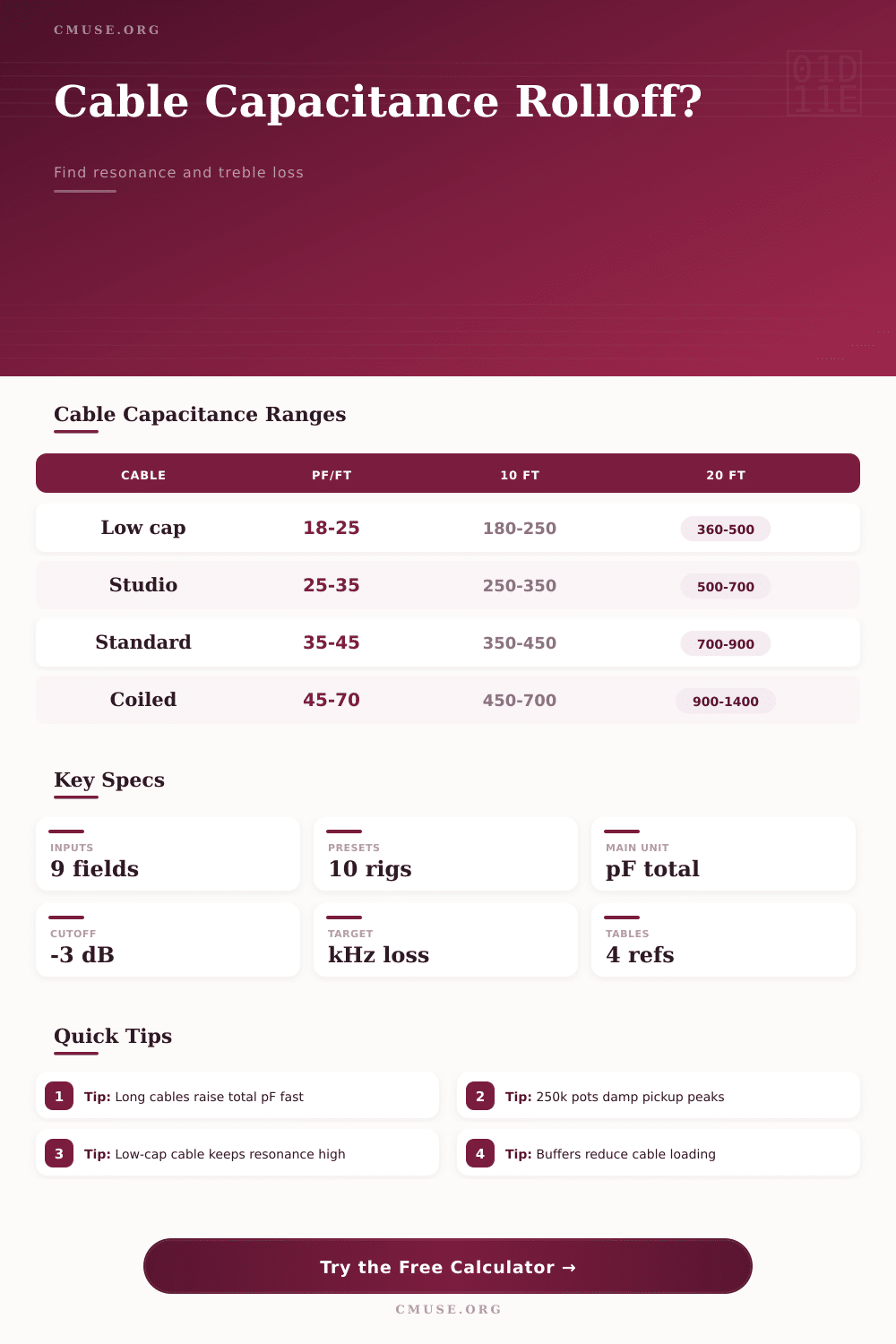
| Cable Class | Typical pF/ft | Typical pF/m | 20 ft Total |
|---|---|---|---|
| Very low-cap instrument cable | 18 to 25 | 59 to 82 | 360 to 500 pF |
| Studio-grade instrument cable | 25 to 35 | 82 to 115 | 500 to 700 pF |
| Standard stage instrument cable | 35 to 45 | 115 to 148 | 700 to 900 pF |
| Vintage-style coiled cable | 45 to 70 | 148 to 230 | 900 to 1400 pF |
| Pickup / Output | Source Estimate | Inductance Range | Usual Pot Load |
|---|---|---|---|
| Vintage-style single-coil | 5.5 to 7.5 kΩ | 2.0 to 3.0 H | 250 kΩ |
| Hot single-coil or P-90 | 7.5 to 10 kΩ | 3.0 to 5.0 H | 250 to 500 kΩ |
| Passive humbucker | 8 to 14 kΩ | 4.0 to 6.5 H | 500 kΩ |
| Buffered or active output | 0.1 to 2 kΩ | Not cable-driven | 25 kΩ or higher |
| Scenario | Cable Path | Capacitance | Likely Rolloff Character |
|---|---|---|---|
| Home recording single-coil | 10 ft low-cap | 260 to 330 pF | High resonance, crisp attack |
| Stage guitar into amp | 18 to 25 ft standard | 700 to 1100 pF | Lower peak, smoother edge |
| Passive bass long run | 20 to 30 ft standard | 800 to 1350 pF | Noticeable upper-mid softening |
| Buffered pedalboard output | 30 ft after buffer | 900 to 1200 pF | Small loss from low source Z |
| Frequency Band | What It Affects | Cable Sensitivity | Useful Check |
|---|---|---|---|
| 2 kHz | Presence and note edge | Usually mild | Compare darker pickups |
| 4 kHz | Pick click and clarity | Often audible | Check stage cable length |
| 6 kHz | Sparkle and string noise | Very sensitive | Check coiled cables |
| 8 kHz | Air above guitar fundamentals | Strongly sensitive | Check buffer benefit |
Sometimes while playing onstage, your guitar just seem to dissapear in a mud puddle of sound and it’s not due to your fingers, the room, or even the amp. What’s missing is your own guitar! And it’s not magic. It’s physics. Your passive pickups create a high-impedance signal that doesn’t like heavy load. As you add more feet of cable, you’re also adding capacitance. Capacitance is a low-pass filter. It take away high frequencies which give you attack and clarity.
Realizing what causes this loss of tone shifts your perspective on building your rig. It alters your choice of pickups, cable length, and even where pedals goes on your pedalboard. We provide a calculator on top off the article that does it for you. Simply enter your volume pot load and cable specs and you’ll find out how those pF per foot ratings translate into lost treble.
Why Your Guitar Sounds Muddy
Volume pot load and input capacitance are two aspects many player don’t consider. They think longer cable = darker. But that’s an over simplification. What really happens is resonance. A passive pickup forms a resonant peak based off its inductance and total circuit capacitance. Too much cable added pushes that peak down in frequency. It shifts from a crisp sparkle to a honky midrange bump, air becomes mud. Where that resonance occurs is the thing.
And we have a tool here on the page that takes into account pickup inductance, source impedance, and total capacitance from jack to pedal inputs and then cables. Capacitance values vary. While you might think that shorter low capacitance cable sounds brighter than longer, it’s the cumulative pF that counts. Custom low-cap wires will show capacitance two or three times what a standard stage wire do at 20 feet or longer (see the reference table).
Higher-output single-coil pickups tend to be less inductive and handle increased capacitance better. They don’t go dead so fast. Humbuckers tend to be higher-inductance and have lower outputs, too. Their tone will degrade faster with added cable length. Other variables include value of the volume pot: a stock 500k pot will load the tone circuit more heavily than a 250k, leaving the resonant peak higher and sharper. Adding a capacitor in parallel damps this down, and makes a warmer, less bright sound.
This problem becomes clear when you’re running long stages. A buffered active pickup may be OK on an eighteen-foot standard cable. A vintage style passive neck pickup? It may gobble up all your top end. The calculator provides a visual of treble loss at certain frequencies. In this case, it illustrates loss at 5 kHz. That’s in the range of where string definition and pick attack is heard. If there’s substantial dB loss here, then that’s telling you your cable chain is too much for that combination of pickups.
Fixing it won’t necessarily be solved by spending more money on a better cable. It would of been solved either by shortening overall length or by putting a buffer closer to the source so as not to load down the passive pickup. Properly located buffers are not tone suckers. Why? Because they give you a high impedance input from the guitar. This maintain the resonant peak. And they output a low-impedance signal into the long cables which eliminates any additional coloration.
Now, putting a buffer after a bunch of capacitance has built up won’t reverse that. By then the signal has already been filtered. Think about it like this: If your tap water was really dirty, wouldn’t you rather have a way to get clean water into your tank? Yeah, me too. So keep those first few feet from the guitar to the amp or pedalboard short and with low capacitance.
It’s all compromise with your gear. You get freedom with stage length. You get tone with studio clarity. And the math doesn’t lie. But you know what it does? It lets you stop guessing about why something sounds dull. Learn the science of capacitance. It shows how it dampens high end and shifts resonant frequency. Then you can make educated decisions on signal chain order, pot values, and even cable specs.
That lost sparkle isn’t gone forever. It is just behind a few feet of copper wire. Trim the fat and it’s back.