Pickup Height Gap Calculator
Estimate bass and treble string clearance, output balance, and magnetic warble risk for guitar and bass pickups using your string set, magnet type, pickup position, and fret reference.
Pickup Gap Results Low risk
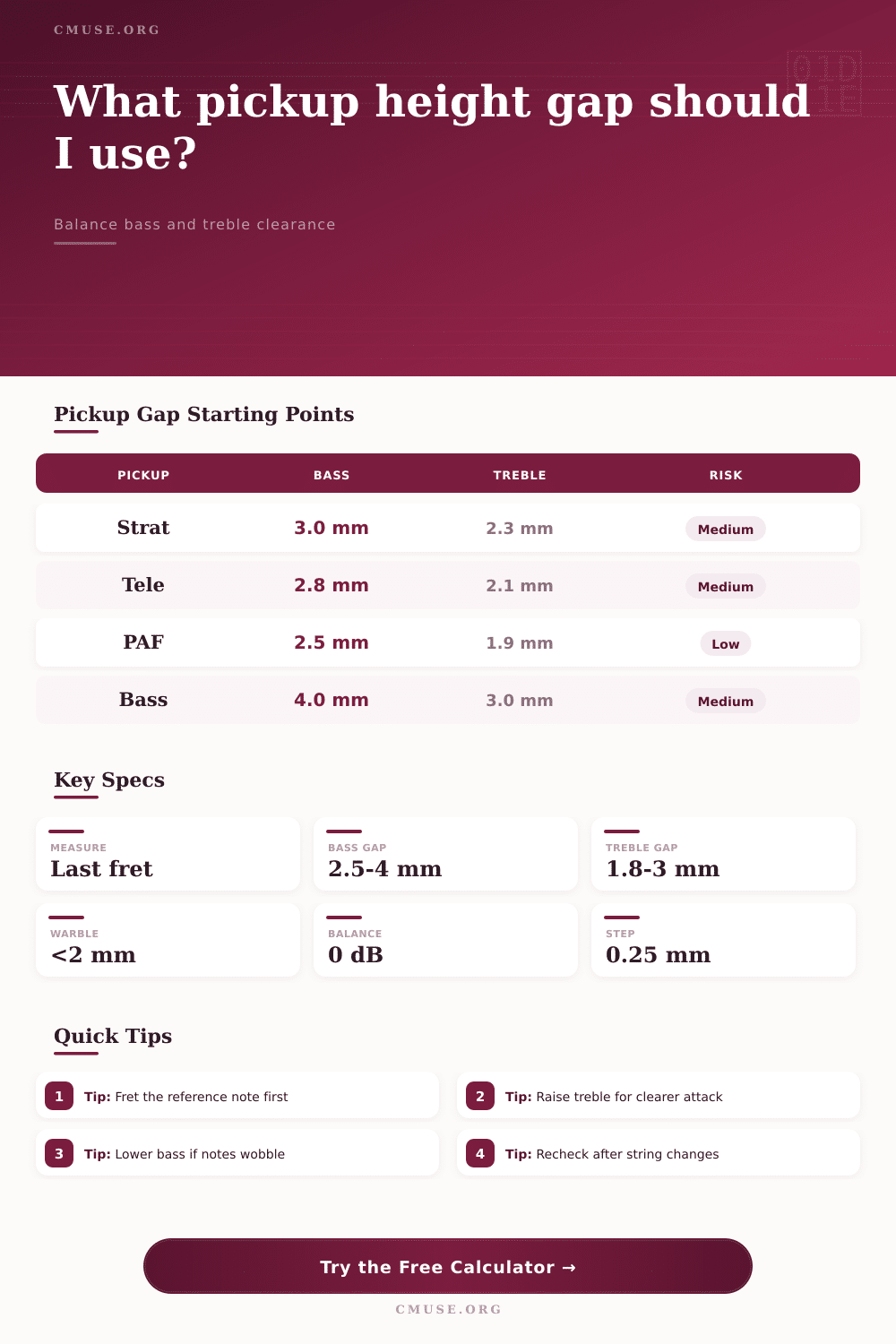
| Pickup family | Neck gap bass / treble | Bridge gap bass / treble | Typical balance use |
|---|---|---|---|
| Strat single coil, Alnico V | 3.2 mm / 2.4 mm | 2.7 mm / 2.0 mm | Lower bass side to control magnetic pull. |
| Tele bridge single coil | 3.0 mm / 2.2 mm | 2.8 mm / 2.1 mm | Closer treble edge keeps bite without heavy low-end bloom. |
| PAF-style humbucker | 2.6 mm / 1.9 mm | 2.2 mm / 1.6 mm | Often tolerates closer height because pole magnets pull less. |
| P-90 soapbar | 3.0 mm / 2.2 mm | 2.5 mm / 1.9 mm | Moderate height preserves midrange punch and note shape. |
| Jazz Bass single coil | 4.2 mm / 3.2 mm | 3.6 mm / 2.8 mm | Wider gap leaves room for larger string travel. |
| Precision Bass split coil | 4.0 mm / 3.0 mm | 3.8 mm / 2.8 mm | Set each half so E-A and D-G speak evenly. |
| Factor | Clearance change | Output effect | Warble note |
|---|---|---|---|
| Alnico II or III magnet | 0.2-0.3 mm closer | Softer transient, lower pull | Usually low risk unless strings are extremely close. |
| Alnico V rod magnet | Reference baseline | Balanced output and attack | Watch neck pickups under bass strings. |
| Ceramic or neodymium magnet | 0.4-0.8 mm farther | Higher voltage and firmer attack | Risk rises quickly below 2.5 mm on guitar bass strings. |
| Stainless roundwound strings | 0.1-0.2 mm farther | Brighter, more upper harmonic energy | Extra treble output may need a wider treble gap. |
| Flatwound strings | 0.1-0.2 mm closer | Smoother top, denser fundamental | Less clank, but bass excursion still matters. |
| Scenario | Pickup and magnet | Reference gap | Best first adjustment |
|---|---|---|---|
| Vintage Strat neck | Single coil, Alnico V rods | 3.4 / 2.5 mm at last fret | Lower bass side before raising treble. |
| Tele bridge bite | Bridge single coil, Alnico V | 2.8 / 2.1 mm at last fret | Keep treble close enough for snap. |
| PAF neck warm | Humbucker, Alnico II | 2.7 / 2.0 mm at last fret | Use pole screws for final string-to-string trim. |
| Active bridge tight | Active ceramic bar | 2.2 / 1.7 mm at last fret | Listen for compression before moving closer. |
| Jazz Bass bridge | Bass single coil, Alnico V | 3.8 / 2.9 mm at last fret | Set while playing normal stage attack. |
| Risk score | What it means | Likely symptom | Height response |
|---|---|---|---|
| 0-35 | Stable magnetic window | Clear sustain and normal pitch decay | Fine tune for balance and feel. |
| 36-64 | Moderate pull or output mismatch | Notes may bloom unevenly on the bass side | Lower the stronger side by 0.25-0.5 mm. |
| 65-79 | Close to magnetic interference | Chorus-like wobble or shortened sustain | Lower bass side first, then compare treble. |
| 80-100 | High magnetic pull risk | Pitch warble, false overtones, unstable intonation | Increase clearance before judging tone. |
How many hours have you spent looking for just the right tone instead of thinking about the geometry between your pickup(s) and strings? This is one of the most important mechanical controls on your instrument. The final sound is based off how far away the steel string is to the magnet. If it is too close, the pitch will be unstable but the volume will increase. Too far apart and clarity and sustain will decrease.
You don’t need to memorize specs; what you need is an understanding of the magnetic physics involved in a practical manner. If you know how you play, what kind of magnet you have and the make up of your strings, you input those into the calculator above and it does all the math for you. Does a ceramic magnet sound too strong for your existing setup? Are your heavy gauge strings asking for extra clearance? How do you know without guesswork? It calculates the possible warble risk and estimated output balance.
Why Pickup Height Matters for Your Sound
Why does this matter? The vibration of strings and their pull against a magnetic field interact in complicated ways. If the magnetic field is stronger than the air gap between the string and magnet, then it will dampen the string’s vibration. The string bends out of tune as the note fades which kills the sustain. That wobbly chorus effect is likely due to your instrument fighting itself.
The inputs help you trust the outputs For instance, picking your magnet type will have a huge impact on the recommended clearance. A neodymium magnet is very strong and needs to be kept further away from any metal parts in order to avoid being overwhelmed by its own magnetism. Alnico II magnets is softer and allow for a closer gap, whereas ceramic magnets are much stronger and require more distance. Ceramic or neodymium magnets produce higher output but requires more distance to prevent that magnetic choking effect.
Without accounting for this variable, it’s easy to use old wisdom from back when pickup output was lower and base your gaps on something that won’t apply to your setup today. That’s why the calculator takes care of this for you automatically, making sure your suggested treble and bass gaps considers the strength of your hardware’s pull.
Bass strings aren’t like trebles: different mass and different vibration amplitude. Bass strings move physically further when they’re vibrating. Thin strings don’t. They can get away with a narrow gap between them and still sound cleanly articulated. Thick strings on the other hand swing back and forth big time. They want a little space to breathe, and if you put too much pressure against the pole pieces or pickup cover then you’ll hit them.
That’s why we rarely talk about balanced being equal distance on each side. It is actualy compensation for the physical nature of the string. Look at the reference table on the page. Most Stratocasters and Telecasters has a bigger gap on the bass side than the treble side. You’re not doing it to make the number lines look even. You’re adjusting for the physical nature of the string itself.
The right pickup height depends on how hard you play, too. Light players who use a light touch can get away with running the pickups up higher. There isn’t as much displacement of the string so they never approach the high-field zones. Players who slap or otherwise aggressively play the instrument have much greater string displacement. That means when you really dig in, the strings come very near the magnets. What sounded great sitting down with fingerpicking might be sloppy and mushy with a pick.
The calculator takes that into account, too. Your attack style is part of the warble risk score. By the time you make the change, it warns you about the results.
The height of the pickups takes some trial and error. There’s no “set and forget”. Take the starting points from above as your guideline. Then pick up your guitar and listen to see if the high strings are clear and the low strings has punch. Do they need a little more defined? Loosen the bottom side a little. Is there too much attack or are the highs too weak? Raise the treble side a notch. Little changes here. In the world of pickups, a millimetre change is huge. At half a millimeter you’ll be able to detect most changes.
Now things get complicated by string changes. Heavier gauge strings offers more resistance for the magnets and need their own adjustments compared to lighter ones. Stainless vs. Nickel changes the interaction between string and field too. Whenever you change strings it’s a good idea to check again. Consistency is key to keeping your desired tone over time.
Don’t sacrifice stability for volume. You’re not going to hear anyone using a loud, but warbly-sounding pickup in a band mix. Sustain and clarity are what’s wanted in the mix with this kind of sound. So allow the tool to lead you to the stable place to start from and let your ear be the final judge. The numbers will get you there. Your playing will tell you if it is right or wrong. It’s that balance of intuition and calculation where good tone realy lives.