Pre Bend Release Pitch Calculator
Calculate the hidden pre-bent pitch, released target, cent accuracy, and string feel context from a starting fret, note, gauge, scale length, and bend interval.
The calculator converts the starting fret to concert pitch, adds the pre-bend cents, subtracts the release amount, then compares that release with the intended target.
Pre-Bend Release Results
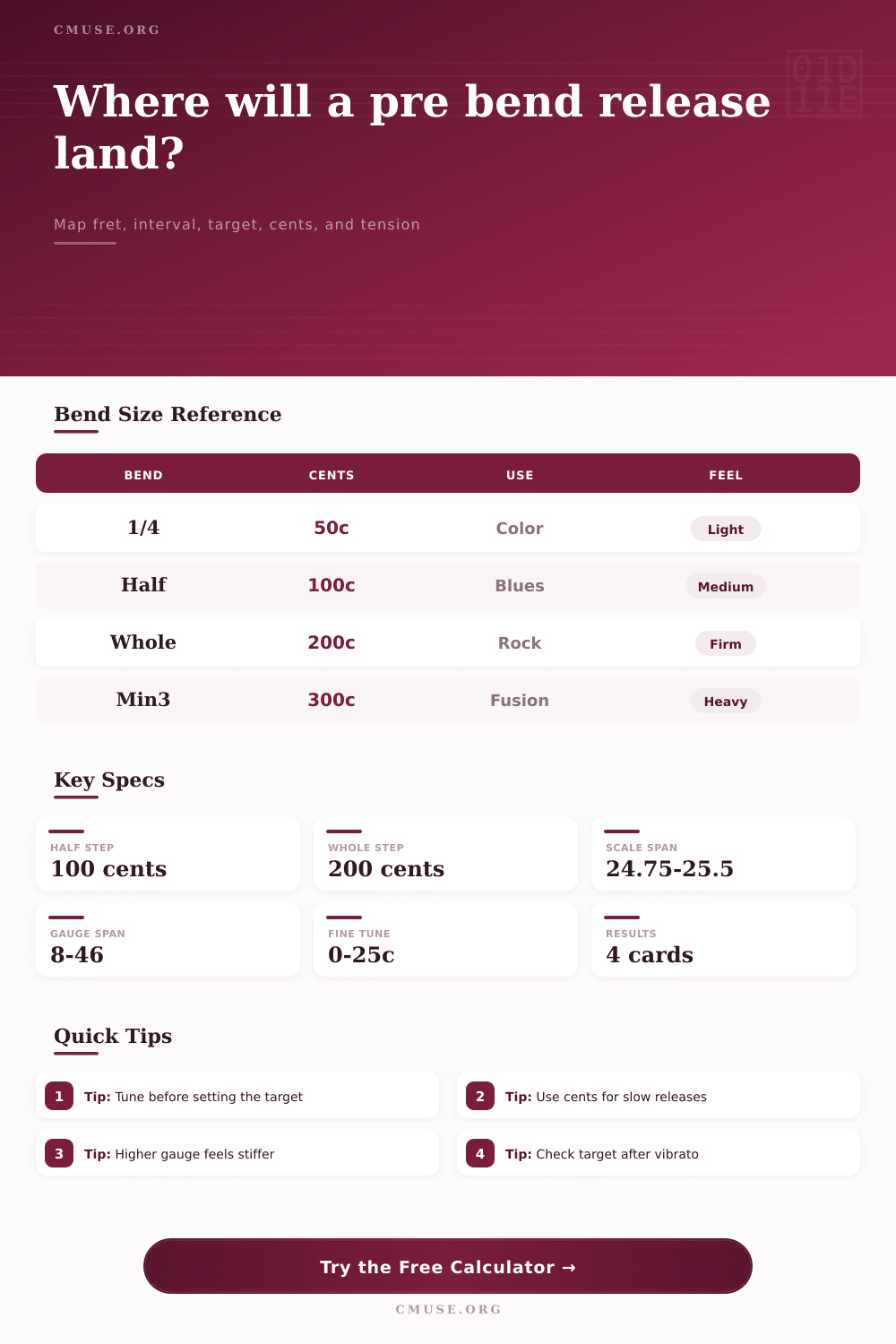
| Interval | Cents | Frets Heard | Common Release Use |
|---|---|---|---|
| Quarter step | 50 cents | Half of 1 fret | Blue note shading and vocal inflection |
| Half step | 100 cents | 1 fret | Country dips, chromatic returns, quick sighs |
| Whole step | 200 cents | 2 frets | Most rock and blues pre-bend releases |
| Minor third | 300 cents | 3 frets | Wide expressive releases on lighter strings |
| String Example | Typical Gauge | Open Tension Range | Pre-Bend Release Feel |
|---|---|---|---|
| High E on light set | .009 in / 0.23 mm | 12 to 14 lb | Easy to overshoot; small cents offsets matter |
| B string on regular set | .011 in / 0.28 mm | 10 to 13 lb | Balanced for whole-step release control |
| Plain G on blues set | .017 in / 0.43 mm | 15 to 18 lb | Stiffer, clearer target, wider hand motion |
| Wound D or baritone string | .026 to .046 in | 17 to 30 lb | Use smaller release intervals and slower travel |
| Result | Cents Reading | What It Means | Practice Adjustment |
|---|---|---|---|
| Dead center | 0 to 5 cents | The release lands inside a tight tuner window | Keep the same hand endpoint and listen for decay |
| Slightly sharp | 6 to 15 cents high | The string is not released far enough | Relax the fingertip earlier or lower the wrist |
| Slightly flat | 6 to 15 cents low | The release drops past the desired target | Hold more bend height or slow the release tail |
| Wide miss | Over 15 cents | The pre-bend setup and release endpoint differ | Recheck the fret anchor, interval, and string tension |
| Scenario | String / Fret | Bend / Release | Why It Is Useful |
|---|---|---|---|
| Classic B string whole step | B3 / fret 15 | 200c / 200c | Hears the high target before resolving to the fretted note |
| Country half step dip | G3 / fret 7 | 100c / 100c | Checks small release travel against chord tones |
| Unison bend release | B3 / fret 12 | 200c / 200c | Compares the released note with a fixed nearby string |
| Baritone heavy string | D2 / fret 10 | 100c / 100c | Keeps low-string releases from sounding sluggish |
First, you need a good idea in your head about what will happen before you pluck the string to get started. Your target is not to strike a lower note then glide up to the right one but rather just create a tone that slides gently onto desired note. That’s where the pre-bend comes in. Physically controlling it require more than musical intuition, especially if you move from a set of strings to another type like baritones or thinner string.
Once you input the details about your instrument, the calculator do the work of figuring out the frequency and the number of cents required. No guesswork needed. Did you go slightly sharp because of an incorrect release? Was it your ear or your hand? The calculator takes the guesswork out of it.
How to Bend Strings Perfectly
This is where one of the primary challenge comes in, string resistance varies from string-to-string. For example, a half-step bend on your high E string feels like it should of take the same amount of effort as a half step on the D string, yet our brains tend to treat them equally throughout the neck. That’s why a lot of folks end up sounding flat on heavy sets and accurately on lighter ones.
Before even approaching the string, you need to consider its resistance. The trick is knowing how much resistance exists beforehand, which is something you can’t easily do with raw intuition alone. The tool help you input your exact string gauge and scale length so it can give you some context the way muscle memory do not.
Rather than thinking of the release as simply letting go, think of it as a controlled decay. When you pre-bend, you are storing potential energy in the string windings. Releasing it smoothly require a different motor skill than bending up without pre-bending. Rushing the action at the beginning or hesitating towards the end results in an uneven phrasing.
On the page I have set some preset scenarios that help visualise the arc by establishing common target areas such as the classic B-string whole step or the subtle country half-step dip. These are not random examples but rather a way of providing reference points for comparison with how you play. Once you get the 200-cent release working accurately on the B string then you’ve established a benchmark for accuracy.
From here you can adjust for physical resistance and transfer it to other strings. So it’s not just hit/miss: there are no hard edges when bending. That means you’re either close enough that your ear hears the pitch as steady or not. Fifteen cents begins to become noticeably out of tune, while five cents can be hard to detect amidst a crowded mix.
That said, table on the page breaks down some reference points so we know precisely what those cents equate to (e.g., half step, minor third). Once you understand this measurement, you’ll know when you’re getting close and will no longer be trying to match a feeling; instead, you will be aiming for a specific frequency. Now, a tight release doesn’t seem like an opinion anymore; it becomes a distance in cents from a lazy one.
String tension is the silent variable that ruins most practice sessions. We tend to think we’re playing just fine if it’s easy because then we feel like we’re working less hard. In fact, we’re probably compensating for a lack of resistance. When we put on heavier gauge strings, we find out real quick what our shortcomings was because there is nothing to hide behind anymore.
The tension context function in the calculator really brings that home as it shows not only your resulting pitch but also how much weight was on the open string. Suddenly that 200-cent bend doesn’t seem quite the same when you’re pulling against twenty-five pounds of tension as opposed to ten pounds. And knowing that matter.
No longer are you forcing the bend to happen. Instead you begin to learn to facilitate it using wrist rotation instead of finger pull to keep the bend under your control. Ideally, these mechanisms will fade. If successful, all the hearer notices is the melodic line sinking into its place; none of the struggle that accompanies it ever reaches the surface.
This is where the calculator becomes a way to measure how reliable your technique is under various conditions. It is not merely a cheat sheet but a diagnostic tool. It connects the intention to perform something with what emerges from the amplifier.
From there, the digits melt into insignificance because you know how finger placement on a string interacts with mass of the string and the desired pitch. What you’re left with is a sharper ear, more dexterous hands and the courage to stretch towards any note you desire.