Vibrato Rate Calculator
Measure vibrato from counted oscillations, seconds, BPM sync, direct Hz, target style, instrument or voice mode, and pitch depth.
🎼Style Presets
🎚Vibrato Inputs
📊Current Spec Grid
🎧Mode Rate Reference
| Mode | Usual Rate | Common Depth | Use Case |
|---|---|---|---|
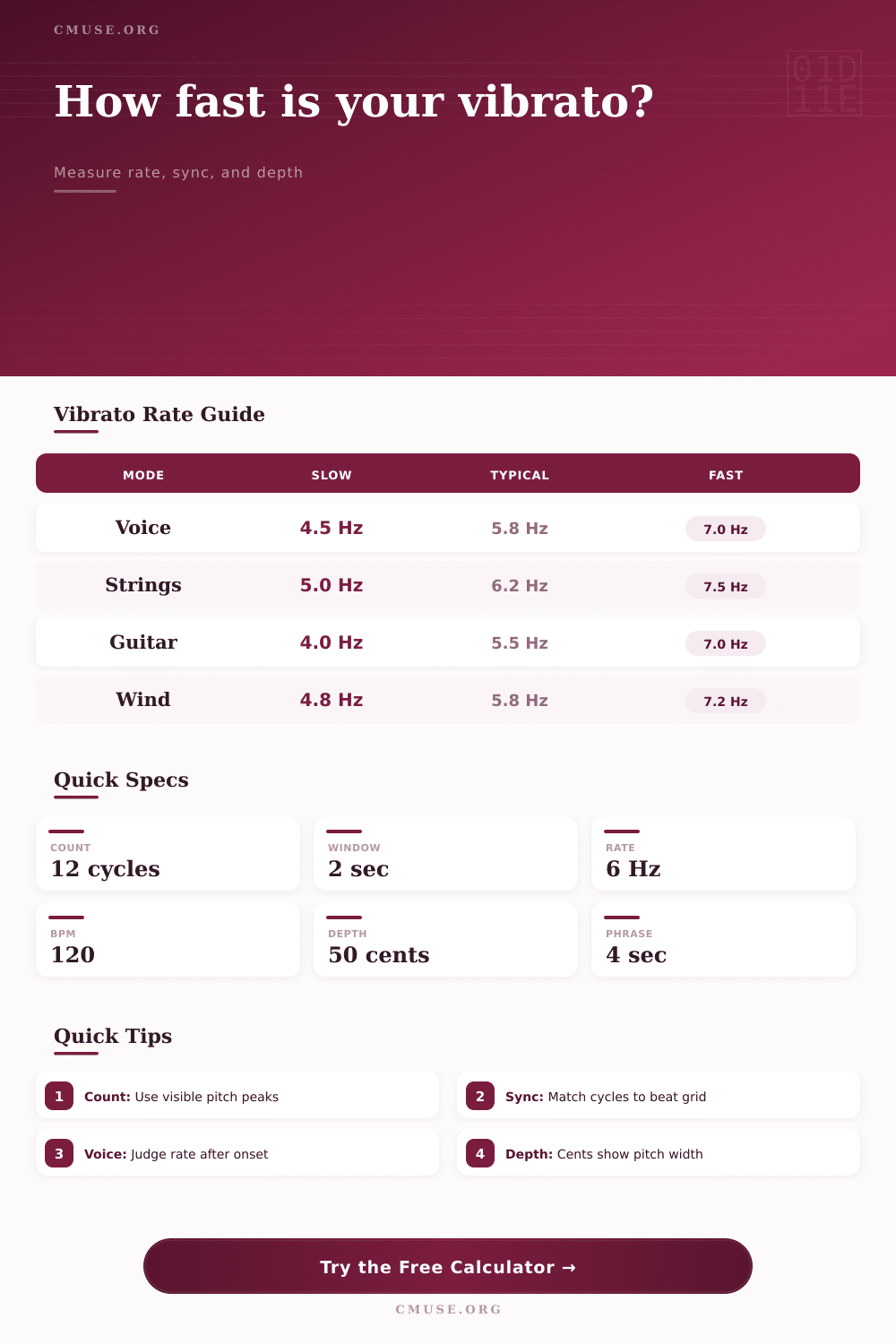
| Voice | 4.5–7.0 Hz | 30–100 cents | Sustained vowels, bel canto, pop tone |
| Violin, Viola, Cello, Bass | 5.0–7.5 Hz | 20–80 cents | Finger vibrato, wrist vibrato, lyrical lines |
| Guitar or Bass | 4.0–7.0 Hz | 40–140 cents | Bent-note vibrato, whammy vibrato, fretless lines |
| Woodwind or Brass | 4.8–7.2 Hz | 15–60 cents | Breath, embouchure, or jaw vibrato |
| Synth LFO | 0.5–12.0 Hz | 5–200 cents | Tempo-locked pitch modulation and sound design |
⏱BPM Sync Reference
| Tempo | Quarter Cycles | Eighth Cycles | Eighth Triplet |
|---|---|---|---|
| 60 BPM | 1.00 Hz | 2.00 Hz | 3.00 Hz |
| 90 BPM | 1.50 Hz | 3.00 Hz | 4.50 Hz |
| 120 BPM | 2.00 Hz | 4.00 Hz | 6.00 Hz |
| 150 BPM | 2.50 Hz | 5.00 Hz | 7.50 Hz |
| 180 BPM | 3.00 Hz | 6.00 Hz | 9.00 Hz |
🎹Style Preset Targets
| Style | Target Rate | Typical Depth | Best Match |
|---|---|---|---|
| Subtle straight-tone edge | 3.0–4.5 Hz | 10–30 cents | Choir blend, early note onset, gentle flute tone |
| Classical centered | 5.5–6.8 Hz | 25–65 cents | Violin, cello, trained voice, lyrical wind tone |
| Operatic sustained | 5.0–6.5 Hz | 50–110 cents | Long vowels and fully supported notes |
| Blues or guitar bend | 4.5–6.5 Hz | 70–160 cents | Electric guitar, slide, expressive fretless pitch |
| Fast expressive | 6.8–8.5 Hz | 25–90 cents | Excited string passages and rock lead peaks |
📝Measurement Examples
| Scenario | Counted Oscillations | Time Window | Calculated Rate |
|---|---|---|---|
| Slow choir blend | 8 cycles | 2.5 sec | 3.20 Hz |
| Jazz vocal phrase | 10 cycles | 2.1 sec | 4.76 Hz |
| Classical violin note | 18 cycles | 3.0 sec | 6.00 Hz |
| Rock guitar sustain | 21 cycles | 3.0 sec | 7.00 Hz |
| Synth LFO at 120 BPM triplets | 18 cycles | 3.0 sec | 6.00 Hz |
Wait for the note to develop while holding it in tune. Then there is point of stability, when the pitch solidifies and starts to vary. Too slow and the note will sound static; too fast and you’ll have a shaky tone. These is the kind of mechanical facts that make for an amateur or professional-sounding performer.
When you input what you hear into the calculator above, it do the maths. No need to guess at conversions and numbers, just find out a specific place from which to improve.
How to Fix Your Vibrato
In rehearsal most players only work on the where of their pitch. They tune until needle sits in the middle, let go and there they are. Vibrato isn’t half the equation this way; it’s also about how far and how fast. How wide does your pitch move off center? How quickly does it swing around the center point? These two things describes speed and width.
Both measurable by ear yet never felt often sufficient for correcting poor habits. The brain is occupied with supporting breath or placing fingers. Asking yourself to measure these will bring problem to light and correct it.
Why do these inputs matter? They translate physical experience into something you can monitor to see how it changes over time. Counting the number of oscillations in a given window isolates the rate as separate from any other element in your phrase. The rhythm may be tricky and melody complex, but none of that matters. How many complete cycles did you observe in those two seconds? Twelve? Then you’ve got six hertz of vibrato. It is right in the middle of typical range of most trained voices and classical strings.
Did you get eight cycles? Chances are that you’re dragging a bit. Fine for a slow blend in a choir perhaps, but on a quick solo line it’ll be lethargic. Depth is another factor here, as rate alone isn’t the complete picture. It is possible for the rate to be perfect (six hertz) but the pitch excursion so minimal it hardly even moves. This results in a flat, thin tone that only shimmers slightly. On the other hand, it may be the same rate but much bigger pitch changes which produce a broader dramatic sound that can swamp a delicately composed passage.
As shown in table of references on the page, there are preferred combinations for each mode. Violinists tend towards narrower depths than guitarists do, as attack and string tensions needs greater pitch change to make their way into the mix. While flautists may go narrower still to retain pure tones, an electric guitarist looking for a heavy rock sound will extend rate and depth further upwards.
When playing as ensemble, you don’t need to be rigid about synchronising your vibrato to the pulse, but being aware of it helps you decide how to play for stylistic reasons. Even when playing in time with band or recording on a click (at 120 BPM say), getting your pitch changes aligned to the grid will contribute to a coherent sound texture. It makes each player’s expressiveness part of the rhythmic texture. It doesn’t mean you have to be rigid, but knowing where naturaly your vibrato lies in relation to the beat gives you a choice about speeding up or slowing down if it sounds right for the style. Less obvious than pitch errors, this synchronization is what defines the professional sheen on a track.
It’s important to understand that there is no need to beat yourself up if you don’t hit one number on the head. That’s not what these are for. They’re not mathematical; they’re musical. Emotion and intent speak more to people then spreadsheets do, which is why musicality will always trump math. What these things do do, though, is eliminate the guesswork in your self-assessment.
Instead of wondering if you’re holding back too much or perhaps going a little too wide at times, you’ll know exactly where you land compared to the style you seek to copy. From there, you’ll be able to experiment confidentely, rather than in frustration. After all, this isn’t about taking away the spontaneity of the music by making each note a calculation. This is about providing your instinctive side with a map, something to show where it can wander off to when it feels like expressing itself fully. And you determine exactly how fast it beats and how wide the tone opens, free of any blind spots that hold you back. You should of seen how much it helps.