Palm Mute Duration Calculator
Calculate how long your muted notes actually ring by combining muted beats, tempo, riff length, note value, release timing, and section repetitions.
Palm mute timing result
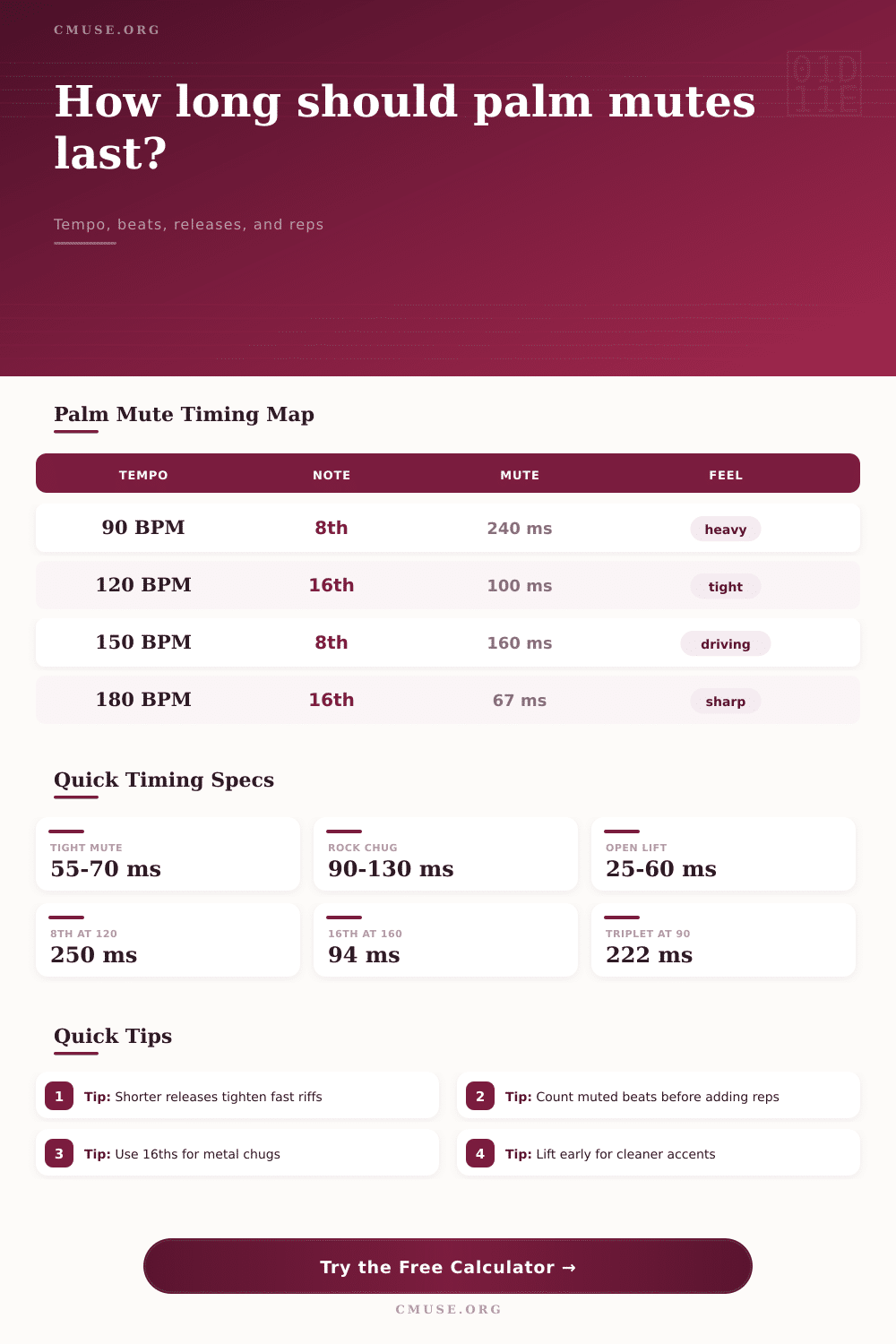
The grid gives practical timing zones for picked guitar palm mutes. The live result above uses your tempo, subdivision, muted-beat count, release timing, and repetitions.
| Tempo | Quarter | Eighth | Sixteenth | Triplet eighth |
|---|---|---|---|---|
| 80 BPM | 750 ms | 375 ms | 188 ms | 250 ms |
| 100 BPM | 600 ms | 300 ms | 150 ms | 200 ms |
| 120 BPM | 500 ms | 250 ms | 125 ms | 167 ms |
| 150 BPM | 400 ms | 200 ms | 100 ms | 133 ms |
| 180 BPM | 333 ms | 167 ms | 83 ms | 111 ms |
| Riff feel | Common note value | Contact range | Release range | Timing goal |
|---|---|---|---|---|
| Classic rock chug | Eighth notes | 60-75% | 30-70 ms | Weight without blur |
| Modern metal run | Sixteenth notes | 55-70% | 10-35 ms | Fast attack clarity |
| Gallop pattern | Triplet or 16th feel | 58-72% | 20-45 ms | Pulse separation |
| Funk ghost mute | Sixteenth notes | 35-55% | 35-90 ms | Percussive lift |
| Breakdown stabs | Quarter or eighth | 75-90% | 0-25 ms | Hard cutoff mass |
| Release setting | Milliseconds | Best for | Audible effect | Calculator cue |
|---|---|---|---|---|
| Hard stop | 0-15 ms | Stabs and stops | Dry cutoff | High mute density |
| Tight lift | 16-35 ms | Fast metal riffs | Clear separation | Good at 16ths |
| Normal lift | 36-70 ms | Rock eighths | Short open tail | Balanced chug |
| Loose lift | 71-120 ms | Groove riffs | More sustain | Lower density |
| Open accent | 120 ms or more | Lifted phrases | Obvious release | Watch overlap |
| Section use | Typical bars | Common reps | Muted beat count | Timing focus |
|---|---|---|---|---|
| One-bar tag | 1 bar | 2-4 reps | 2-4 beats | Accent placement |
| Verse riff | 2-4 bars | 2-8 reps | 6-14 beats | Consistency |
| Chorus push | 4-8 bars | 1-4 reps | 8-20 beats | Lifted contrast |
| Bridge build | 4 bars | 2-4 reps | 10-16 beats | Rising density |
| Breakdown | 2-4 bars | 2-6 reps | 4-12 beats | Stops and space |
In professional mixes, you’ll commonly listen for palm mutes that sound tight and percussive. Trying to do the same thing with your own gear tend to sound loose and muddy. Typically, the cause isn’t a problem with tone settings but one of hand timing. Many musicians view palm muting as an on-off switch thing. It’s really about duration.
How long does the string ring out until you stop it again? Unless you know exactly how much time each mute takes in the bar, you’ll find yourself drifting out of time. Enter your tempo and subdivision into the calculator above and let it crunch the numbers. No more need for guesswork regarding where the mud has crept in.
Use Timing for Better Palm Muting
Let’s begin with the tempo. A quarter note at eighty beats per minute equals seven hundred fifty milliseconds. That is a long time for a guitar string to ring out if you’re not paying attention. Now let’s crank it up to one hundred and eighty beats per minute. Our quarter note now reduces to three hundred thirty-three milliseconds. In other words, there’s less physical distance between your pick, yet the ear demands equal levels of definition.
Tempo is important here but so is note value. Imagine yourself playing a fast passage where every note is a sixteenth. Each individual attack has roughly eighty-three milliseconds to set down before next note strikes. There is no margin for error. A release time that feels comfortabley at a slow groove will turn your fast riff into a blur.
By breaking down each subdivision into milliseconds, the tool lets you see exactly when you can release the note after muting it. The other input variable that makes all the difference is contact percentage. At seventy-two percent, your palm remains pressed on the string for nearly three-quarters of the note duration, then lifts off for the open tail. That produces that signature chugging texture.
The silence between the hit determines the rhythm. Reduce that contact and the notes will begin ringing out. How that sounds depends on your intent, rich or sloppy? The reference tables provided with the tool break this down nicely. Shorter releases (often below thirty-five milliseconds) work best for tight metal riff. Funk patterns live in the gray area of the ghost notes. In those types of music, a longer release doesn’t produce a sustained chord but rather a percussive snap. Knowing this helps avoid treating a breakdown style as a groove requiring some air.
Then there’s repetition. Something that may seem do-able playing through only once turns into an exercise in rhythm exposure if you repeat it six times. Any slight mis-match in rhythm now stands out because it has had time to build on itself throughout the bars. A mute that lingers just a fraction longer than intended will now accumulate enough sustain to muddy the mix over the course of several bars.
To maintain consistency in both your music and your energy, know how much time you’re going to be muting for whole passage. The calculator provides a grand total for your repeated section. This not only allows you to plan your musical phrasing but also your physical stamina. How many attack does this equate to? What is the overall density like? Does it have a high density, meaning you must pick very loosely to keep pace? Or is it a low density with space to move deliberately?
This is a small detail that makes a big difference. We don’t all pick with equal accuracy mechanically speaking. Some of us may have a heavy finger which tends to lengthen the mute period. Others may have a more staccato pick that chops the end off immediately. This slider compensates for how you play. It closes the gap between what we think the note is supposed to sound like based off theory versus what it actualy sounds like physically.
For example, you might see where your number says you need to be tight but your natural picking creates an additional 8% to the mute. That extra time can be the difference between a riff that locks in with the drums and one that feels rushed. At the end of the day, millisecond decisions builds tight riffs on guitars.
At speed, you cannot feel every mute using only your ears. Having data to help you learn provides you with a target to aim towards. When you hear the numbers, then your brain can concentrate on executing rather than calculating. Return to the first sound we discussed, the knife cutting sound. Not magic? No. It is just accurate timing, measured and mastered.