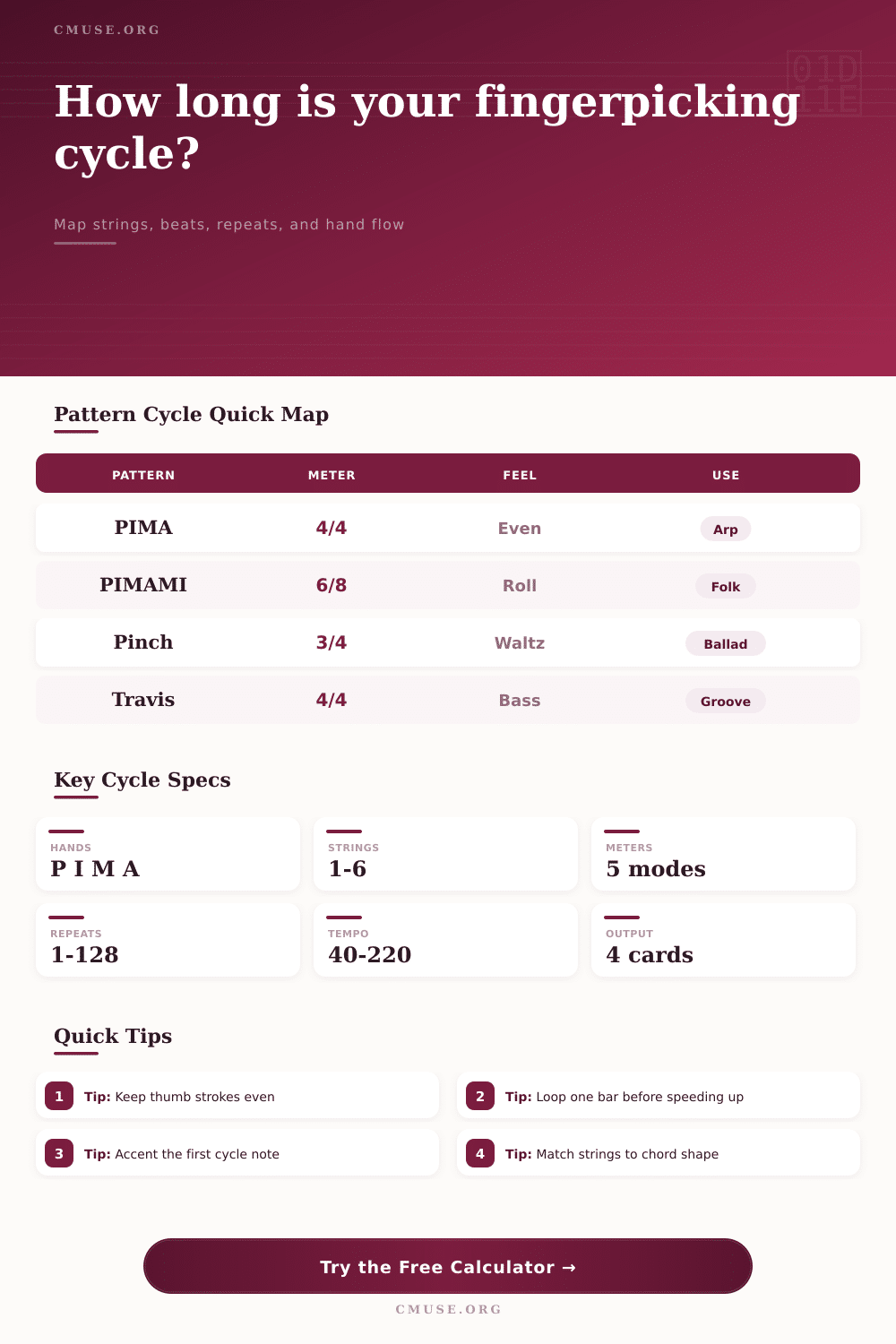
Fingerpicking Pattern Cycle Calculator
Map thumb and finger order, string sequence, meter, tempo, repeats, and hand alternation in one practice loop.
🎵Real fingerpicking cycle presets
🖐Pattern inputs
📊Current pattern spec grid
The spec grid updates after each calculation so the visible reference matches the active pattern.
🎼Fingerpicking stroke roles
| Symbol | Finger | Typical strings | Cycle job |
|---|---|---|---|
| P or T | Thumb | 6, 5, 4 | Bass pulse, alternating bass, root movement |
| I | Index | 4, 3, 2 | Inner voice, offbeat reply, crossing link |
| M | Middle | 3, 2, 1 | Treble roll, melodic support, even subdivision |
| A | Ring | 2, 1 | Top note, chord color, tremolo preparation |
⏱Meter and subdivision reference
| Meter | Beats per bar | Strong counts | Useful cycle length |
|---|---|---|---|
| 4/4 | 4 | 1 and 3 | 4 or 8 eighth notes |
| 3/4 | 3 | 1 | 3, 6, or 12 picked notes |
| 6/8 | 6 eighths | 1 and 4 | 6 picked notes |
| 12/8 | 12 eighths | 1, 4, 7, 10 | 12 picked notes |
| 5/4 | 5 | 1 plus grouped accent | 5, 10, or 20 picked notes |
🔁Common cycle patterns
| Pattern type | Hand order | String idea | Best meter fit |
|---|---|---|---|
| Travis-style bass | P I P M P I P M | 6-3-4-2-5-3-4-2 | 4/4 eighth-note groove |
| Classical roll | P I M A M I | 5-3-2-1-2-3 | 6/8 or triplet 4/4 |
| Waltz arpeggio | P I M P I M | 5-3-2-4-3-1 | 3/4 eighth-note flow |
| Tremolo preparation | P A M I | 5-1-1-1 | 4/4 sixteenth-note cell |
📝Practice block guide
| Block size | Repeats | Tempo range | Check before advancing |
|---|---|---|---|
| Single-cycle loop | 4 to 8 | 40 to 70 bpm | No missed string changes |
| One-bar lock | 8 to 16 | 60 to 90 bpm | Accent lands on the same beat |
| Phrase loop | 16 to 32 | 80 to 120 bpm | Thumb stays even under fingers |
| Endurance pass | 32 to 64 | 90 to 140 bpm | Same tone on first and last repeat |
Basically, it converts what you intend to play into real measures of string movement and beat span. So there is no second guessing if something might work in a four-four bar or conflict with the time signature. You state the desired finger pattern (e.g., a typical P-I-M-A one) and the strings to be used. Then calculator determines the number of beats your pattern occupies. And it tells you exactly how long eight repeats will take at any speed you choose.
This is where many performers err; they think a pattern appears straightforward on sheet music but do not understand that it extends over bar lines in unexpected directions until attempting to play it. Understanding meter is arguably more important than memorizing the notes themselves. Even if you play an arpeggio on guitar that uses the same set of fingers, it feels like something different when you’re playing in three-four (waltz) compared to four-four (Travis picking).
How the Calculator Helps You Play Better
The calculator lets you change settings for subdivisions. These show where the pulse falls against the eight-note pattern, the sixteenth note, or the triplet. When you try and impose a triplet feel onto a straight-eighth structure, you’ll find the music stumble unless you adjust your inner clock. By looking at the number of beats per cycle, you can see any syncopation problems arising before they become a habit. It’s all about maintaining consistency in the given grid; not speed.
Finally, the physical aspect of crossing strings is an added layer of complexity not always accounted for in pure notation. For example, while your index finger play the second string, your thumb must move from the sixth string to the third at the right time and place. Hand balance is another area where this tool can help with a rapid check of which set of fingers dominates the pattern, the treble fingers or the thumb. Both factors will affects both tone control and endurance. Too much thumb action may create a rock-solid bass line but a weak-sounding melody. Too much finger activity without a solid thumb anchor tends toward a muddy mixture, where no voice jump out at you.
Beginner: Go slower in practice than you imagine possible. The majority of folks rush it into tempo before they have made the mechanical connection from their hand to strings. Avoid marathon practices. Set reasonable expectations for how much time you spend. Use loop times to help. Go for short sessions that allow you to work toward gradual increases.
Thumb strokes should of be even and consistent regardless of the finger action above it. It’s that even pulse that will establish everything else. Make sure you can execute the pattern cleanly at a slow pace without accenting any unintended beats or missing any string changes. Once you feel confident, slowly add some speed.
Fingerpicking is about creating independence among limbs that naturaly want to move together. And it’s how the calculator becomes a map to the journey. Before you even begin to play, it identifies where the challenges lie. The calculator handles the heavy lifting. Listening carefully with repetition builds muscle memory along the way. Let your ear be your guide, trust the math to get you started and find your way back.