Piano Finger Stretch Calculator
Estimate interval reach, finger-pair comfort, and repertoire fit from your measured hand span and keyboard geometry.
🎼Repertoire Presets
🖐Stretch Inputs
⚙Live Spec Grid
📏Interval Reach Table
| Interval | White-Key Gaps | Standard Reach | Common Use |
|---|---|---|---|
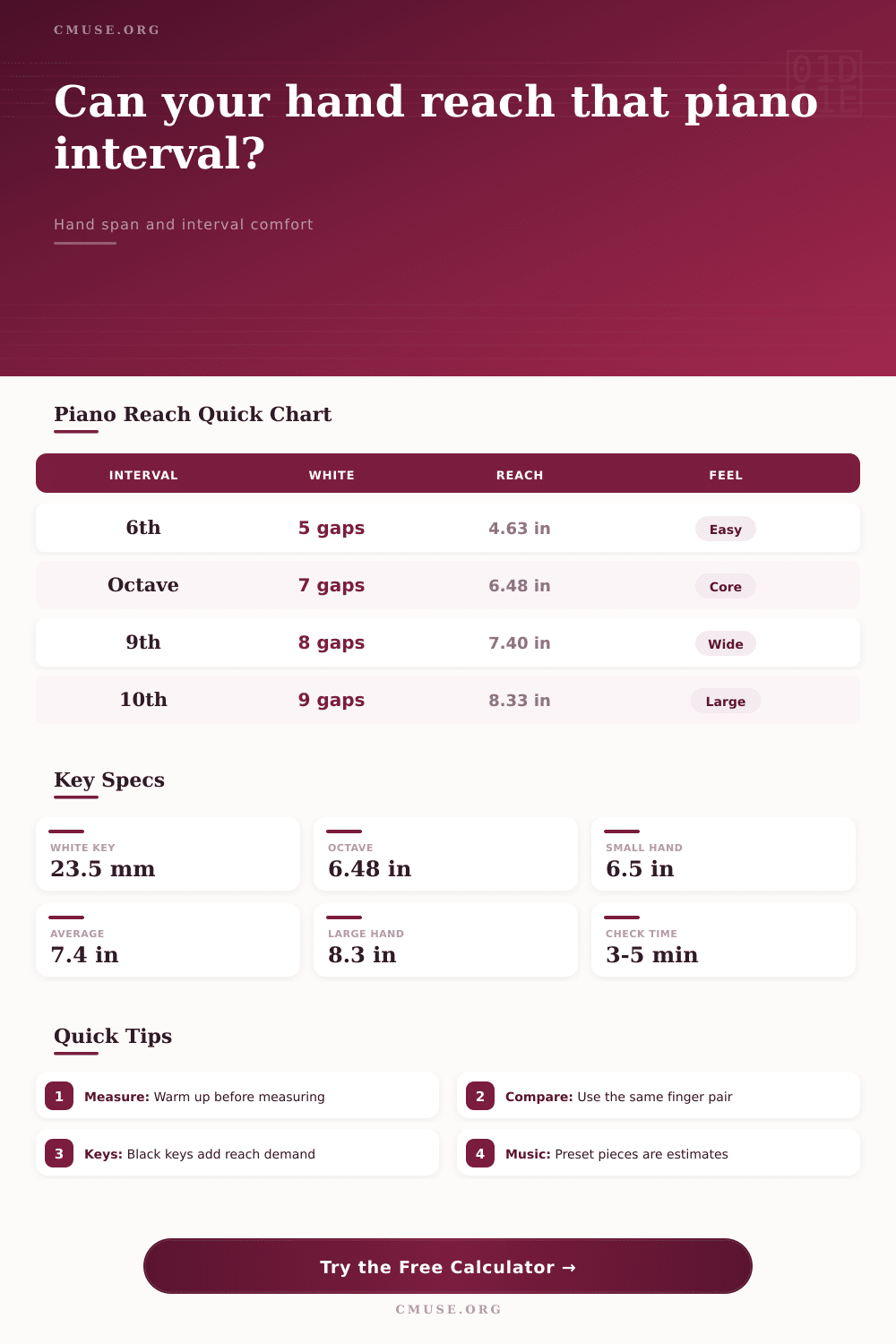
| Major 6th | 5 | 117.5 mm / 4.63 in | broken chords, inner voices |
| Major 7th | 6 | 141.0 mm / 5.55 in | romantic voicing, stride preparation |
| Octave | 7 | 164.5 mm / 6.48 in | core piano reach, octaves, bass lines |
| 9th | 8 | 188.0 mm / 7.40 in | Debussy, Chopin, jazz color tones |
| 10th | 9 | 211.5 mm / 8.33 in | Rachmaninoff, Liszt, wide arpeggios |
| 11th | 10 | 235.0 mm / 9.25 in | large-hand writing, redistributed chords |
🖐Finger Pair Reference
| Finger Pair | Usable Span Factor | Typical Role | Comfort Note |
|---|---|---|---|
| 1-5 | 100% | octaves, 9ths, tenths | best maximum span reference |
| 1-4 | 93% | legato octave substitution | often steadier than forcing fifth finger |
| 1-3 | 85% | rolled chords, inner melody | useful but less open than 1-5 |
| 1-2 | 72% | seconds, thirds, compact voicing | poor choice for big outer intervals |
| 2-5 | 82% | right-hand top voicing | works if wrist remains free |
| 2-4 | 64% | middle notes in chords | avoid treating as a maximum span pair |
| 3-5 | 62% | upper dyads, repeated thirds | high tension if stretched too far |
🎹Keyboard Geometry Table
| Keyboard Detail | Typical Value | Calculator Effect | Why It Matters |
|---|---|---|---|
| White key width | 23.5 mm | base distance per gap | wider keys make every interval larger |
| Standard octave | 164.5 mm | 7 white-key gaps | sets the reference for most span checks |
| White-black reach | +4 mm | small added demand | black keys sit higher and farther back |
| Black-black reach | +8 mm | largest color penalty | both outer notes may require deeper contact |
| Narrow keyboard | 21-22 mm | reduced distance | can make tenths feel closer to 9ths |
📚Preset Scenario Table
| Preset | Interval | Likely Finger Pair | Stretch Demand |
|---|---|---|---|
| Bach Prelude in C | 6th | 1-5 or 1-4 | moderate hand opening |
| Beethoven Moonlight | Octave | 1-5 | steady repeated reach |
| Chopin Nocturne Op. 9 No. 2 | 9th | 1-5 | lyrical wide color |
| Debussy Arabesque No. 1 | 9th | 1-5 | flowing broken figure |
| Rachmaninoff Prelude Op. 3 No. 2 | 10th | 1-5 | large chord spacing |
| Liszt Un Sospiro | 10th | 1-5 | fast arpeggiated reach |
💡Stretch Reading Tips
Let’s begin with a straightforward test: You stretch your hand from thumb to pinky on a flat surface and measure distance. How long is it? That distance, you might think, is a fixed fact about yourself. Not quite. There’s another side to the equation, the piano keyboard, and its shape doesn’t necessarily align precisely with human anatomy.
That’s what causes so many learner to look enviously (or apprehensively) at a piece of Debussy or Rachmaninoff, wishing desperately they could fit into the music they adore. Chances are high, however, that it’s not simply a matter of size. Rather, it has far more to do with how well you can navigate space between notes while tempo changes, tensions rise and fall, and colors play across the keyboard beneath your fingers.
Hand Size Is Not Just About Distance
It’s not a fixed thing called Hand Span. It varies according to whether your hands is cold or warm. It depends on whether you reach out slowly and carefuly isolating each finger or leap through a fast broken chord. What feels like a comfortable span in slow exercises can suddenly become uncomfortably tight as you click the metronome a little higher.
The calculator above do all this math for you after you enter your measured hand length and interval you want to play. It takes into account all those factors and adjusts your raw hand size against the demands of the music. You’re not simply trying to measure distance here, you are measuring how much comfort you have left under pressure.
Few novices understands that their choice of finger pair makes a difference. You get most reach by using the thumb to fifth finger combination. However, this pair also presents the greatest mechanical challenge. It requires you to relax your shoulders and rotate your wrist significantly. Other times it can feel more solid to use the second to fifth fingers (or occasionally the first to fourth) which has less stretch tension between them and offer better strength in finger independence.
This is where the table on the page come into play, as it outlines which combinations cut down on your usable span percentage. In practical terms, however, the lesson is that sometimes you need to sacrifice some reach to make sure your finger movements are more secure. You might sacrifice an inch of distance to gain an ounce of stability. That ounce is the reason that, after years of practicing, your playing remains safe.
Every stretch is assisted or hindered by the geometry of the keyboard too. The white keys is bigger than the spaces between them. And the black keys are further back towards the edge of the fallboard. To get from a white note to a black one means you need to make a subtly different wrist angle and add a couple of millimetres of distance as your reaching farther back into the keyboard. You might find that a ninth on white keys is doable but when it’s two black keys it sounds like jumping over a canyon. Not that this is in your head. Nope. It’s physics. The hand has to go further back (reducing thumb leverage) and up higher (stretches the tendons harder).
What happens when you view repertoire presets? Well, you’re viewing estimates based off average piano dimensions and hand size. The idea of a sixth or ninth from Bach or Chopin gives you a benchmark, but what about your own margin for error? Does it depend on speed and dynamic requirements of a passage? The faster the repetition of notes, the greater the need for reserve. There is no space to let go before the next note. The louder the chords, the stronger the requirement for a stable hand frame.
The closer to zero the margin displayed by the calculator, the less leeway you’ll have for error. Slowly work on those phrases strengthening yourself rather than forcing them at speed, only when your joints protest against further action. Pain is a sign to stop and reconsider.
In conclusion then, no; there are no hard and fast rules, nor are pianists required to use brute strength for playing. Instead, it’s all about learning the most effective route across the keyboard. Hands are tools, not measuring devices. When treated patiently, they will conform to the instrument itself. Know your measure and respect your current flexibility. Remember also, that stretching comfortabley now becomes confident performance later. The space between the notes doesn’t change; how you bridge it with comfort certainly will.