Mode Rotation Calculator
Rotate any seven-note parent scale into a named mode, then spell the modal tonic, interval pattern, and playable note output.
🎹Real Mode Rotation Presets
🎼Rotation Inputs
Mode Rotation Result
📊Mode Rotation Spec Grid
🎶Selected Parent Mode Names
| Rotation | Mode Name | Tonic Offset | Core Color |
|---|---|---|---|
| 1 | Ionian | 0 semitones | Major tonic |
| 2 | Dorian | 2 semitones | Minor with natural 6 |
| 3 | Phrygian | 4 semitones | Minor with flat 2 |
| 4 | Lydian | 5 semitones | Major with sharp 4 |
| 5 | Mixolydian | 7 semitones | Major with flat 7 |
| 6 | Aeolian | 9 semitones | Natural minor |
| 7 | Locrian | 11 semitones | Diminished tonic |
📐Parent Scale Interval Formulas
| Parent Scale | Semitone Formula | Step Pattern | Common Use |
|---|---|---|---|
| Major | 0 2 4 5 7 9 11 | W W H W W W H | Diatonic modes |
| Natural Minor | 0 2 3 5 7 8 10 | W H W W H W W | Relative minor modes |
| Melodic Minor | 0 2 3 5 7 9 11 | W H W W W W H | Jazz minor colors |
| Harmonic Minor | 0 2 3 5 7 8 11 | W H W W H A2 H | Dominant flat 9 color |
| Harmonic Major | 0 2 4 5 7 8 11 | W W H W H A2 H | Major with flat 6 colors |
| Double Harmonic Major | 0 1 4 5 7 8 11 | H A2 H W H A2 H | Double leading-tone color |
🔁Major Parent Rotation Reference
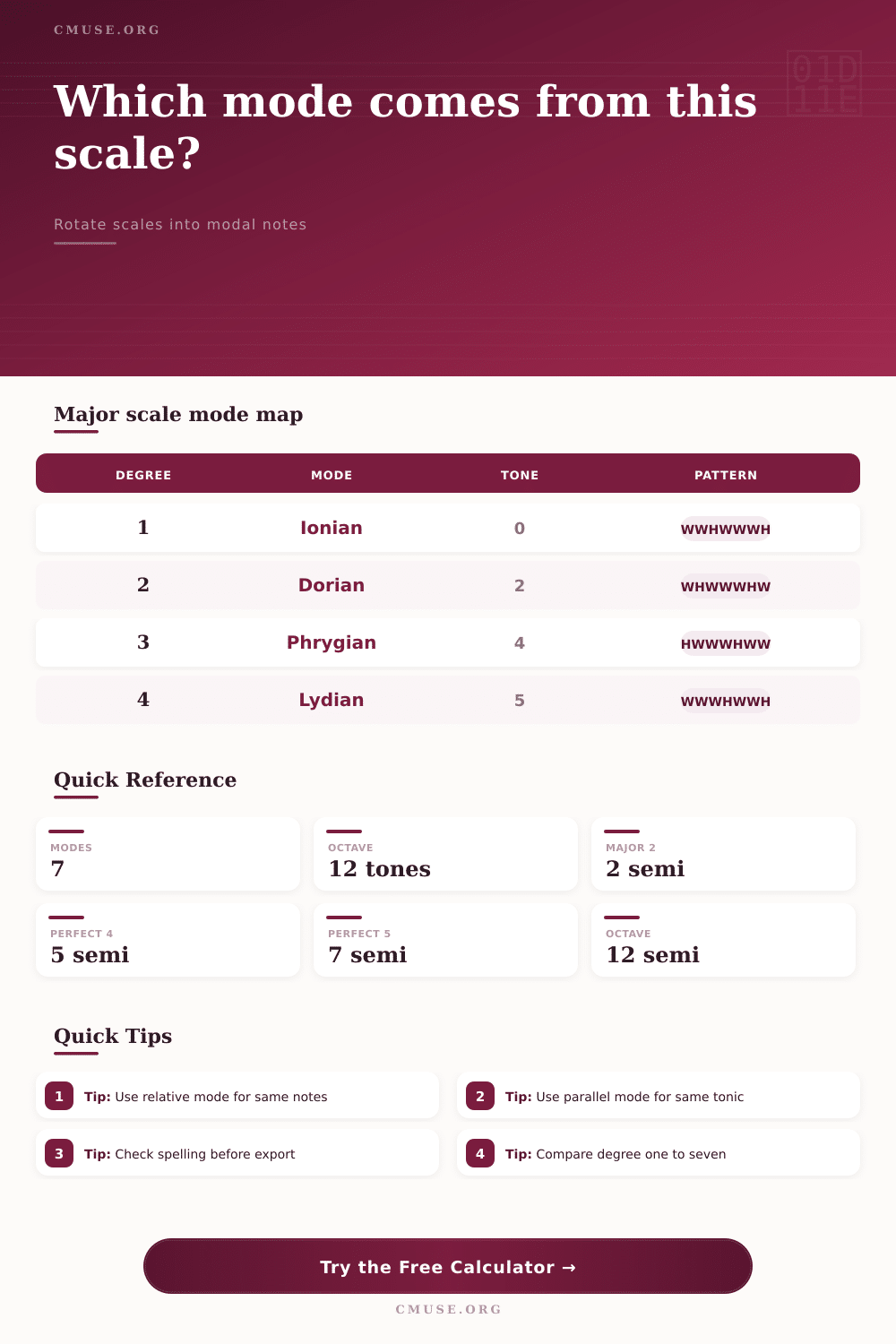
| Degree | Mode | Relative Tonic | Scale Formula |
|---|---|---|---|
| 1 | Ionian | Parent tonic | 1 2 3 4 5 6 7 |
| 2 | Dorian | Whole step up | 1 2 b3 4 5 6 b7 |
| 3 | Phrygian | Major third up | 1 b2 b3 4 5 b6 b7 |
| 4 | Lydian | Perfect fourth up | 1 2 3 #4 5 6 7 |
| 5 | Mixolydian | Perfect fifth up | 1 2 3 4 5 6 b7 |
| 6 | Aeolian | Major sixth up | 1 2 b3 4 5 b6 b7 |
| 7 | Locrian | Major seventh up | 1 b2 b3 4 b5 b6 b7 |
🎧Note Output Examples
| Input Parent | Rotation | Mode Result | Notes |
|---|---|---|---|
| C Major | 2 | D Dorian | D E F G A B C |
| C Major | 5 | G Mixolydian | G A B C D E F |
| A Harmonic Minor | 5 | E Phrygian Dominant | E F G# A B C D |
| C Melodic Minor | 4 | F Lydian Dominant | F G A B C D Eb |
| C Harmonic Major | 3 | E Phrygian b4 | E F G Ab B C D |
💡Rotation Tips
To illustrate this in action, consider why some chord progressions look right on paper yet sound wrong. Partly because we rotate through mode. If you’ve ever thought of scales as unchanging lists then you’re in good company: Scales are rotations that pivot around a center.
Enter your root note and formula into the calculator at the top of page and let it do all the math for you. You won’t have to fiddle with chromatic tones or wonder what is changing. It provides concrete results from an abstract theory.
How to Use the Mode Calculator
Most musicians starts with the major scale because it is the most familiar ground. Turning C Major a whole step bring you to D Dorian. Same notes, completely different harmonic gravity. No need to alter the notes at all just the way they function. Look up D Dorian in the tool to see the interval pattern that re-arranges those steps into a new sounding minor scale with a natural sixth. That natural sixth defines Dorian as opposed to Aeolian and it’s a big deal when it comes to the notes you use when improvising.
Move beyond the diatonic major system and things gets trickier. Jazz players frequently use harmonic or melodic minor as their parental scales, which gives them Phrygian Dominant or Lydian Dominant colors respectively. These modes contains sharps of an eleventh, or even augmented seconds that are not always included in traditional text books. Luckily, the calculator covers these extended families too. Rotate through C Melodic Minor and what do we have? Well, we have F Lydian Dominant, with a flat 7th and sharpened 4th. It has a major chord quality but with tension from a sharpened 4th. It sounds resolved but still has a tense edge. That’s why you hear it crop up in so much funk and fusion music. Knowing where the parent scale originates allow you to anticipate the changed notes without having to learn each variant in isolation.
The tonic shift is another decision you make. In relative mode, you’re holding onto the key signature but shifting your root note making it easier to grasp shared tonal material. With parallel mode, you hold onto the root while changing the key signature; this makes it easier to compare modal colors across one chord. You can switch back and forth with this tool so you can view the same mode from multiple angles.
When you find yourself playing chords over F, you should of realized that F Major shares the tonic with F Lydian, but provides alternate melodic possibilities due to the raised fourth. Beyond sounding alike (a B-flat is the same as an A-sharp when equally tempered), spelling has different implications in theory. If you write B-flat then this will be understood differently than if you spell it A-sharp. Similarly, using flat keys instead of sharps changes the reading of voice leading and chord symbols. You can opt to have the calculator mostly spell one type of accidental above another or allow it to auto-spell according to tonic. This ensures the transcribed note matches the written harmony even if you used an enharmonic note that sounds correct but is technically different. Instead, it ensures your transcription matches standard notation practices rather than just pitch proximity.
One stumbling block I see beginners make is attempting to learn all modes in all keys separately. This is inefficient use of your brain power! Instead, get comfortabley with understanding how the parent and interval structure relate to each other. Now that you know Mixolydian is ALWAYS the fifth mode of a major scale, you have it wherever you go and you don’t even need a different rule for each spin. This relational thought process is supported in the breakdown section where the method of calculating modes is spelled out in detail. Now you remember that G Mixolydian is simply C Major beginning on the 5th note and now your rote memorization is transformed into flexible application.
Names and notes are offered by the calculator, but it is up to your ear to check the color. Structural awareness will help you know where the tension lives and how it resolves, whether improvising freely over a jazz standard or picking apart a Bach fugue. Try starting with some presets to observe the logic at play, and then move parents to discover for yourself how it all changes when the environment alters the flavor. While the notes may not change, when you turn the lens the story totaly transforms, and this is where creativity starts.