Accidental Count Calculator
Estimate printed key signatures, written accidentals, courtesy marks, and chromatic density across parts or full scores.
🎼Real score presets
♯Accidental inputs
Breakdown
⚙Current calculation spec grid
♭Key signature reference
| Accidentals | Sharp keys | Flat keys | Printed signs per 10 systems |
|---|---|---|---|
| 0 | C / A minor | C / A minor | 0 per staff |
| 1 | G / E minor | F / D minor | 10 per staff |
| 2 | D / B minor | B-flat / G minor | 20 per staff |
| 3 | A / F-sharp minor | E-flat / C minor | 30 per staff |
| 4 | E / C-sharp minor | A-flat / F minor | 40 per staff |
| 5-7 | B, F-sharp, C-sharp | D-flat, G-flat, C-flat | 50-70 per staff |
📖Chromaticism and review table
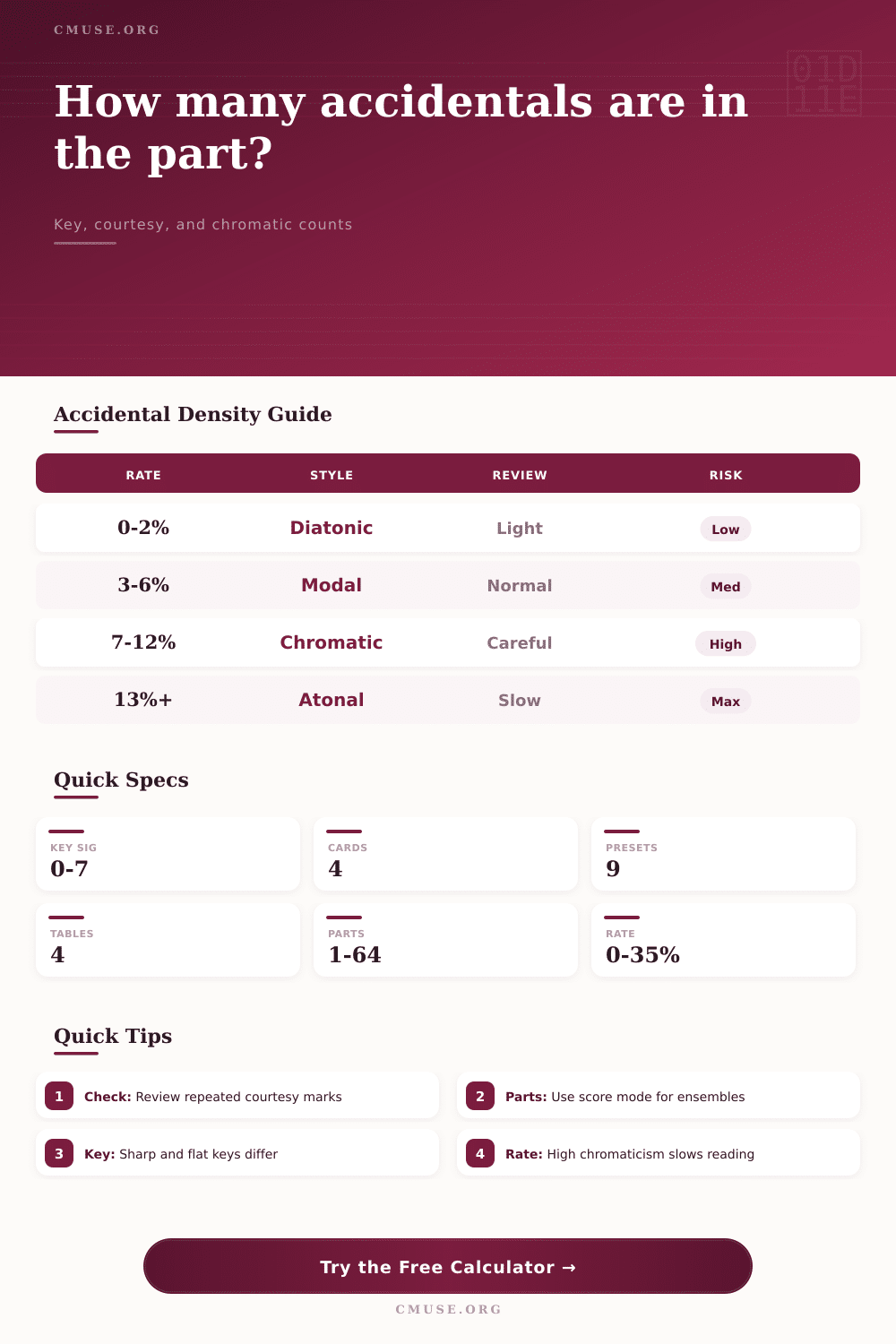
| Rate | Typical notation | Accidental density | Review approach |
|---|---|---|---|
| 0-2% | Diatonic hymn, simple folk tune | Very low | Check key changes and cadences |
| 3-6% | Classical part, modal melody | Moderate | Check altered leading tones |
| 7-12% | Jazz, Romantic harmony | High | Check enharmonic spelling by phrase |
| 13-20% | Modern tonal, dense modulation | Very high | Check every tied or repeated pitch |
| 21%+ | Atonal or chromatic étude | Maximum | Proofread slowly with playback |
🎹Part and instrument mode table
| Mode | Staff behavior | Count adjustment | Best use |
|---|---|---|---|
| Single melodic part | One staff | 1.00x review | Winds, strings, solo voice |
| Vocal with reduction | Voice plus piano staff group | 1.35x review | Art song, choral rehearsal |
| Keyboard or harp | Grand staff | 2.00x key staff count | Piano, celesta, harp |
| Chordal guitar | Dense vertical spellings | 1.45x review | Jazz guitar, rhythm charts |
| Full score | Many staves per system | Uses part count | Orchestra, band, chamber score |
| Percussion | Often no pitch key | 0.25x key count | Unpitched checks |
📋Preset comparison table
| Preset | Measures | Written marks | Chromatic rate |
|---|---|---|---|
| Bach chorale in D | 32 | 28 | 4% |
| Mozart sonata page | 48 | 36 | 5% |
| Jazz lead sheet | 64 | 82 | 11% |
| Romantic piano spread | 96 | 210 | 14% |
| Wind band excerpt | 72 | 44 | 6% |
| String quartet movement | 144 | 95 | 7% |
| Modern violin solo | 80 | 168 | 18% |
| Big band sax section | 96 | 130 | 16% |
| Atonal chamber cue | 54 | 192 | 28% |
💡Counting tips
If what’s printed is too messy to read, use accidental count calculator. It will help you estimate roughly how many printed accidentals is on each page. Occasionally you’ll glance at an engraving and notice groups of sharps and naturals and think ‘why?’ Use the accidental calculator to split out key signature repeats from the necessary written accidentals and the courtesy marks added after ties or line breaks.
Why does it matter? This is because cognitive load affect readability. It is not font choice or note size but an understanding of this density. Before you enter information, you must be clear about what it covers, such as a grand staff system. Are you using individual stave? Whatever decision you make, the rest of the work are done for you by the calculator.
How to Make Music Easier to Read
Because systems begin again on each new line, there may be multiple sharp signs at the beginning of each system in a score with many staves. This is why the number here isn’t an indication of readability at all. The page is just crowded. These are requirements of structure only. The tool then differentiates those elements from the chromatic complexities of melodic line itself.
Courtesy accidentals are a problem for most editor. They are parentheses written after a line break or a tie to tell the performer which pitch to play at that moment. Some engravers add too many, which creates visual clutter. Other engravers forget them altogether and hope that the performer’s memory will be good enough. Use the calculator to enter your own best guess for this separateley. It then enables you to view how much visual impact come from real harmonic change rather than editorial caution.
If you have almost as many accidents entered here as elsewhere it may mean you’re overly notating something. Clarity is appreciated by players but visual static isn’t. Finding the balance between being helpful and creating clutter are the trick.
Setting the Chromaticism rate requires an intuitive guess. How much of your music, on average, lies beyond the key signature? Two per cent may be reasonable for a simple folk tune. Ten to twelve per cent is common for a jazz lead sheet. Twenty or more percent would of be high for an atonal moddern piece. These percentages are given as a benchmark in the reference tables that accompany the tool.
These indicate how chromaticity rates correlates to the amount of proofreading required. If there is lots of chromaticism, then all those accidentals is critical and will require more review time. A single omitted natural sign in a complex section can cause havoc with the harmony. This will add to mental load for both player and engraver.
Remember that numbers alone don’t paint the entire picture; context is everything. Five accidentals in one measure can be doable as held tones on a flute. Rapid sixteenth notes containing the same density? Not so much. Normalize it based off rhythmic activity by entering average number of notes per measure. This helps prevent a slow, chordal section from being mistaken for harder difficulty then a fast-moving, sparse melody. Think of it as finding the signal through the noise. With a better idea of how much you have to read given the note value and tempo, you’ll more clearly see how dense the actual reading material will be.
Another factor enters with Ensemble mode in the full score view. The number of staves multiplies and the calculator takes that into account. Whether it’s estimating proof-reading hours or planning out engraving time for a large project, this comes in handy. On a wide system where each instrument has their own staff, the numbers adds up and you can visually see how many key signatures are added. It makes you appreciate why certain conductors like to have condensed scores for fast reading. There just isn’t enough visual space available to maintain legibility of all those markings.
The point of this tool is balance. Does what you have engraved help, hinder, serve the music? This applies whether you’re trying out a moddern solo for violin or a Bach chorale preset. In the end, the aim is to remove friction from the performer. Clutter remains on the paper; clear notation dissapears into performance. These estimates can be used to fine-tune your approach prior to printing final copy. A good score appears as complicated as it sounds.