Modulation Distance Calculator
Compare source and target keys by circle-of-fifths distance, mode color, pivot strength, chromatic motion, cadence support, and phrase preparation.
🎹Real Modulation Presets
🎼Key and Modulation Inputs
Calculation Breakdown
📊Spec Grid
📘Circle-of-Fifths Distance Table
| Fifths steps | Relationship | Typical key move | Modulation feel |
|---|---|---|---|
| 0 | Same tonic or relative mode | C major to A minor | Very close, color shift dominates |
| 1 | Dominant or subdominant side | C major to G major or F major | Natural, song-friendly, strongly functional |
| 2 | Two signatures away | C major to D major or Bb major | Noticeable lift with common tones available |
| 3-4 | Moderately remote | C major to A major or Eb major | Colorful, needs sequence, pivot, or cadence |
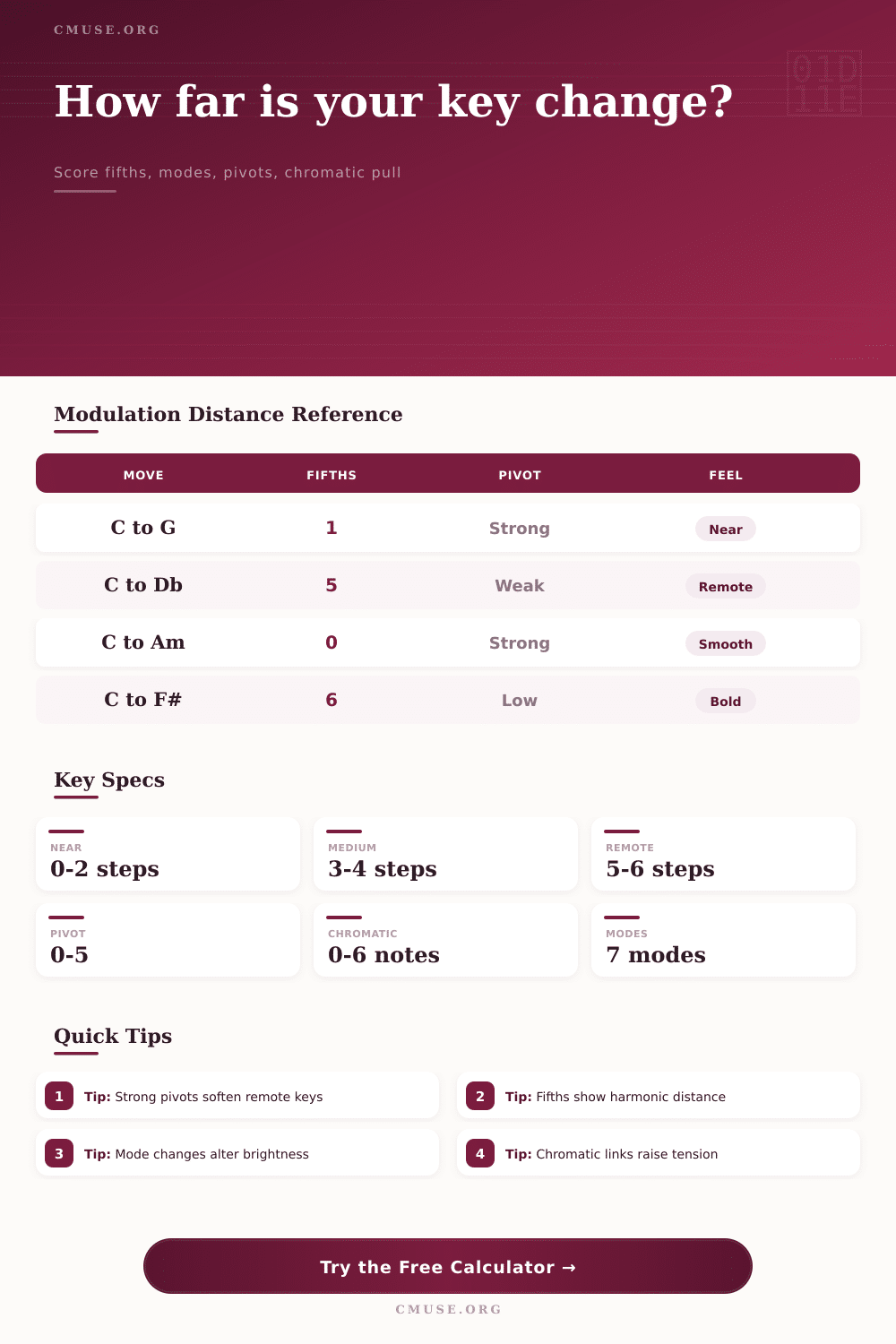
| 5-6 | Remote or tritone region | C major to Db major or F# major | Bold, cinematic, abrupt without preparation |
🎶Mode Color Table
| Mode | Scale color | Brightness index | Distance effect |
|---|---|---|---|
| Lydian | Raised fourth, bright open tonic | +3 | Large color change from minor modes |
| Ionian | Major scale baseline | +2 | Close to Lydian and Mixolydian |
| Mixolydian | Major with lowered seventh | +1 | Functional bridge into dominant colors |
| Dorian | Minor with raised sixth | 0 | Middle color, useful as a modal pivot |
| Aeolian | Natural minor baseline | -1 | Close to Dorian and Phrygian |
| Phrygian | Minor with lowered second | -2 | Dark color, raises perceived distance |
| Locrian | Diminished tonic color | -3 | Unstable, high distance unless brief |
🔀Modulation Method Comparison
| Method | Best use | Distance adjustment | What to listen for |
|---|---|---|---|
| Diatonic pivot chord | Classical, pop bridge, hymn-like moves | Reduces distance strongly | One chord sounds valid in both keys |
| Applied dominant | Clear target arrival | Reduces distance with cadence | V of the new key points forward |
| Common-tone link | Chromatic mediants and film harmony | Reduces shock by shared pitch | One sustained tone glues the change |
| Sequential modulation | Stepwise or fifthwise travel | Spreads distance over time | Repeated pattern makes travel predictable |
| Direct phrase modulation | Final chorus lift, abrupt scene shift | Adds perceived distance | New key arrives without a shared chord |
| Enharmonic reinterpretation | Diminished seventh or augmented sixth pivots | Strong for remote keys | Same pitches are respelled functionally |
📝Common Modulation Examples
| Scenario | Keys | Distance profile | Practical reading |
|---|---|---|---|
| Dominant lift | C major to G major | 1 fifth, 7 semitones | Close enough for a simple pivot or applied dominant |
| Relative minor turn | C major to A minor | 0 fifths, 3 semitones | Low key-distance, mostly a modal function change |
| Parallel color shift | C major to C minor | 0 fifths, 0 semitones | Tonic stays fixed while mode darkness changes |
| Chromatic mediant | C major to A major | 3 fifths, 3 semitones | Moderately remote but common tones can smooth it |
| Tritone move | C major to F# major | 6 fifths, 6 semitones | Maximum tonal distance, best with a strong device |
💡Calculation Tips
Sometimes when I write songs there comes a point at which all the theory tells me something ought to be right but it isn’t. The chord changes from C major to F sharp major and doesn’t sound right. It’s not in tune or anything like that, it simply doesn’t fit the emotion of song.
What has happened is that transition between chords is too great an emotional leap. It is too big a jump in distance. It’s not so much a question of getting notes right as it is one of distance. It is not the kind of distance that appears in musicology textbooks, but the practical one that measures amount of harmonic friction you have thrown into your piece. Once you grasp that then you can manipulate it rather than struggle with it.
How to Use the Chord Distance Calculator
To do so, this page has a calculator that goes beyond circle of fifths. Composers often stop here with the distance from one tonic to another. If we’re moving to the dominant then it’s an easy move; if we are going to the tritone then it’s tough. While this is a useful place to begin, it neglects nuance of what listener actualy hears when they hear the shift. For example, a jump of three steps around circle of fifths might sound seamless given a good pivot chord. But if you arrive without preparation and have a weak cadence, then it can feel more like a car crash. This is where the tool comes into its own.
It blends the raw harmonic distance with strength of your transition technique and other variables. Of course, it begins with target keys (the place you’re heading), and the source key(s) (where you start). From there, you choose the modes. Why? Because moving from A minor to C major is a zero-step move on circle of fifths. It is intimate, familiar, and comfortabley. On the other hand, switching from C Ionian to F Phrygian may be a somewhat close tonic relationship but color shift is drastic. Even though brightness index has changed drastically, the mood alter much more then the key center itself. That is why we include mode selection as part of the input. It captures what pure interval analysis miss, the textural distance.
Lastly, you’ve got your modulation method and pivot strength. Using a diatonic pivot chord makes for smooth handoff and reduces the apparent distance between even distant keys. Going to an applied dominant create forward motion but takes more rhythmic commitment. Directly phrasing a modulation from one key to another without any shared chords is going to be shock value, on purpose. The calculator scores those decisions and give you a number that reflects how noticeable it’s likely to be.
Low chromatic linking tones will make the distance feel vast and unbridged; a strong pivot strength can soften a remote key change. A sting in a film score versus a pop chorus lift: In pop, you want the lift to feel earned and natural. So maybe it’s a dominant move with solid cadence confirmation. For a movie, oftentimes you would of wanted the jolt to be unexpected, so maybe something like a tritone relationship with little preparation. The tool lets you see what ingredients is producing the effect.
It isn’t saying one way or another that subtle or bold is better. It shows just where you are on spectrum of surprising or smooth. To expand on these relationships further, there is an additional table on the page. This table breaks them down into semitone and fifth-step intervals to explain how far away each of these keys are from one another. This also illustrates contrast between a chromatic mediant and a relative minor, where one shares common tones but shifts harmony wildly while the other stay close harmonically but flips emotional polarity. The former swaps harmony completely; the latter stays close to the harmony but reverses the emotional direction.
This knowledge enable you to approach your chord changes intentionally instead of by chance. In short, modulation comes down to controlling audience’s expectations. Break those expectations for dramatic effect, yes. But do so knowing just how hard you’re pushing against them. That’s what the calculator provide; it makes the push concrete (data) rather than abstract (theoretical).
Now you can look at score and change the pivot strength. You can also add a few bars of preparation to make a distant key reachable. Or lean in to the distance for maximum impact. Either way, it’s an informed decision regarding how your music travel from one idea to another. It is not simply where you land, but how far you jump to get there.