Cadence Spacing Calculator
Estimate cadence density, closure strength, and section balance from phrase length, cadence type, tonal weight, and form role.
🎼Real Form Presets
🎚Cadence Spacing Inputs
📊Cadence Spec Grid
📘Cadence Type Reference
| Cadence type | Typical harmonic motion | Closure weight | Best spacing use |
|---|---|---|---|
| Perfect authentic cadence | V to I, soprano scale degree 1 | Very strong | Consequent phrases, section endings, final returns |
| Imperfect authentic cadence | V to I with weaker position or melody | Medium strong | Mid-section arrivals without full finality |
| Half cadence | Any preparation to V | Open | Antecedents, transitions, questions, pre-chorus lifts |
| Plagal cadence | IV to I | Warm close | Hymn endings, codas, softer confirmations |
| Deceptive cadence | V to vi or delayed tonic | Redirected | Extensions, bridge pivots, dramatic delays |
📏Spacing and Phrase Models
| Model | Phrase length | Cadence pattern | Structural result |
|---|---|---|---|
| Parallel period | 4 plus 4 measures | Half cadence then PAC | Clear question and answer balance |
| Sentence | 2 plus 2 plus 4 measures | Cadence near continuation close | Front-loaded idea with later drive |
| Hymn phrase chain | 4-measure phrases | Frequent local cadences | Stable text-led punctuation |
| Pop verse-chorus | 4 or 8 measures | Lighter verse, stronger chorus | Energy release at refrain |
| Development passage | Variable groups | Delayed or evaded cadences | Motion, tension, and instability |
🎵Common Form Section Targets
| Section | Usual span | Cadence count | Spacing character |
|---|---|---|---|
| Antecedent | 4 or 8 measures | 1 | Open ending, often half cadence |
| Consequent | 4 or 8 measures | 1 | Answering close, often authentic cadence |
| Verse | 8 or 16 measures | 2 to 4 | Regular but not overly final |
| Chorus | 8 or 16 measures | 2 to 4 | Stronger closure and arrival points |
| Bridge | 8 measures or more | 1 to 2 | Delayed tonic or redirected cadence |
🔎Tonal Weight Guide
| Weight level | Harmonic signal | Melodic signal | Spacing caution |
|---|---|---|---|
| Light tonicization | Brief tonic or local key color | Often incomplete arrival | Can appear often without stopping motion |
| Medium local close | Clear dominant preparation | Phrase-level punctuation | Works every 4 to 8 measures |
| Strong section close | Root-position dominant to tonic | Stable arrival tone | Use for main answers and section ends |
| Structural final close | Cadential six-four or strong dominant | Final tonic support | Too frequent can flatten the form |
💡Cadence Planning Notes
The melody sound nice. But it doesn’t quite hold together. The singing lack structure. The phrases is flowing, but there’s something lacking. Probably not in the rhythm or the pitches. It’s a sense of punctuation. Like speech music requires a breath too and the spacing between pauses determines how it will breathe out for listener.
A lot of strong cadences will squashes the composition into monotonous repetition. An excess of weak ones will cause it to drift aimlessly. Here’s a place where a structural tool could come into play as it turns your intuitive feelings about music into measurable choices. Could your phrase length be supporting the harmonic closings you’ve made? It all comes down to expectation vs. Satisfaction. How many times do you want to come to a complete stop? By choosing the cadence type, you have chosen your level of stopping difficulty.
How to Shape Your Melody with Pauses and Structure
A perfect authentic cadence is like putting on the brakes at the conclusion of a paragraph. It require buildup and offers satisfaction. Put one of these at every fourth measure in a fast tempo and listener grows weary of constantly being halted. That’s where most folks goes wrong. More resolution must of been good for structure. Right? Wrong! Too much closure kills momentum. The ratio of phrase group:arrivals shown by the calculator will allow you to find this density problem before it turns into a structural problem.
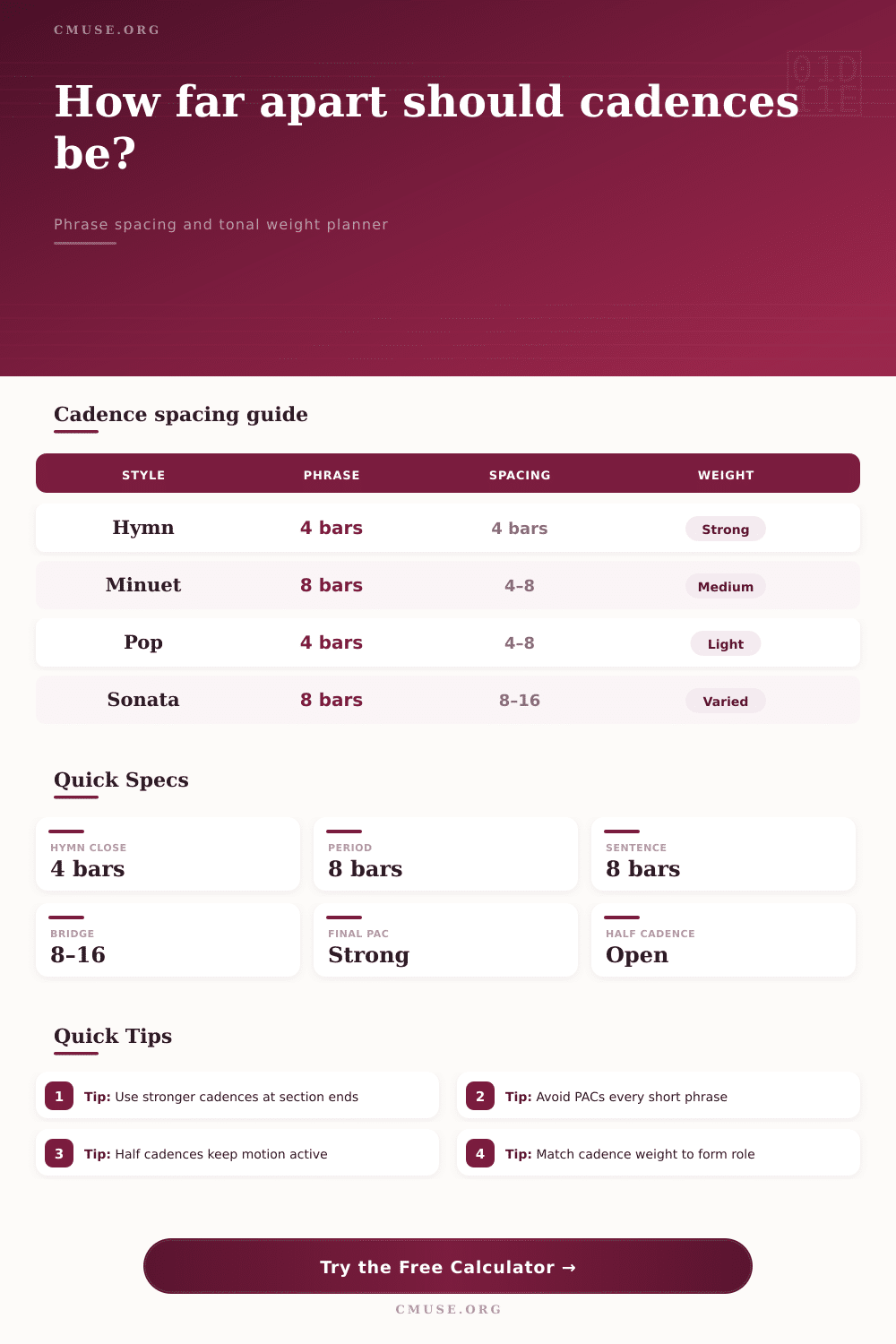
For example, compare the way an expositional section of a sonata and a hymn are punctuated. With a hymn clarity of text is all-important so regular, pronounced punctuation is used. Every few bars you require a good close to allow congregation to know they have got the words right and know where to take a breath. In contrast, in a sonata, it withhold finality to build tension across eight or sixteen measures before letting go.
To illustrate this I’ve created a reference table (on the page) that contrasts the style and weightings for each expected spacing. A minuet lies roughly halfway between the two as you might expect giving medium-weight arrivals to continue the dance while not halting it entirely.
Beyond just chords, there’s the matter of tonal weight. It’s contextual. At bar four, a tonic-dominant move has one feel; at bar forty, another. The tool lets you assign weight levels to match its role in the structure. For instance, a major structural ending might be emphasized strongly, while a movement toward the tonic within a phrase can be only slightly emphasized. Why? Because otherwise all those little bits sounds too final and diminish effect of actual song end. When each minor arrival sounds like the end of the song, then…
Oddly enough, timing matter too. A four-measure phrase played at a tempo of one-hundred and twenty feels significantly shorter than same four measures played at sixty. How long something lasts isn’t only determined by how many bars it contains; your ear takes account of amount of time that has passed. These figures can be converted to seconds, helping you visualize what you hear instead of simply what’s written down. Can you tell whether your harmonic rhythm is rushing, or perhaps your cadential extensions is dragging? Adjust accordingly and see if the emotional pacing aligns with the musical structure.
There are also common mistakes that relate to mixing up your spacing. Using heavy closes with shorter phrase makes for something that feels disjointed and choppy. On the other hand, weak internal punctuation paired with longer phrases can sound muddy and aimless. Remember to align the strength of cadence with length of phrase. Lighter touches work well on short phrases except when used as a clear structural anchor. Longer spans want to have regular check ins, even if only half cadences, to remind the listener where home is before taking him/her on a journey away from home.
So in conclusion, form is ultimately structured time. It’s how you lead the listener on an emotional journey; how do you know what to do next? When to stop? When should you continue? Whether it’s a classical development section or a pop chorus, these concepts of spacing and weight apply. Use the presets as a launching pad and adjust the variables until you hear something that works for your unique material. The math will provide the framework but the final decision lies in your ears.
You’ve written a melody that sounds great, but it doesn’t have shape. Now you know where to place the commas.