Hypermeter Grouping Calculator
Map bars into higher-level beats, phrase units, strong and weak bar accents, irregular groupings, pickup spans, and cadential weight.
Hypermeter Result
4 groups
4 bars each4 / 12
mapped accent positions100%
regular span alignment2
closure-weighted bars| Accent Level | Bar Role | Typical Position | Calculator Treatment |
|---|---|---|---|
| Strong | Hyperdownbeat | Bar 1 of each group | Counts as structural weight 3 or higher. |
| Medium | Midpoint support | Middle of 4-, 6-, or 8-bar groups | Marks a secondary accent when selected. |
| Weak | Passing bar | Interior non-cadential bars | Uses the selected weak-bar weight. |
| Cadential | Closure or extension | Final bar of phrase or cycle | Can override weak placement with cadence weight. |
| Model | Common Span | Strong Bars | Best Use |
|---|---|---|---|
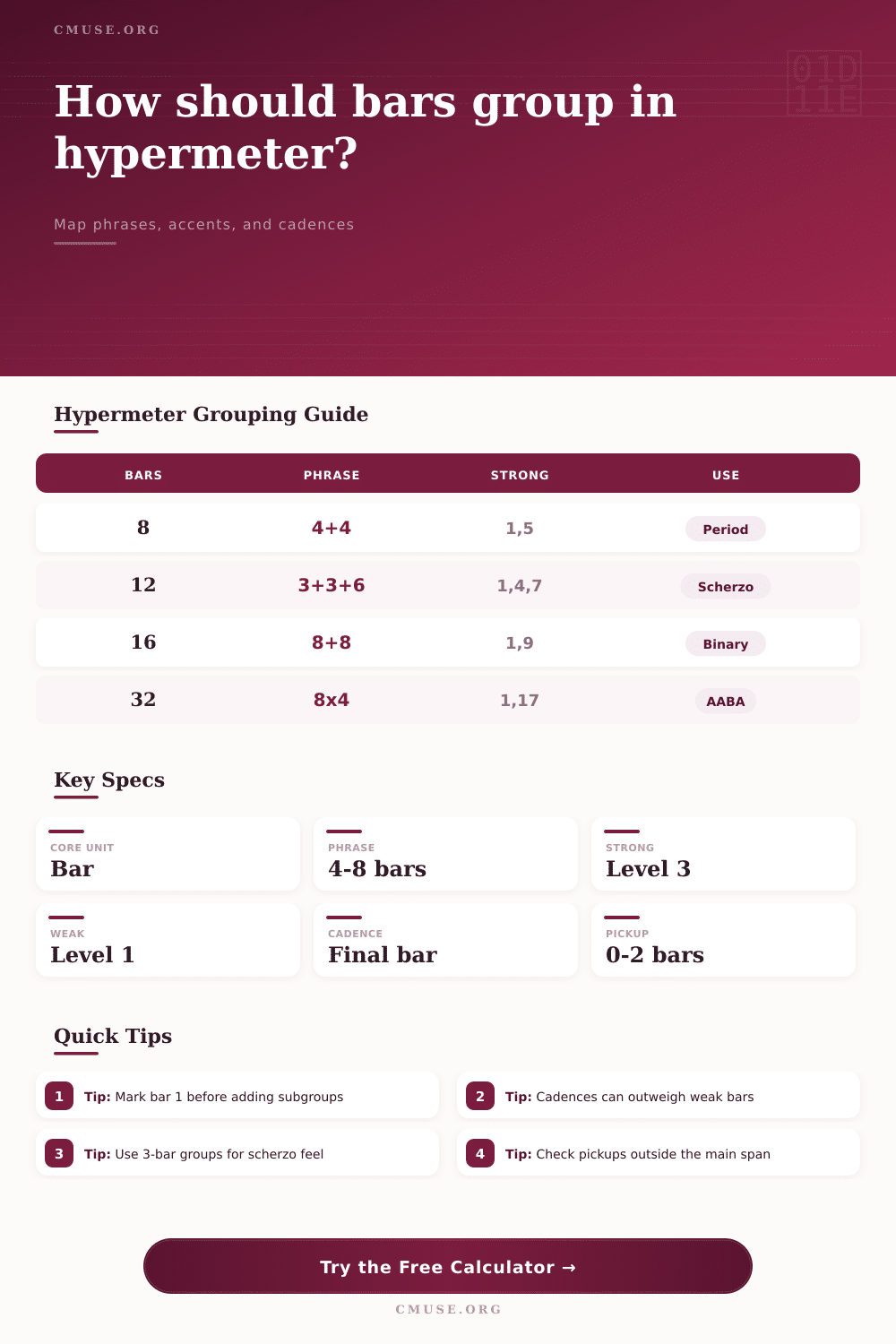
| Regular four-bar hypermeter | 4, 8, 16, or 32 bars | 1, 5, 9, 13 in a 16-bar span | Stable themes, pop sections, hymn phrases. |
| Antecedent-consequent period | 8 or 16 bars | Start of antecedent and consequent halves | Balanced question-answer phrase design. |
| Three-bar scherzo grouping | 3+3+6 or 3+3+3+3 | Each three-bar block, plus longer closure | Quick dance-like phrases and playful displacement. |
| Cadential extension | 4+4+2, 8+2, or 8+4 | Opening bar and extended closure bars | Phrases that delay arrival or hold dominant tension. |
| Pattern | Total Bars | Strong-Bar Logic | Interpretive Result |
|---|---|---|---|
| 3+3+2 | 8 | Bars 1, 4, and 7 | Compressed eight-bar span with displaced arrival. |
| 5+7 | 12 | Bars 1 and 6 | Asymmetrical phrase halves with a longer consequent. |
| 4+4+6+2 | 16 | Bars 1, 5, 9, and 15 | Regular opening followed by expansion and snap closure. |
| 2+2+2+3 | 9 | Bars 1, 3, 5, and 7 | Short repeated cells with a final lengthening gesture. |
| Cadence Situation | Bars Affected | Grouping Effect | Calculator Signal |
|---|---|---|---|
| Phrase-final cadence | Last bar of each phrase | Confirms the current group length | Cadence count rises without changing group count. |
| Repeated cadence every 8 bars | Bars 8, 16, 24, 32 | Marks two-level hypermeter | Closure score increases at each cycle end. |
| Two-bar extension | Added bars after expected closure | Creates phrase surplus | Coverage falls below perfect alignment. |
| Pickup before bar 1 | Partial or full bars before the span | Offsets the felt first downbeat | Pickup is reported separately from main coverage. |
Rhythm exists in a song; most musicians is aware of that, but what about stacking individual rhythms into larger structures? Enter hypermeter. Above the measure (hence the name) is the hypermeter. It is not simply the beat inside a phrase, but its heartbeat. Listen to a pop chorus or even a whole symphony and you hear that group of bars pulse as one unit.
The calculator on this page maps this invisible architecture to help you visualize it. This lets you see and adjust bar counts and accent patterns into clear, organized groups. This turns abstract theory into something real and editable before you analyze or write a piece.
What is Hypermeter?
Let’s start with the phrase length. Melody in classical music is measured by the four bar phrase. It have become a standard and works in a way that is satisfying and predictable because it feels naturaly balanced. The tool understands a common binary structure with sixteen bars total and a four-bar phrase set-up. This becomes the basis of so much western music and what makes it very easy to forget how particular this is.
The calculator breaks this out into strong and weak accents and indicate precisely where the structural weight lands. Almost without fail, bar one are the strongest point, the hyper-downbeat for the whole lot. Bringing in extensions and other irregularities make things more interesting. Composers are human beings, after all; they like to tease their audience, so rarely does music remains nicely symmetrical for too long.
Two additional bars at the end of an eight-bar phrase could extend a cadence and delay its resolution, creating a sense of tension. To account for this, the closure weight is adjusted by the calculator. Those last two bars can be marked up to have greater structural importance, overriding the standard weak accent pattern. Why? If one bar falls into a rhythmically weak place but contains dominant harmony, it is a heavier bar then the one passing through on the way. By allowing this, the tool puts the harmonic reality before strict mathematical symmetry.
This all gets more complicated by pickup notes and anacruses. When the melody begins in a partial bar (such as ‘on the ‘and’ of four), then the alignment change too. The calculator can be set to start from a pickup bar so that the hypermeter grid lines up accordingly. This is very important when analysing accurately since it’s not necessarily the case that beginning of the piece corresponds to the first full measure. If you don’t account for this offset, you’ll end up with a confusing accent map where strong beats appear to be misplaced.
To avoid having to do the mental maths, the interface contains a handy reference table of common examples such as hemiola patterns or scherzo groupings. You can see what difference they make to the overall shape. Using regular equal groups or an antecedent, consequent periods completely changes the feeling of your analysis. If we are talking about a period then this indicates that there is a question and answer element to the phrase with a clear division into two corresponding parts.
This is also reflected in the calculator where both halves is indicated as strong points, giving you a mid-phrase stress that leads the ear around the development. This is a subtle point, but it explains how some phrases sound like fully formed thoughts while others seem incomplete and need to be finished. By being aware of this contrast you can compose melodies that naturaly breathe instead of a collection of random notes.
The other thing I’d bring up is how tempo affects perception. The tool considers tempo solely for estimating duration; however, a quick tempo can compress hyperbeats and make longer phrases sound more fluid, while a slower one can expand them and make each bar have greater weight. This is something that’s not considered in the accent map, but worth remembering when interpreting the results.
The visual output shows you the skeleton, but it’s the ear that supplies the flesh. Consider the tool for checking your intuition rather than replacing it. Ultimately, it is all about expectation and fulfillment. As listeners, we instinctively count out and wait for the next strong beat. If you give it to us on time, it provides stability. If not, it creates interest by delaying it or displacing it.
Once you have plugged your specific constraints into the calculator above, it does the math for you; no more highlighting scores with arrows and highlighters. It should of been a handy sanity check for more complex forms. This understanding of these extended rhythms provides your music with direction and purpose. You move beyond simply creating notes and begin to create structures that support one another and hold together when scrutinized.
You have control over how people experience time within your music as you visualize the grid beneath the surface. It comes back around to that first feeling of pulse only now elevated not as a simple beat but into a compeling narrative arc.