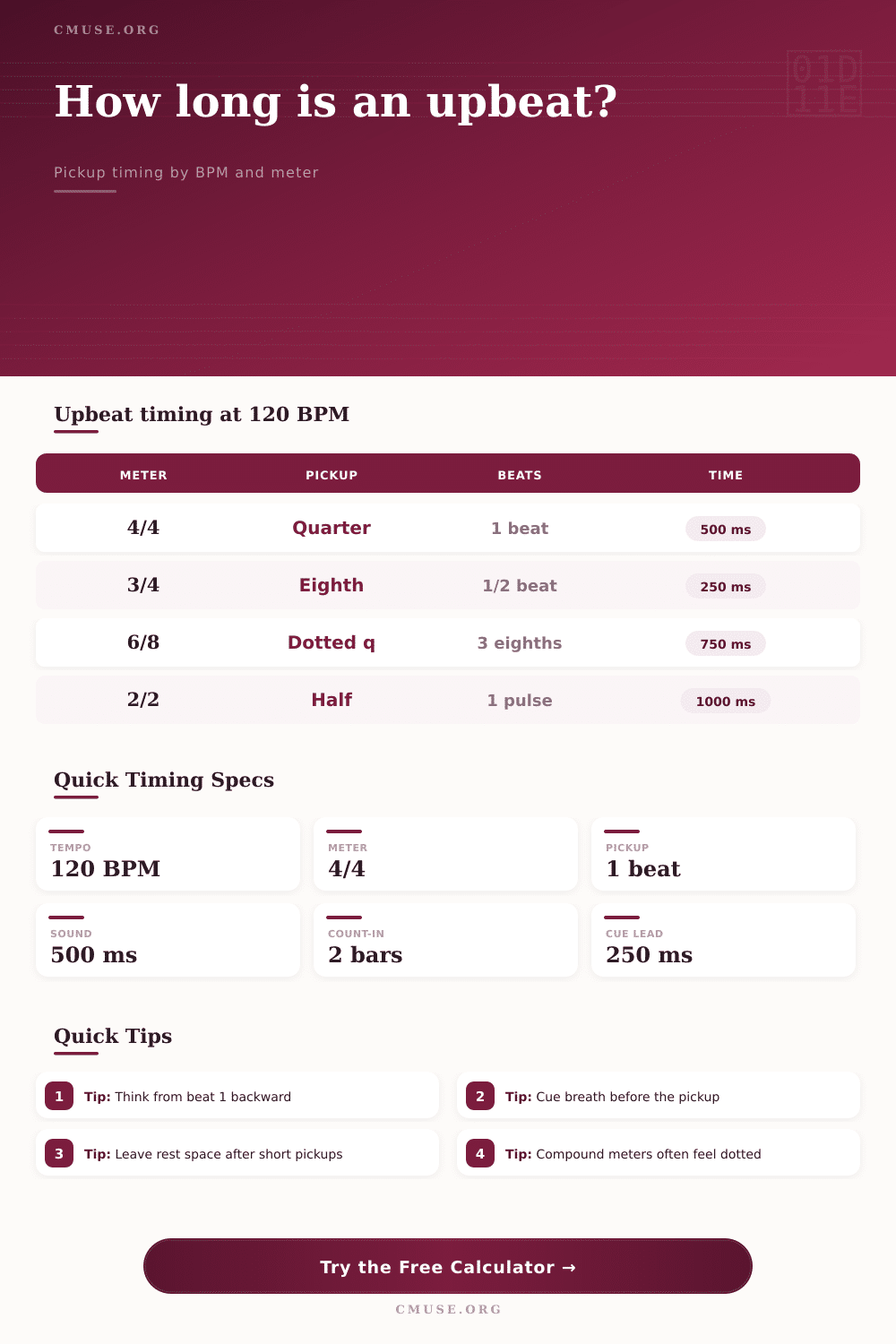
Upbeat Duration Calculator
Convert pickup notes, rests before beat 1, count-ins, and ensemble cue lead into exact milliseconds from BPM and meter.
♫Real Upbeat Presets
⏱Timing Inputs
🎼Upbeat Spec Grid
📊Reference Tables
| Upbeat Value | Whole-note Fraction | Quarter-beat Equivalent | Duration at 120 BPM |
|---|---|---|---|
| Half note | 1/2 | 2 beats | 1000 ms |
| Dotted quarter | 3/8 | 1.5 beats | 750 ms |
| Quarter note | 1/4 | 1 beat | 500 ms |
| Dotted eighth | 3/16 | 0.75 beat | 375 ms |
| Eighth note | 1/8 | 0.5 beat | 250 ms |
| Sixteenth note | 1/16 | 0.25 beat | 125 ms |
| Meter | Common Pulse | Typical Upbeat | Beat 1 Planning |
|---|---|---|---|
| 4/4 | Quarter | 1 quarter or 2 eighths | Count 4, enter on 4 |
| 3/4 | Quarter | 1 eighth or 1 quarter | Count 3, enter before 1 |
| 2/2 | Half | Half-note pickup | Feel two broad pulses |
| 6/8 | Dotted quarter | 3 eighths or 1 eighth | Feel two dotted pulses |
| 9/8 | Dotted quarter | 3 eighths | Feel three dotted pulses |
| 7/8 | Eighth groups | 1 or 2 eighths | Name the grouping first |
| Ensemble Setting | Cue Lead | Reaction Buffer | Use Case |
|---|---|---|---|
| Solo practice | 0.25 pulse | 0-40 ms | Metronome precision |
| Small combo | 0.5 pulse | 60-100 ms | Shared breath or nod |
| Choir | 0.75 pulse | 100-180 ms | Vowel and breath prep |
| Orchestra | 1 pulse | 120-220 ms | Visible conducting cue |
| Pit band | 0.5 pulse | 80-150 ms | Scene-to-song entrance |
| Preset | Meter | Pickup Shape | Count-in Plan |
|---|---|---|---|
| Rock Band Quarter Pickup | 4/4 | Quarter into beat 1 | 2 bars, cue on last beat |
| Waltz Eighth Pickup | 3/4 | Eighth before downbeat | 1 bar, light prep |
| 6/8 Dotted Cue | 6/8 | Dotted-quarter pickup | 2 bars in two |
| Orchestral Anacrusis | 4/4 | Dotted eighth plus rest | 1 bar, larger cue arc |
| Pit Band Cue | 12/8 | Three-eighth pickup | 2 bars, visual lead |
✦Timing Notes
It is the link from rest to movement, the upbeat, or anacrusis. Not only does it keep time but length of it is key. It provides each individual in that space with enough clues to join in and do so without thought.
If a group of musicians fail to reach agreement on how long the leading note should be then the band will rush the song. If the conductor grips the cue too firmly then the choir will drag its entry.
The Importance of Pickup Notes
Most musicians has always thought of tempo as speed at which a song is played. When making plans for an entrance, think of the tempo as a way to measure amount of silence between notes. Since an eighth note equals x milliseconds and a quarter note equals y milliseconds, you can be sure of how much time remains before your entry. Starting with beat one, it’s just a matter of subtraction: What is the length of my pickup notes? Subtract those from the downbeat. There’s your starting point for the onset of sound.
Counting off from zero forwards is where so many people go wrong; it only leads to vague anticipation. Working backwards from beat one are like having a concrete target for initial note. The tool above handles the conversion so you do not have to pull out a calculator during rehearsal. It will translate your rhythmic value into exact millisecond windows because this is all about human reaction time.
In a small combo, sure maybe you glance at each other and go in on instinct. That’s fine in small combos. It is not as fine when there are 30 pieces of brass waiting to enter on cue. That’s where the danger of going on instinct comes in for a larger group like a pit band or a full orchestra.
We want a clearly defined lead window. The calculator lets us define it by including a duration for the lead cue. We can then add a buffer to the following ensemble entry to account for things like stick lift or breath prep, this turns a vague gesture into a timed event.
Then there’s meter. A pickup in common time sounds different than a pickup in cut time or six eight. A pickup of an eighth note in three four waltz time is light and airy and requires that you enter quickly. A pickup of a half note in two-two cut time has weight, pulling the listener into the downbeat with more gravity.
The reference tables shows these typical pickups to help you understand what is usual for your genre. If you’re playing rock music, a quarter note pickup is probably fine. Maybe if you’re doing folk in six eight, you’ll want three eighth notes to fill the gap well enough.
After the pickup sound, think about the rest. Often there is a break between the final upbeat note and the downbeat. That space has time value as well. A short pickup followed by a long rest can cause momentum to stop. You can enter this rest value separately on the calculator. This enables you to see complete span between the cue and initial impact.
For songs with asymmetrical meters such as seven eight or five four this is invaluable. These time signatures don’t fall cleanly within our natural rhythm counting loop in the brain. Knowing exactly how long each beat lasts in milliseconds will help players rely on the form instead of guessing when the downbeat occur.
Another sneaky one is latency; it is the time it takes for sound to travel from the conductor’s baton through the air to your ear while you are performing onstage. With this tool, you can introduce a millisecond-based reaction buffer to account for that. It is micromanaging but it saves time at rehearsals.
Why does everybody keep rushing into the piece? You would of argued that it’s not true until you both agree on some numbers and let the body do its thing. Your hearing shifts when thinking back from beat one. You anticipate the landing rather than awaiting a starting signal. Because of this, the downbeat sounds more powerful since it is the setup instead of an upbeat that comes after.
The entrance is synchronized and tight because every player has timed their preparation perfectly. There’s no need to be concerned about arriving too soon or having to shout out count ins. You simply wait for that window of silence that you know exists, and then fill it with sound. It takes away anxiety and replaces it with precision, all by knowing the timing before you’ve picked up your instrument.