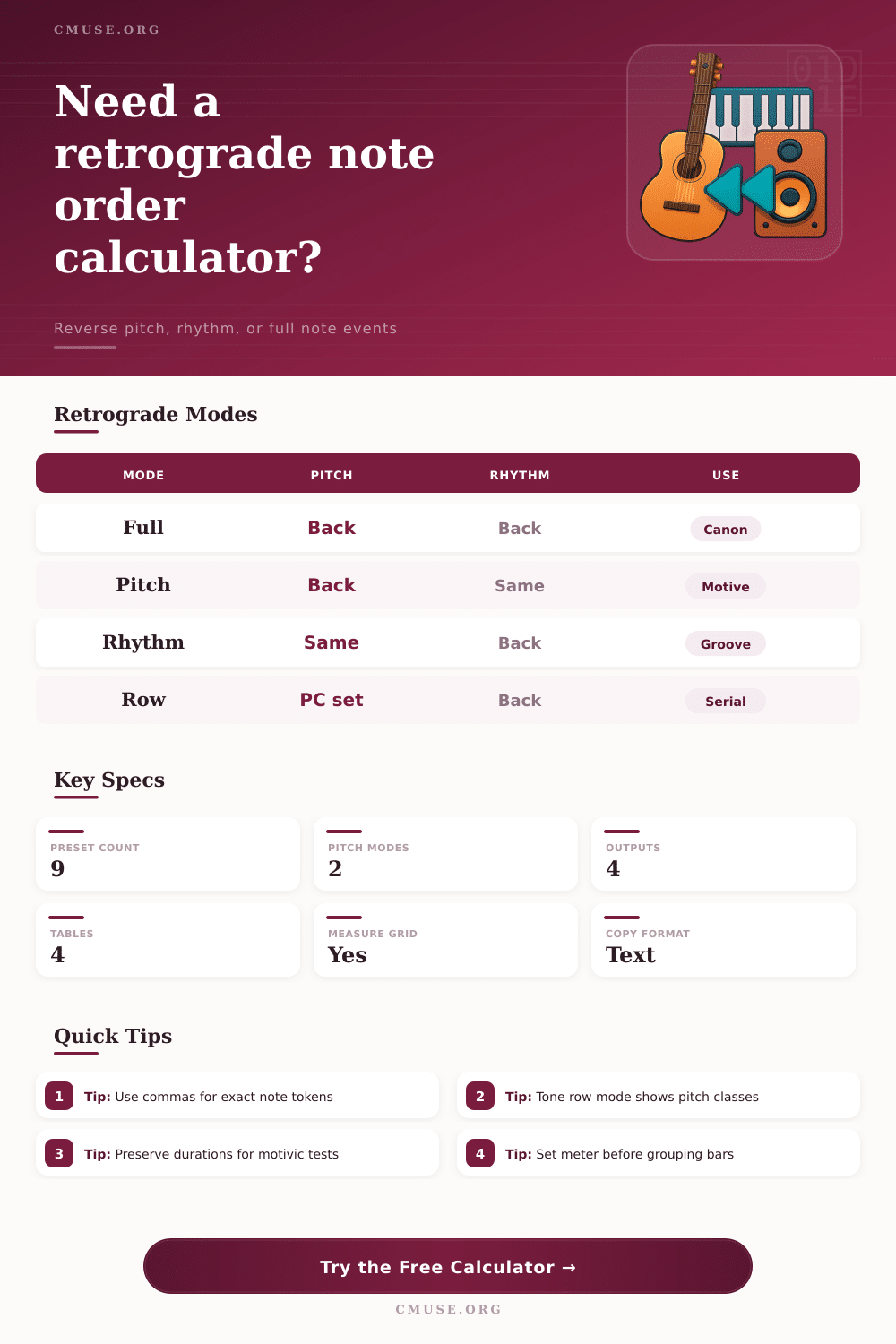
Retrograde Note Order Calculator
Reverse pitch rows, rhythmic cells, or complete note events with measure grouping and copy-ready output.
| Slot | Original pitch | Original rhythm | Retrograde event |
|---|---|---|---|
| 1 | C4 | 1/4 | A4 1/2 |
| Measure | Beat range | Events | Load |
|---|---|---|---|
| 1 | 0-4 | C4 1/4 | Balanced |
| Mode | Pitch behavior | Rhythm behavior | Best use |
|---|---|---|---|
| Full retrograde | Reverse pitch order | Reverse duration order | Crab canon, serial row, mirrored phrase |
| Pitch retrograde | Reverse pitches | Keep rhythm order | Motive testing, contour inversion planning |
| Rhythm retrograde | Keep pitch order | Reverse durations | Groove variation, phrase displacement |
| Preserve durations | Reverse pitches | Original rhythm stays left to right | Compare contour without changing beat profile |
| Preset | Default mode | Pitch count | Typical purpose |
|---|---|---|---|
| Bach Crab Canon Cell | Motive | 8 | Contrapuntal reversal check |
| Schoenberg-Style Row | Tone row | 12 | Serial retrograde inspection |
| Webern Interval Cell | Tone row | 7 | Pointillist interval order |
| Jazz Turnaround Motive | Motive | 8 | Phrase ending variation |
| Film Ostinato Phrase | Motive | 8 | Loop tension reversal |
| EDM Synth Hook | Motive | 8 | Drop fill and answer phrase |
| Percussion Rhythm Cell | Motive | 8 | Rhythmic retrograde without pitch focus |
| Modal Chant Line | Motive | 9 | Melodic arch comparison |
| Classroom Twelve-Tone Row | Tone row | 12 | Teaching R0 and ordered pitch classes |
It plays one melody forwards while another play backwards, creating a symmetrical effect called a crab canon. Because each note has been inverted in exactly the same order, they locks into harmony with each other. Flipping your original idea horizontally create a mirror image, which is why this musical device are called retrograde motion. It can absorbs when writing a serial tone row or varying a repetitive synth loop.
Knowing how the reversal work enables you to work out how it happens without making typing errors that destroy the contour. A reversal by eye is something most musicians attempt; many succeed in reversing phrases but also miss out changing one note for another (an accidental) or swapping a duration. In the field above type in the sequence of pitches you wish reversed, and how strictly you want this reversal applied. Then sit back as the calculator takes care of reversing the list while you listen to the result.
How Retrograde Motion Works
As humans we tend to switch off when asked to repeat a task. Separating this process from the creative assessment step mean a script deals with the repetition, leaving us free to concentrate on the creative part. The type of transformation alter the sound of the music. When you opt for full retrograde, then both rhythm value and pitch order is inverted. In effect, last note of your first phrase becomes the first note, followed by its length. It makes a complete mirror image with time running in reverse. This could of been useful when creating a canon that demands strict mathematical symmetry, or when testing whether a motive can function as a palindrome.
It won’t resemble the starting material, and will frequently feel like an echo of the original theme. On the other hand, you may wish to reverse it entirely. In groove-based music, reversing tends to kill the pocket. Any swung eighth note will fall on the off beats that collide with the drum pattern. Using the pitch retrograde feature reverses only the notes while retaining the original rhythmic values flowing through. This can be good if you want to try out new melodic contours without disturbing the groove. The comfortabley rhythmic skeleton remains intact, yet the pathway is new and travels against the grain of what you initially thought.
Here, for example, the meter show you which events are grouped into measures so you can see how the phrase resolves. A retrograde line may not finish on a weak beat at all but instead land in a strong position that completely alters the phrasing. Here, you would want to ensure new ending falls on the expected point both rhythmically and harmonically. Knowing what measure grouping the tool has produced allows you to identify misplaced accents or odd bar lengths before committing pen to paper. This avoids creating a retrograde that is mathematically accurate yet musically impossible because it fails to account for the pulse underneath.
The tone row mode for serial composers are an application that removes octave tags entirely and concentrates only on pitch classes. This allows you to see if the retrograde maintains the interval relationships required by the twelve-tone rules. It takes out the distraction of register choice so that you can check how well the row itself is built. The reference tables in the tool explain it all clearly and show where transformations apply to rhythm or pitch. That’s important to know because sometimes you’ll want a partial reversal whereas other times a full reversal. So knowing that will keep you from getting confused.
Perspective is everything with Retrograde. It compels you to view your melody as a performer would from behind, revealing both its intervals and shapes which may have been obscured by forward motion. Some melodies are the same forward as backward; others are completely different ideas. The calculator only offers the mirror. Whether the reflection is useful or even beautiful is up to your own ear.
Type in your notes, select your constraints and let the reversed sequence do the talking. Listen once more. What was already there waiting to be heard?