Augmentation Duration Calculator
Expand a rhythmic motif by factor, tempo, note value, and meter, then check how the augmented line fits in canon, fugue, and invertible counterpoint entries.
🎵Real Augmentation Presets
🎼Motif And Tempo Inputs
📏Augmentation Spec Grid
📋Reference Tables
| Original value | 1.5x result | 2x result | 4x result |
|---|---|---|---|
| Sixteenth, 0.25 beat | Dotted sixteenth, 0.375 beat | Eighth, 0.5 beat | Quarter, 1 beat |
| Eighth, 0.5 beat | Dotted eighth, 0.75 beat | Quarter, 1 beat | Half, 2 beats |
| Quarter, 1 beat | Dotted quarter, 1.5 beats | Half, 2 beats | Whole, 4 beats |
| Half, 2 beats | Dotted half, 3 beats | Whole, 4 beats | Breve or tied whole notes, 8 beats |
| Whole, 4 beats | Whole tied to half, 6 beats | Breve or two wholes, 8 beats | Four tied wholes, 16 beats |
| Context | Typical factor | Entry behavior | Best check |
|---|---|---|---|
| Strict canon | 2x or 4x | Follower enters while leader continues in longer values | Measure alignment and cadence point |
| Fugue exposition | 2x or 3x | Subject may return as an augmented answer | Subject length against episode space |
| Stretto passage | 1.25x or 1.5x | Entries overlap before the motif completes | Overlap percent and beat offset |
| Cantus firmus | 3x or 4x | Original melody becomes a slower structural line | Long-note ties and harmonic rhythm |
| Process ostinato | 1.5x, 2x, 3x | Repeated cell expands across cycles | Loop point and bar grouping |
| Meter | Beat unit | Bar duration at 96 BPM | Augmentation warning |
|---|---|---|---|
| 2/4 | Quarter beat | 1.25 seconds | Long factors quickly cross barlines |
| 3/4 | Quarter beat | 1.88 seconds | Dotted results often fit naturally |
| 4/4 | Quarter beat | 2.50 seconds | 2x expansion usually reads cleanly |
| 6/8 | Eighth beat | 3.75 seconds | Clarify compound beat grouping |
| 12/8 | Eighth beat | 7.50 seconds | Use ties for sustained subjects |
| Preset scenario | Starting motif | Factor | Counterpoint use |
|---|---|---|---|
| Bach-style fugue subject | 8 notes across 2 bars | 2x | Augmented subject under episode |
| Palestrina canon | 6-note stepwise cell | 2x | Follower at four-beat distance |
| Organ pedal subject | 5-note pedal line | 4x | Slow foundation beneath imitation |
| Minimal cell process | 4-note repeated cell | 1.5x | Phase-like metric expansion |
💡Composer Tips
The rhythmic idea just sounds good in your head. It is short and crisp but you would of like to extend it for a fugue or canon. When we try to stretch our rhythms ‘by ear’ we can run into some notational issues. Measures overflow with tying lines that look like a ball of string, and notes turns into blob-like shapes on the stave.
Here’s an augmentation duration calculator which takes those initial note values and expands them in their extended rhythmic values. By the time you’ve drawn your first barline, you’ll know precisely how long the new line should last. It is really all just basic math, but applying it to music take some musical intuition.
How to Use the Augmentation Calculator
First, you need to determine what motif you will be augmenting. Is this a broader half-note theme or perhaps a quick sixteenth-note cell? Then you enter the number of notes that make up your motif into the calculator as well as note value of those starting notes. Did you have a specific rhythm pattern in mind? Perhaps entering the value of each of the beats would work best. Precision here matters, because augmentation is not simply a matter of slowing down. It is a matter of proportionally expanding the time frame.
Doubling the duration of each note is an expansion of the time scale yet also maintains the same overall shape or contour of the motif. The math of rhythm are left to the calculator, allowing you to concentrate on the counterpoint.
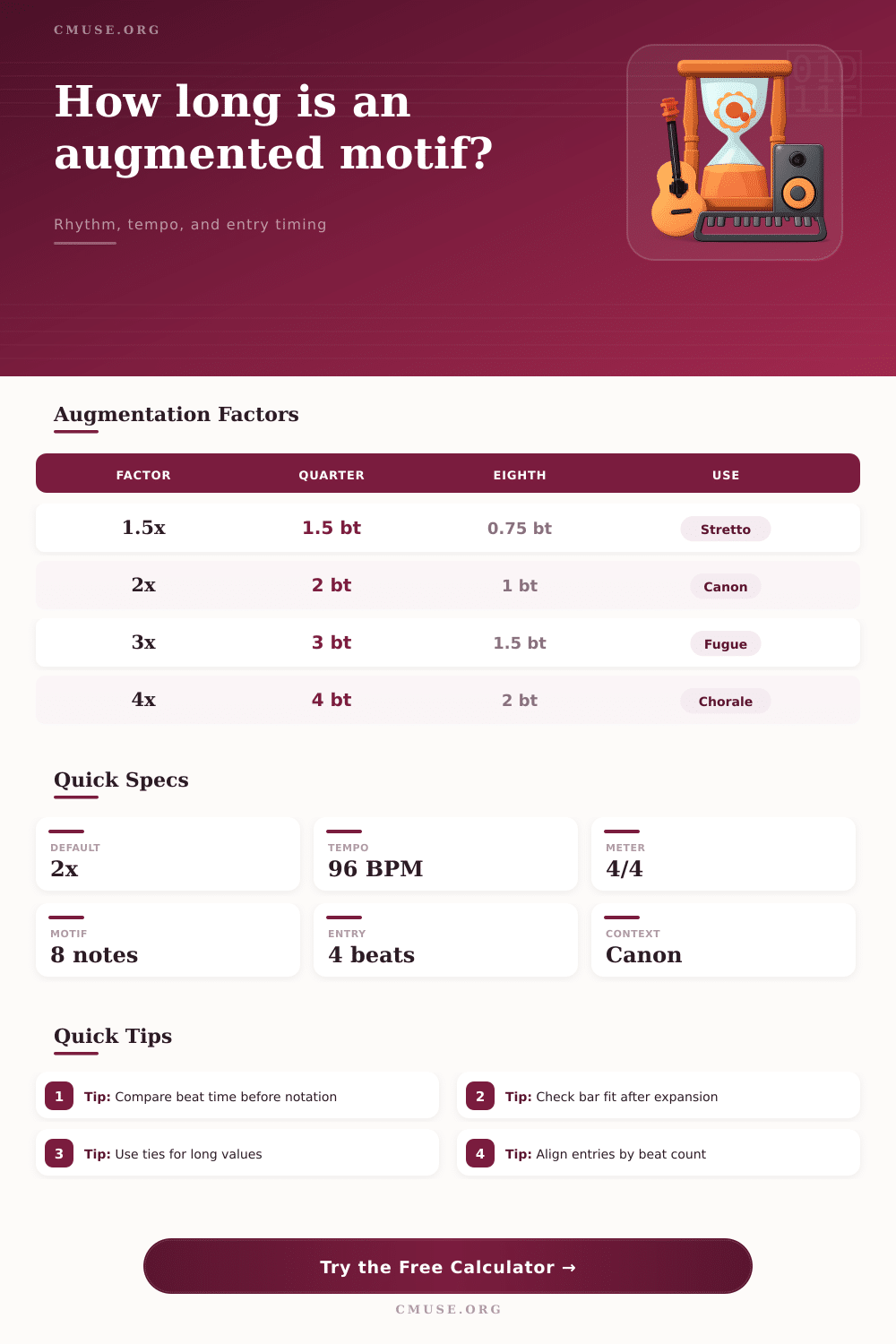
The initial mistake in judgment in these cases comes down to your choice of augmentation factor. For strict canons and more traditional fugues, the norm is twofold. Here it allows subject time to breathe but not so much that it loses all recognition. If you are composing a stretto then perhaps you’d consider a one-and-a-half fold. This places the entries closer together, allowing them to overlap each other and create tension.
This chart above explains it well with reference tables on the page that connect the factors with particular examples of counterpoint situations. You can see that a four-fold expansion is reserved for cantus firmus work. Here original melody is used as a slowly moving harmonic bed instead of a live melodic line.
Meter and tempo are more than just background settings. They dictate where your augmented line might (or might not) fall within the measure. When you double the length of your motif from equal quarter notes, it will now span four measures in a two-fold augmentation. However, if you switch your time signature to a compound meter such as twelve-eight or even six-eight, all bets are off since the groupings of beats will be completely different.
The calculator checks this fit for you and tells you precisely how many measures the augmented line will consume. It will also calculate how much overlap there is between the entry of both voices in a fugue or canon. And this is critical. Too early an entry and you will have the tail end of one voice clashing with the other’s beginning. Too late and the texture thins out waiting for the new voice to arrive. Here the tool provides a percentage overlap, helping you determine if spacing is right for your particular genre.
Another place where theory and practice meet is about notation output. In augmentation, this often means that the note value goes beyond the bar line. In four-four time, for example, a whole note spans one full measure. Augment it by three or four times, and now we’re talking about notes that span six or eight beats. There’s no way to write a single note for so long in standard notation. That requires ties. The calculator provides mensural ratios and tie suggestions. This allows you to see visually what the music would look like on paper. This saves hours of laborious adjustments later.
Take for example the preset of a Bach style fugue subject. It consists of two bars and eight notes. By default it has two parts. This creates a sixteen-note line over four bars. Look at the output from the calculator and you have not only the measure count but also the duration in seconds and the exact beat values for each note. You can even check the offset into the entry. Set that to four beats in and the tool works out how much the entries will overlap. This indicates if they are conversing or colliding.
Finding the balance between complexity and clarity is an art. Stretching a motif too far risks losing its identity. You no longer recognise the original theme in the slow version. Not stretching it sufficiently means that what was intended as counterpoint becomes cluttered and indistinct. This isn’t something the calculator will make the artistic decision about for you. All it reveals are the results of your decisions. Abstract rhythm becomes concrete in time.
The bottom line here is that augmentation is all about how you look at things. It involves taking a tiny element and magnifying it into something that works within a greater form. A piece of music might be a contemporary minimal cell process or a Palestrina-like canon. If you understand the time then you can direct the flow. That is where the calculator comes in; you have the power to make sure that everything still adds up if you want to slow things down. Get the big, sweeping lines without compromising on the grid. It works; the counterpoint does exactly what it is supposed to do.