Imitation Delay Calculator
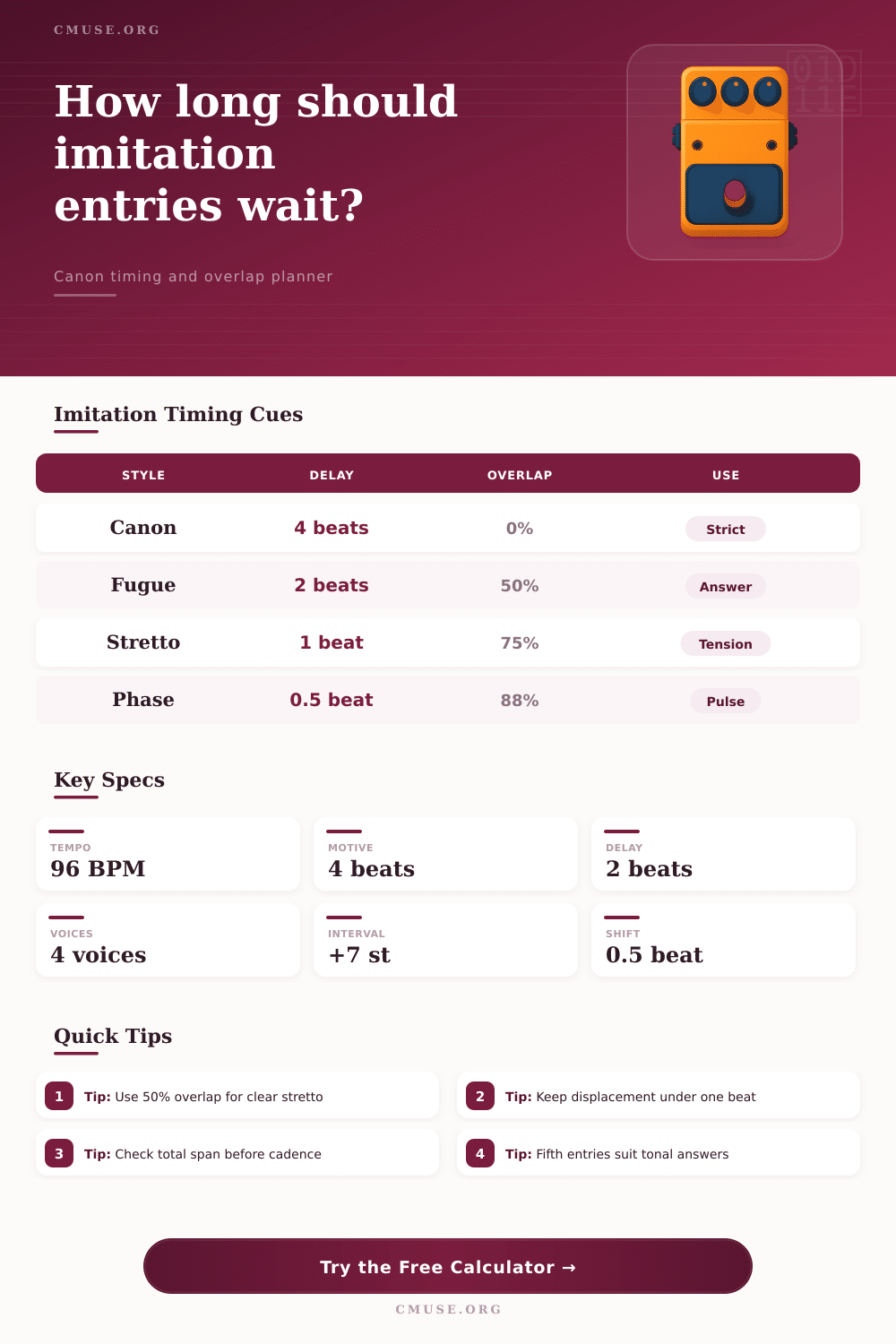
Plan canon, fugue, stretto, and phase-style entries from motive length, entry delay, tempo, voices, overlap, interval of imitation, and rhythmic displacement.
| Delay Type | Beats | Time at 96 BPM | Imitation Effect |
|---|---|---|---|
| Half-beat anticipation | 0.5 | 0.31 s | Phase nudge or close echo |
| One-beat entry | 1 | 0.63 s | Tight stretto pressure |
| Two-beat answer | 2 | 1.25 s | Balanced fugal response |
| Full-motive canon | 4 | 2.50 s | Clear successive imitation |
| Interval | Semitones | Common Role | Texture Note |
|---|---|---|---|
| Unison / octave | 0 or 12 | Strict canon | Best for exact contour imitation |
| Perfect fifth | +7 | Fugue answer | Strong tonal contrast without blur |
| Perfect fourth | +5 / -5 | Invertible answer | Useful when bass and upper voices trade roles |
| Third imitation | +3 / +4 | Color answer | Creates warmer harmony but changes tendency tones |
| Texture | Entry Delay | Overlap Target | Good Use |
|---|---|---|---|
| Strict canon | Motive length | 0% to 25% | Transparent two-voice writing |
| Fugal exposition | Half motive | 40% to 60% | Subject and answer planning |
| Stretto | Quarter motive | 70% to 85% | Cadential tension or climax |
| Phase process | Small offset | 85% to 95% | Gradual rhythmic drift |
| Scenario | Tempo | Motive / Delay | Voices / Interval |
|---|---|---|---|
| Renaissance point | 72 BPM | 8 / 6 beats | 4 voices, unison |
| Baroque fugue answer | 96 BPM | 4 / 2 beats | 4 voices, fifth |
| Choral sequence | 84 BPM | 6 / 3 beats | 5 voices, fourth |
| Minimal phase | 120 BPM | 3 / 0.5 beats | 2 voices, unison |
Another kind of anxiety occurs if your fugue subject sound amazing by itself but turns to mush as soon as second voice enters. That’s because rhythmic material has become too dense for our ears to untangle. This problem almost never results from melodic content; it’s usually because the moment it enters just isn’t working. It’s not about musical intuition, but about math.
This is where something like this can make counterpoint less painfully. Imagine then that imitation delay you apply is the space you allow between each voice before starting following one. A strict canon would have no overlap where the delay are as long as your motive. It will sound clear and uncluttered, much like Palestrina’s writing, which was designed to sound clear rather than tense.
How to Avoid Muddy Fugues Using Math
Shorten that delay though and what happens? Well now there is an overlap. One voice continue to sing through the end of its phrase while other voice starts. This thickens up the harmony (texture), but it runs the risk of muddling shape too much. So how much of motive do you let be heard, balanced against how thick harmony becomes?
This page has a calculator that will convert beats to seconds and then graphically show that overlap percentage for you. It tells you exactly how long there is between entries based off the tempo and the length of the motive. Why? Because we humans hear things different depending on the speed at which they’re presented.
At sixty beats per minute, a two-beat delay sound deliberate and spacious. At one hundred eighty beats per minute, the same two-beat delay now seem dense and rushed. Having the exact amount help determine if the gap in entry is providing enough contrast or merely creating a wall of sound.
Equally important is your interval choice. The default fugal answer would of be a perfect fifth as this bring harmonic movement without disturbing the key. Harmonically, it’s robust enough to establish key centre but also flexible enough to develop counter-subjects. If you choose thirds or sixths then these will warmer, but will lose the rhythmic distinctiveness of subject sooner. Imitation at unison or octaves retains the precise contour of the subject but adds nothing in terms of harmony that could potentialy become static if held too long. Here you’re effectively swapping rhythmic clarity for pitch interest (or the other way around).
That’s where displacement enters the mix. Imagine a strict metrical pulse with an entry point. You can move your entry forward or backward in time to sit just outside of that pulse, In jazz pieces or minimalist compositions this provides a syncopation or phase feel. Here the inputs assist in deciding whether that small rhythmic variation make the pattern clearer or muddies water. A slight nudge of something rigid can bring life while too great a displacement obliterates the imitative relationship altogether.
Style-wise, how much overlap on targets varies. Typically, for a clean fugal exposition, you’d aim at roughly half overlap so that subject can finish its arching line and the answer can be clearly heard to. If you push toward seventy-five percent or higher, you are entering stretto territory; this is where voices crowds each other to build tension before a cadence. It is effective but dramatic, so it is best suited to simpler motives. Too many syncopations or rests on complex lines and they’ll drown out in a high-overlap texture.
The challenge for most writers is they decide what they’re going to write about first then fret over the spacing. Flip that. Before you start writing, decide how thick you want the texture to be. Do you want shorter delays and simpler rhythms for a dense, driving sound? Or do you want wider gaps and a simpler accompaniment so the sound can be clear polyphony?
The ear has its limits and the math tell you where they are. When you get a feel for how tempo, interval, and delay work together, composing counterpoint ceases to feel like guesswork, and instead feels like engineering. Create the structure first and allow the music to flow through it. That’s the trick to having distinct voices chasing one another across the staff.