Articulation Density Calculator
Measure how heavily a passage is marked by comparing total notes, slurs, staccatos, accents, tenutos, tempo, measures, and instrument clarity.
Articulation Density Results
Calculation breakdown
The grid updates after each calculation so you can compare a passage against the reference tables below.
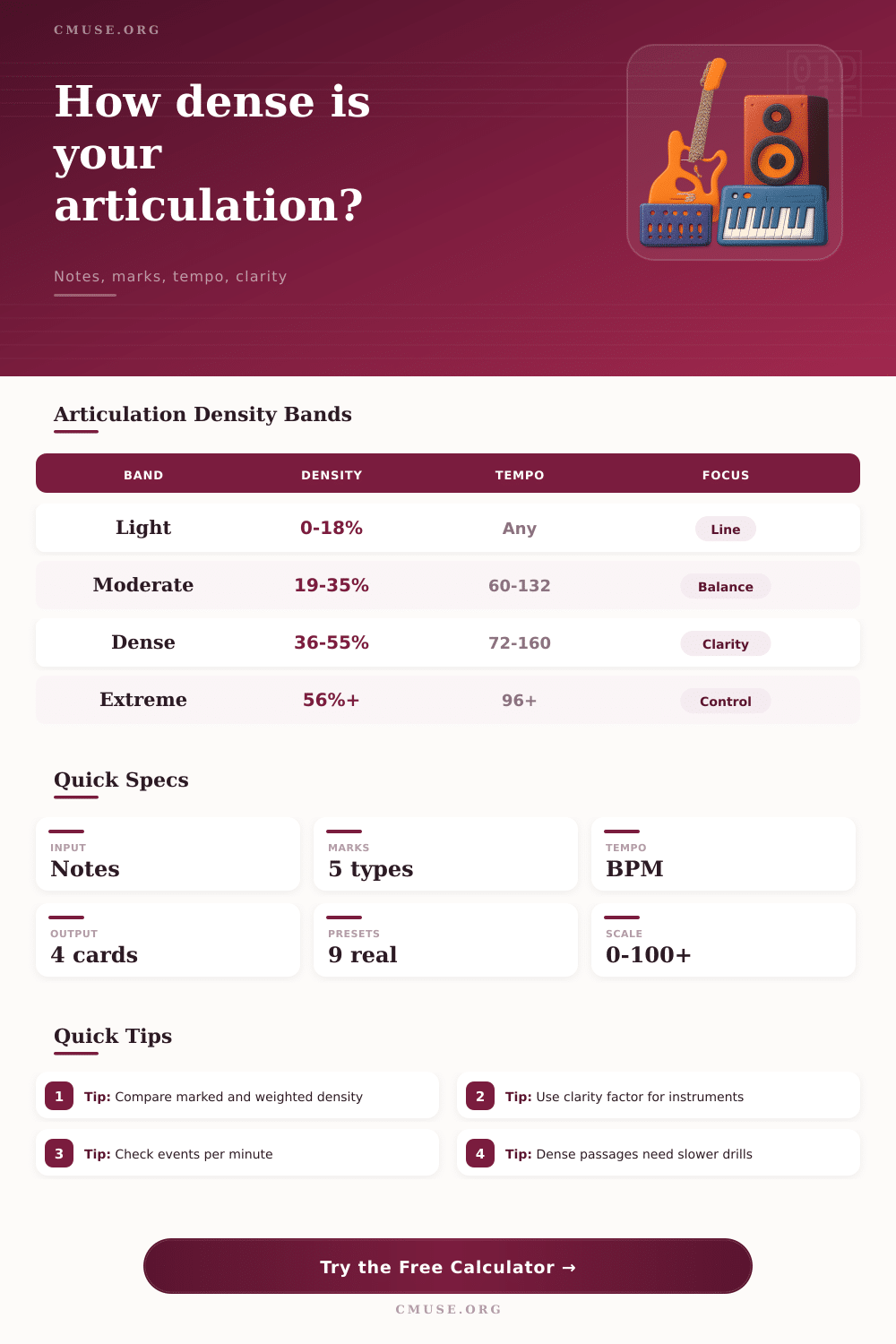
| Band | Marked density | Typical reading | Practice focus |
|---|---|---|---|
| Light | 0% to 18% | Mostly phrase, bowing, or breath shape | Line direction and tone release |
| Moderate | 19% to 35% | Regular but not crowded markings | Consistent note length and attack placement |
| Dense | 36% to 55% | Articulation becomes a primary technical demand | Slow separation, subdivision, and matching releases |
| Extreme | 56% and above | Markings approach every other note or more | Tempo layering, isolated stroke types, and fatigue control |
| Instrument profile | Clarity factor | Why it matters | Density warning sign |
|---|---|---|---|
| Violin / bowed strings | 0.96 | Bow changes and slur groups can blur rapid mark changes | Mixed staccato and slur strokes above fast tempos |
| Clarinet / single reed | 1.02 | Tongue clarity is strong, but register changes add resistance | Accents inside crossing phrases |
| Flute / high woodwind | 1.05 | Light attacks speak quickly with air support | Tenuto contrast at soft dynamics |
| Trumpet / brass | 0.94 | Articulation is direct, but endurance affects repeated accents | Marcato or sforzando clusters |
| Piano / keyboard | 1.10 | Attack is clear, while sustaining contrast needs pedaling control | Legato-staccato contrast in fast figuration |
| Classical guitar | 0.90 | Plucking pattern and left-hand release shape the articulation | Accent density during string crossings |
| Voice / choir | 0.88 | Text, vowels, and breath make articulation slower to coordinate | Consonant-heavy marked passages |
| Percussion / mallets | 1.08 | Attacks are naturally clear, but rebound and stickings decide control | Tenuto or accent changes at high note rates |
| Marking | Weight | Counts as | Reason for weighting |
|---|---|---|---|
| Slur | 0.65 | Phrase connection event | One slur often governs several notes, so it carries less per-note pressure |
| Staccato | 1.00 | Short attack and release | Usually applies directly to one note and changes its length clearly |
| Accent | 1.20 | Attack emphasis | Needs timing, dynamic control, and immediate recovery |
| Tenuto | 0.90 | Length or weight change | Less percussive than an accent but still alters note proportion |
| Ornament / grace cluster | 1.45 | Compressed articulation event | Consumes time rapidly and can hide the main-note attack |
| Scenario | Notes / measures | Tempo | Expected demand |
|---|---|---|---|
| Baroque violin etude | 192 / 24 | 126 BPM | High separation demand from mixed bow strokes |
| Mozart clarinet line | 96 / 16 | 108 BPM | Moderate density with clean phrase connections |
| Brass fanfare excerpt | 72 / 12 | 132 BPM | Accent-heavy load with endurance pressure |
| Jazz sax solo chorus | 220 / 32 | 148 BPM | Syncopated articulation pressure at fast note flow |
| Choral legato phrase | 84 / 14 | 72 BPM | Low raw density, high blend sensitivity |
If there are too many things happening simultaniously during a passage, then it falls apart in rehearsal. Why? Because your brain cannot process an accent mark, a slur line and a staccato dot all in one beat without something snapping inside your head. At this point, articulation density is no longer a theoretical concept but something which determine if you sound panicked or polished. Musicians tend to consider these markings as decorative extras; however, they are not; they are physical commands that consume energy and time. Stack them up too tight, and the music simple becomes physically unsustainable at performance tempo.
Once you have plugged in marking types and note counts, the calculator does all the math for you. It crunches the raw data on the page and turns it into a density percentage that represents actual physical demand. You input total number of sounding notes. Then you subdivide them into how many are staccato, slurred, accented, etc. You also note if any is marked with tenuto lines. Because ornaments tend to pack many different note changes into a short amount of time, they is weighted heavily here as well. Based off your instrument profile, tempo, and these inputs, the tool provides a clarity load index. In short, it identifies potential areas of technical friction so that you can deal with them before the downbeat.
How to Measure Music Difficulty
Think about how you might notate an accent compared to a slur. One is a sharp attack with instant recovery. The other is a group of notes intended to be played smoothly within a single breath or bow stroke. It becomes physicaly demanding if your passage contains both marks alternating measure after measure. Your body has to shift from playing legato (flowing) to playing staccato (percussive punch). That is fatiguing!
To account for this, the calculator gives different weight to each mark type. Because it is the direct change of note length, staccatos has a normal weight assigned. Because it adds the need for precise timing and dynamic control, accents receives a higher weight. Because it is a technical hurdle disguised as decoration, ornaments receive the heaviest weight. Knowing the weights will help you understand why two pieces containing the same number of notes could feel entirely different than difficult.
The type of instrument used matters more than many people think. Bow changes within slurs are especially difficult to pull off cleanly as a violin player; without careful attention they can wash out the quick changes in markings. Register resistance can make accents sound weightier at the upper end of a clarinet’s range. Back-to-back marcato clusters presents an endurance challenge for brass players. Because it accounts for these realities, the calculator includes a clarity factor based on each type of instrument. Rather than simply counting up markings, it calculate how easy they might be to read during use.
When playing the piano, your attack is naturaly easy to hear. However, maintaining contrast relies heavily on pedal control and this can muffle the texture during dense passages. For singers, where vowels and text determine timing, pure notation often ignores these nuances. These subtleties suggest that what sounds feasible on guitar might prove unattainable on trumpet.
The reference table on this page organizes density levels from light to extreme and explains what those levels mean for you. Focus on tone release and line direction. Moderate means attack placement and note length are consistent. These is dense or extreme subdivision and slow separation drills. At any stage above moderate, you’ve reached high density and you simply can’t rehearse it at full speed. It should of been dismantled.
If you’re finding the event count per minute too high, don’t try and play through the passage. Single out the stroke type, work just on the accents then just on the releases. Slowly reassemble it. This approach respects the physical limits of your instrument and your body.
What many people don’t realize about articulation is that it can be a technical constraint, not just a musical decision. Don’t avoid density; in fact, avoiding it is a fight against the laws of physics. If you measure density then you are playing within the confines of reality. And this is not a bad thing. Understanding the structure of dense music before stepping into it allows you to achieve an end where what might appear complicated on paper is simplified in performance. Then what was thought of as panic becomes precise, and what seemed like density becomes clear.