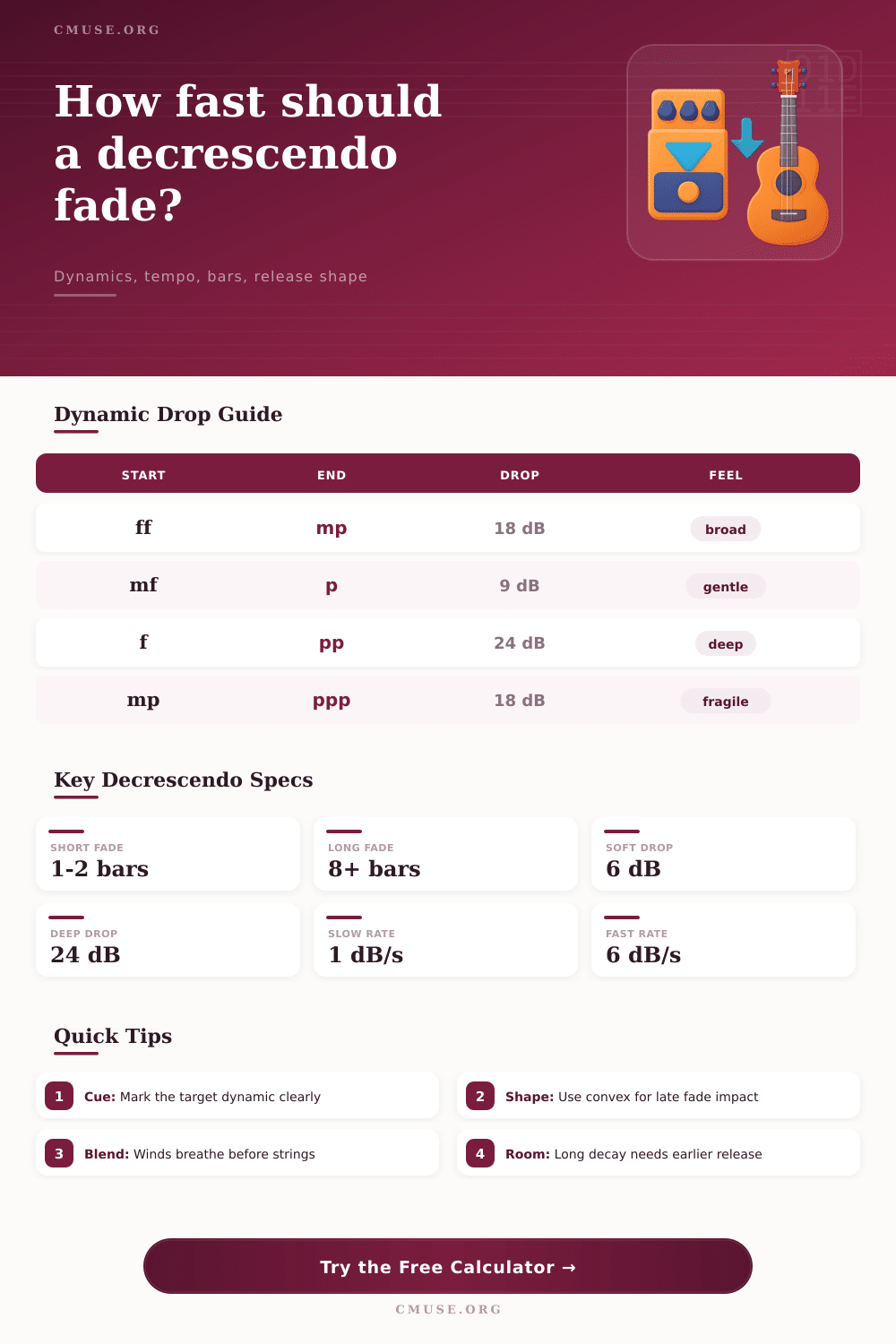
Decrescendo Rate Calculator
Estimate the practical fade rate from starting dynamic to ending dynamic using dB drop, measures, tempo, release shape, and instrument response.
♫ Real Decrescendo Presets
🎚 Decrescendo Inputs
Decrescendo Rate Result
📊 Decrescendo Spec Grid
🎼 Dynamic Drop Reference
| Marking | Relative Level | Typical Use | Next Softer Step |
|---|---|---|---|
| fff | +30 dB | Peak orchestral force | 6 dB to ff |
| ff | +24 dB | Full strong sound | 6 dB to f |
| f | +18 dB | Projected melody | 6 dB to mf |
| mf | +12 dB | Normal present tone | 6 dB to mp |
| mp | +6 dB | Contained support | 6 dB to p |
| p | 0 dB | Soft but clear | 6 dB to pp |
| pp | -6 dB | Quiet color | 6 dB to ppp |
| ppp | -12 dB | Near silence | 12 dB to niente |
⏱ Release Shape Table
| Shape | Energy Path | Best For | Rate Adjustment |
|---|---|---|---|
| Linear | Even loss | Clear rehearsal math | 1.00 factor |
| Convex | Late taper | Cadences and suspensions | 0.78 early, 1.25 late |
| Concave | Early drop | Clearing accompaniment | 1.35 early, 0.72 late |
| Terraced | Stepwise fade | Sectional orchestration | Split by beats |
| Al niente | Last sound vanishes | Strings, choir, winds | Extra 3 dB floor |
🎻 Instrument Response Table
| Instrument Group | Response Trait | Risk Point | Useful Cue |
|---|---|---|---|
| Strings | Continuous bow speed | Pitch thins at tip | Save bow for last bar |
| Woodwinds | Air pressure taper | Reed closes early | Dim. with supported air |
| Brass | Embouchure resistance | Tone cracks under pp | Release in staggered parts |
| Choir | Vowel and breath blend | Final consonant jumps | Delay consonants together |
| Piano | Natural string decay | No true sustain fade | Shape with pedal timing |
| Percussion | Roll density control | Texture gets uneven | Lower density gradually |
📝 Common Decrescendo Plans
| Scenario | Length | Dynamic Path | Practical Rate |
|---|---|---|---|
| Short phrase release | 2 measures at 84 | f to p | 1.26 dB/s |
| String cadence fade | 4 measures at 72 | ff to pp | 1.80 dB/s |
| Choir amen tail | 6 measures at 60 | mf to ppp | 0.75 dB/s |
| Brass diminuendo | 3 measures at 96 | fff to mp | 2.40 dB/s |
| Orchestral vanishing | 12 measures at 54 | f to niente | 0.56 dB/s |
The problem isn’t only about volume but about time, space, and the physical capabilities of human being to control their bows/breath. Sometimes musical tension can occur if conductor indicates a fadeout and suddenly everyone stop playing without allowing the music to gently dissipate. Dynamics can be marked down on a score as static levels; f or p for example. But in performance, they is not static levels but rates of change. A decrease from forte to piano across two bars sound different than one that spans eight.
Once you have input your chosen length and tempo into the calculator above, it do the maths for you. No more guesswork on how something might feel; is this going to feel like an abrupt cut or a gentle exhalation? It’s just that instruments are not like knobs on a mixing desk. They don’t respond in that way.
How to Control Musical Volume and Silence
A string section control continuous friction that can be faded smoothly. For brass players, the physics of their embouchure mean that lowering the level of intensity usually has an impact on the stability of the pitch before it reduces loudness. With wind players, there is the management of air pressure which without care will tend to collapse more quickly then tone quality. This is why the tool make you select what kind of response the instrument have. It makes you recognize that a woodwind section need a different physical strategy than piano tail end. They cannot be cued equally and expect equal results. Conductors mostly fails to make this point.
Enter tempo. Four-measure decreases in volume at slower tempos (adagio) seem to last forever. Those same four measures dissapears before anyone realizes anything is different when played at a fast tempo. The relationship between beats per minute and the number of measures create a rate in decibels per second, shown in table on this page. If that rate is greater than three decibels per second, it is probably too much of a leap for someone playing to adjust internally. It’s not possible for them to control it subconsciously. A gesture should of been provided.
Then there is another layer of trickery: the acoustics of the room. Fading down to pianissimo in a dry rehearsal space can sound quiet, well-controlled. Play that same passage in a live hall with high reverberation and the residual energy lingers long past when players stop pushing the air. This is where the calculator allow you to choose room sustain settings. It reminds us it isn’t only about what goes out of the instruments but what remains in the room. A cathedral may need a concave shape to make sure the early drop gets rid of any sound clutter before the final notes come through.
In terms of the shape you choose for release, it’s the mix of science and art. For simple transitions, a linear fade makes perfect sense and is always going to be a reliable option. But if your music calls for something a little more moddern than this, consider a convex shaped release that prolongs the tension, allowing the remaining note to linger in the air a bit longer before the eventual taper off. This can work nicely with cadences that require an almost resolved feeling without the emptiness. An al niente curve requires careful thought around the bottom end; after all, silence isn’t only about not hearing anything. It’s also about anticipating what comes next, so plan out the final decibel as much as you do the first.
Many people cue the stop rather than the shape. They’ll say play quietly at bar ten. The orchestra’s objective is to meet the target and they does so accurately. What this results in is a subtly inaccurate timing, stepping down the dynamics. Imagine the rate as a continuous pressure release. There is a sense of inevitability about the decay. Gravity is not instruction. Sometimes it’s about communicating how quickly you expect them to do this (or not). If you want a quick fade, then have a clear and distinct visual cue. If you’re expecting a longer fade, hold the hand in place to allow air to slowly escape.
Pay attention to your singers’ breathing in the chorus section. How does the woodwind section get nearer the soft end? Do you hear the ‘chatter’ from the reeds? These are all real-time clues that the rate of change is beyond what the human body can do with grace. Adjust the shape or slow the transition till it sounds naturaly.
Few times in life does a flat ending make such a huge difference than a resonant one. It is not by playing louder, but by controlling the decay with intention. Knowing the limits of your body, space, and time give more meaning to your releases. What was once merely absent, now becomes part of the music; the silence after. You’re not fighting to bring it to a halt. You’re guiding it home.