Crescendo Rate Calculator
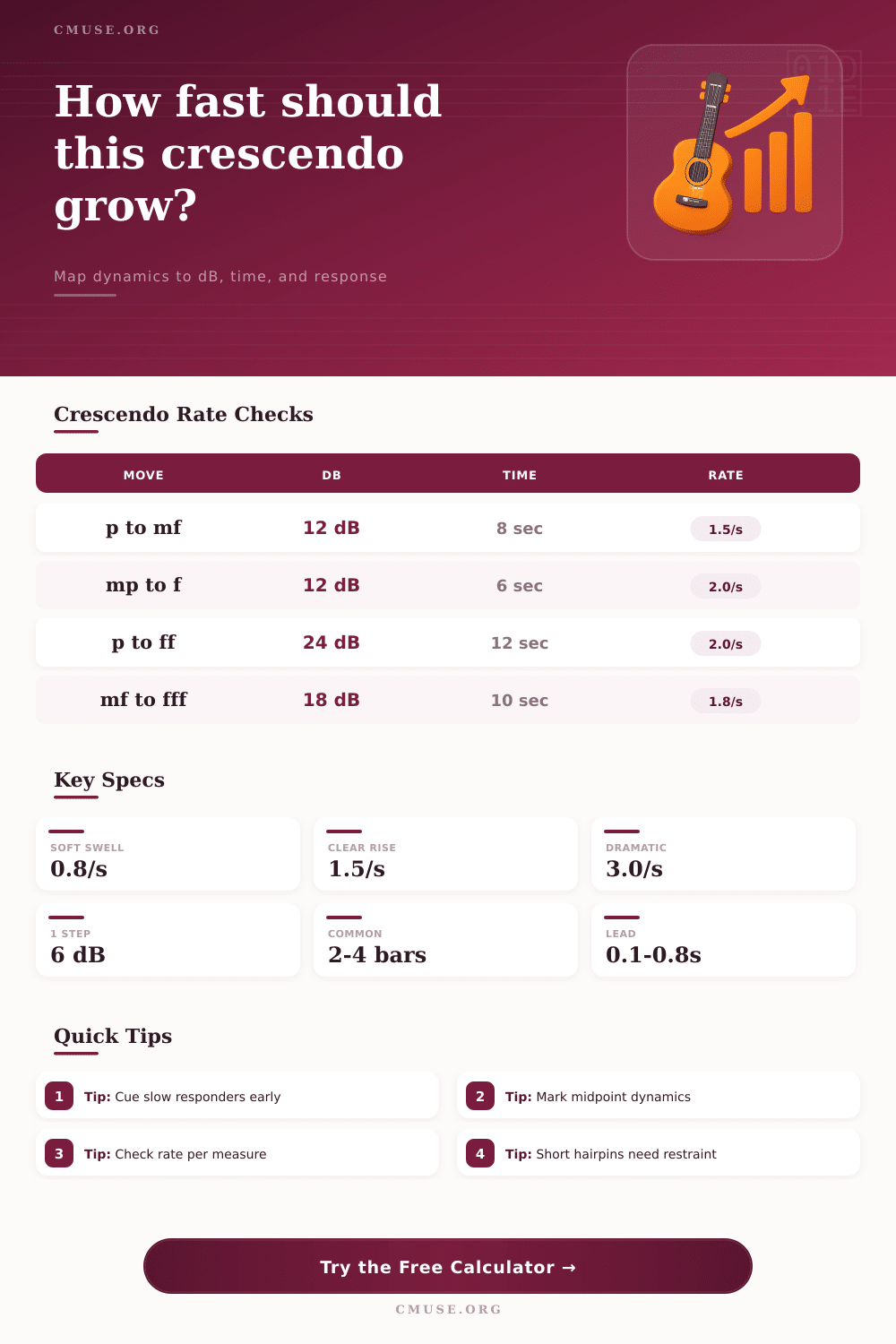
Translate written dynamics, dB change, measures, tempo, hairpin length, and ensemble response into a playable crescendo curve.
🎼Real Crescendo Presets
🎚Crescendo Inputs
Crescendo Result
📊Crescendo Spec Grid
🎶Dynamic Reference Ladder
| Marking | Relative Level | Practical Meaning | Use In Crescendo |
|---|---|---|---|
| pppp | -42 dB | Threshold-soft texture | Needs long preparation |
| ppp | -36 dB | Extremely soft color | Use slow entrance slope |
| pp | -30 dB | Very soft but present | Good for chamber starts |
| p | -24 dB | Soft controlled sound | Common hairpin origin |
| mp | -18 dB | Soft middle intensity | Stable midpoint target |
| mf | -12 dB | Comfortable presence | Useful checkpoint |
| f | -6 dB | Strong musical sound | Strong arrival without strain |
| ff | 0 dB | Full strong reference | Arrival needs support |
| fff | +6 dB | Maximum dramatic level | Keep duration realistic |
⏱Rate Character Table
| dB per Second | Musical Character | Best Fit | Rehearsal Check |
|---|---|---|---|
| 0.3 to 0.8 | Very gradual | Long strings, choir, organ-like fades | Mark quarter-point levels |
| 0.8 to 1.6 | Natural growth | Most 2 to 4 bar hairpins | Listen for steady support |
| 1.6 to 2.8 | Assertive rise | Short orchestral or band swells | Coordinate attack and breath |
| 2.8 to 4.5 | Dramatic surge | Fanfare, roll, film cue push | Give early visual cue |
| 4.5+ | Near accent shape | Half-bar punch or sforzando lead-in | Consider rewriting as accent |
🎻Instrument Response Table
| Profile | Response Delay | Rate Multiplier | Planning Note |
|---|---|---|---|
| String section | 0.12 sec | 1.00 | Bow speed can track smooth curves |
| Woodwind choir | 0.18 sec | 0.95 | Breath support shapes the first third |
| Brass section | 0.28 sec | 0.88 | Bloom often lands after the cue |
| Choir | 0.32 sec | 0.84 | Vowel focus affects apparent loudness |
| Percussion roll | 0.10 sec | 1.08 | Roll density can rise quickly |
| Piano | 0.05 sec | 0.72 | Decay limits sustained crescendos |
| Electronic fade | 0.00 sec | 1.00 | Automation can follow exact dB ramps |
| Full ensemble | 0.38 sec | 0.82 | Mixed attacks need extra lead time |
📝Common Hairpin Examples
| Scenario | Dynamic Move | Length | Typical Rate |
|---|---|---|---|
| String quartet phrase | mp to ff | 3 bars at 72 BPM | 1.6 dB/sec |
| Wind chorale swell | ppp to mf | 6 bars at 60 BPM | 0.75 dB/sec |
| Brass fanfare lift | mf to fff | 2 bars at 120 BPM | 4.5 dB/sec |
| Timpani roll arrival | p to ff | 4 bars at 88 BPM | 2.2 dB/sec |
| Synth pad automation | ppp to f | 8 bars at 100 BPM | 1.1 dB/sec |
💡Practical Rate Notes
What is missing is that if a swell sounds flat then conductors tend to point the finger at player; musicians point back at score because it is too vague. More likely it’s a question of mathematical physics or unwritten physiology. If a crescendo covers two bars or twenty, it is given as piano to forte and looks exactly the same but requires a completely different amount of physical effort. It is asking something quite different of instruments and human body that plays them.
This calculator translates those abstract symbols into real rates of growth. This enables you to convert visual into measurable goal for your hands and ears.
Why Tempo Changes How You Play Dynamics
Dynamics are not static points but rates of change. Unfortunately most musicians consider them only as static points, not understanding the timing element makes for an elementary mistake in planning rehearsals. You want to arrive at each new dynamic level on time and you should of have a clear idea of how quickly volume needs to rise in a given number of seconds to achieve this.
For example, at a moderate tempo you may expect a gentle lift up from mezzo piano to forte across four bars. But if you double speed at a brisk allegro, that lift becomes twice as rapid. This makes a huge difference in how much bow pressure or breath support you need. Too many player forget about the rate and end up rushing their arrival. By the time they reach fortissimo, they have arrived before the downbeat. This happens because they gave themselves that first push upwards but forgot about slope.
However, this all hinges on instrument family. With woodwind instruments, the player’s embouchure and breath pressure are naturaly latent, while strings can accelerates smoothly because the player controls friction directly through the bow. The brass section has an even greater uphill battle with swell of sound frequently trailing far behind physical attack. This leads to addition of response profiles for each section in the calculator. What violinists find effortless may seem jarring to trombonists. It isn’t simply about level but also inertia.
If you understand this you will begin to see how certain swells can be described as bloated or thin, whilst others are identical in dynamic marking. This also adds another sneaky part to the mix: acoustic environment of room. If it’s highly carpeted or a dry studio, there’s nothing hanging in the air, and each decibel matters. You have to push harder to get to what seems like the same level of loud as say a ringing hall. By contrast, in a live church setting, the natural reverb do some of the work for you. What may be a modest physical increase can sound dramatic due to those reflections amplifying the initial attack.
Why then are mid-point dynamics such a helpful marker? It provides a point of reference for player. It acts as an internal checkpoint that considers space they are playing in, so they do not have to rely only on the end target which can often seem abstract and distant.
Where many performances go awry is at the hairpin. If you place a crescendo across less than half a measure, then it’s effectively an accent in disguise. Attempting to play a proper linear increase across this limited space usually produces a clunky onset and rapid descent. Frequently, it’s best to think of them instead as instantaneous bursts of energy, not gentle arcs. When the gradient becomes unmanageable without smoothing out, the calculator will indicate this; possibly indicating you’ve written something that should be reconsidered. The difference here between an accent and a swell is key for tidy ensemble performance.
To practice swells you need feedback. Try not to say ‘softer’ or ‘louder’, but ‘at this rate’. Encourage them to consider how much volume to include every beat. Suddenly it becomes less about the finished article and more about the doing. From an artistic direction that can be hard to grasp, you have created something concrete and physical.
When your players understands the pace at which they are building then they tend to align with one another, locking the section in place. Many voices turn into a focused energy and the noise fades away. So in conclusion, the build-up isn’t simply a matter of increasing volume. Instead, it’s all about using energy and doing so over time. It becomes less about guesswork and more about shaping the energy once you know how fast it should builds up. The notation on score turns from a mystery into a map, and you feel yourself expertly leading your group towards the swelling sounds as you intuitively know where to place pressure at each instant. This clarity moves the climax away from being a mess and closer to a purposeful goal. It has the weight it deserves, but without the tension of working against misplaced effort.