Fermata Duration Estimate Calculator
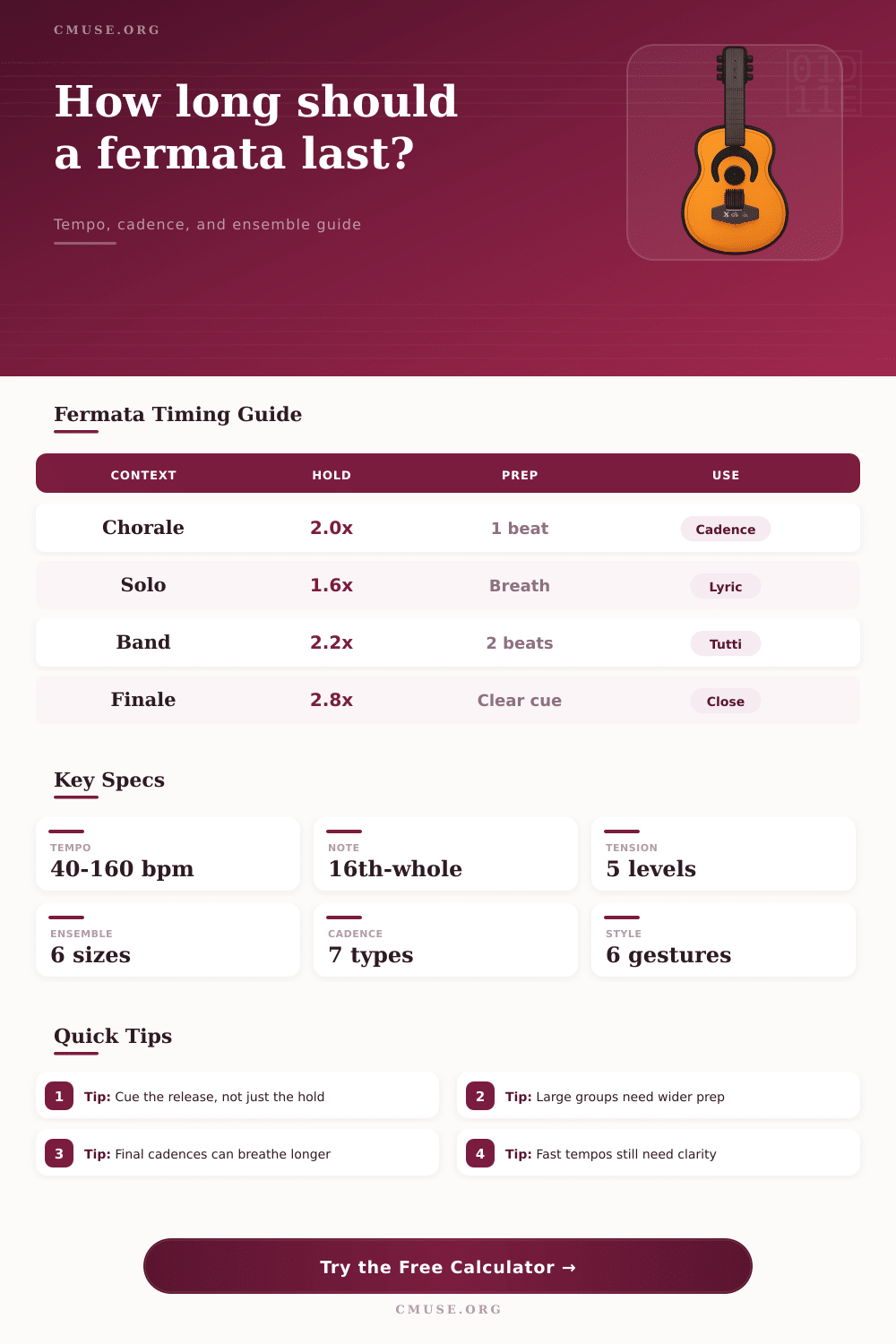
Estimate a practical hold length from tempo, base note value, phrase tension, ensemble scale, cadence function, and conducting gesture.
♫Real Fermata Presets
🎼Fermata Inputs
The estimate treats one quarter-note beat as the tempo reference and converts the selected note value into seconds before applying musical context multipliers.
Estimated Fermata Result
⏱Duration Spec Grid
📘Fermata Mark Reference
| Marking | Typical stretch | Best context | Release cue |
|---|---|---|---|
| Short fermata | About 1.25 to 1.50 times the written value | Passing breath, light pause, internal punctuation | Small lift or visible breath |
| Ordinary fermata | About 1.60 to 2.00 times the written value | Phrase ending, hymn cadence, common choral arrival | Clear ictus and rebound |
| Long fermata | About 2.10 to 2.70 times the written value | Suspension, dramatic rest, broad instrumental cadence | Prepared breath plus cutoff |
| Grand pause fermata | About 2.80 to 3.60 times the written value | Final arrival, theatrical stop, cadenza landing | Full ensemble reentry preparation |
🎶Cadence And Phrase Timing Table
| Cadence role | Musical effect | Duration influence | Practical note |
|---|---|---|---|
| Mid-phrase breath | Comma-like punctuation without structural closure | Usually trims the hold below the average fermata | Keep pulse memory active for the next entrance |
| Half cadence | Suspends on dominant harmony and invites continuation | Adds time for tension without sounding final | Release with enough preparation for forward motion |
| Authentic cadence | Provides strong tonal arrival and phrase confirmation | Supports a stable, moderately broad hold | Useful default for chorales and hymn endings |
| Plagal cadence | Softens closure with an amen-style resolution | Often broadens slightly for warmth and blend | Let resonance settle before the cutoff |
| Final cadence | Signals large-scale ending and audience release | Can extend beyond ordinary phrase timing | Coordinate breath, eye contact, and cutoff shape |
👥Ensemble Size Adjustment Table
| Forces | Coordination need | Timing effect | Useful cue habit |
|---|---|---|---|
| Solo performer | Personal breath and style control | Can be shorter or more elastic | Shape the release by phrase direction |
| Duo or trio | Shared eye contact and chamber breathing | Usually close to written expressive intent | Agree who leads the release |
| Chamber ensemble | More players, but still responsive | Slightly longer for a unified cutoff | Show the release before sound decays too far |
| Choir or small band | Blend, vowel, breath, and cutoff alignment | Moderate extension often feels natural | Prepare consonants and releases together |
| Full orchestra | Long sight lines and varied resonance | Needs more time for a confident collective release | Use a broad preparatory motion |
📋Common Fermata Scenario Table
| Scenario | Starting tempo | Common note | Typical result |
|---|---|---|---|
| Bach-style chorale cadence | 72 to 88 bpm | Half note or whole note | Broad, balanced closure with clear cutoff |
| Gregorian psalm tone ending | Free pulse near 60 to 72 bpm | Quarter note or half note | Breath-shaped hold with modest extension |
| Concert band tutti cadence | 80 to 112 bpm | Quarter note or half note | Long enough for brass and winds to release cleanly |
| Concerto cadenza arrival | Flexible | Dotted quarter through whole note | Soloist-led stretch before ensemble reentry |
| Final symphonic cadence | 60 to 96 bpm | Whole note | Large-scale hold that confirms the ending |
On the conductor’s desk sits one symbol that looks like bird wearing spectacles; however, it is a trap for orchestral or choral conductors alike. It is the fermata sign which mean ‘hold’. At this point in the music, notation hands over to the judgment of the performer. This creates potential for anarchy unless musicians are collectively certain about just how long to hold silence. Most conductors would be aware that they should prolong the note but none agree exactly by how many beats before next breath is taken.
Above is a calculator that does all this work for you, turning your abstract feeling of music into actualy time in seconds and beats. It take into account several factors that most players process subconsciously. First, tempo means that an ordinary hold mark on a note played at sixty beats per minute will feel different than the same held note at one hundred and twenty beats per minute. To account for this it converts the starting note value into seconds; then whatever is outputted will scale according to pulse of the music.
How to Use the Fermata Calculator
What else alters length massively? It is the number of people performing. If you’re playing alone then you can let go of the chord as soon as it feels right to you; there’s only one player controlling all those voice. If you’re conducting a full orchestra, you’ll need to find a way for the cut-off to happen at same time among thirty-plus players dotted around stage. This take time. The calculator knows that, depending on your ensemble size (whether you play in a trio or a symphony), you will require a longer window to prepare for this. Otherwise, you get some awkwardly timed stops and starts with the strings stopping while the brass carry on.
These estimates is improved further by cadence type and phrase tension. The breath at the end of a phrase is like a comma in writing; it provide a short break so we can hear next idea without thinking the thought has ended. A final cadence (or period), calls for more definite and broad close while the deceptive or half cadences need treatment different than an authentic ending as shown in reference table on the page. Knowing these differences will help avoid treating all fermatas as equal in length irrespective of their structural purpose.
The length of time we hear something is also heavily influenced by room resonance. A dry studio environment means sound dissipates rapidy. A shorter hold might be enough. Conversely, a ringing cathedral will ring long after players has finished their performance. Without consideration of that inherent natural reverb, your cutoff cue could of come too soon and sever the sonic blend before the natural soundscape have had time to settle. There are settings available for all manner of acoustic environment in the tool where you can match physical space with musical intent.
Finally there’s conductor style, which can add another subjective layer. Some conductors like a strict beat that instantly snaps back to rhythm. Other conductors prefer using rubato, allowing phrase to breathe until the natural tension fade. This will change the effective multiplier added to your base calculation. It’s less about the right answer and more about setting up a clear framework for decisions.
When it comes to rehearsing fermatas, the emphasis is not only on how long to hold, but also on how to release that note or phrase. Musicians are often tempted to focus on how to start sustaining a sound, but it is harder to know when to end it. If everyone shares an idea about timing and has a clear visual clue then rushed entries are avoided, as well as unwelcome periods of silence. Making a guess gives you something to discuss during your rehearsal, where you can try different timings until it feel right. It’s not about mathematical accuracy but rather musical cohesion.
These numbers provide a helpful reference point. They stop us from making unfounded assumptions during a performance and allow for more control over those hanging pauses that color the music with its personality. It transforms what might of been a random signpost into a considered artistic decision based off a deeper knowledge of context, ensemble size and tempo.