Divisi Part Split Calculator
Assign divided ensemble lines across players, desks, leaders, stands, balance targets, and difficulty load without leaving exposed voices undercovered.
Presets fill the form and calculate immediately, using common rehearsal situations rather than generic sample numbers.
Calculated Divisi Plan
| Voice | Players | Desk coverage | Leader | Stand note |
|---|
| Divisi texture | Best player count | Desk plan | Leader priority |
|---|---|---|---|
| Two-way octave split | 6 to 14 players | Split outside and inside desks evenly | Top voice if exposed, low voice if foundational |
| Three-note chord divisi | 9 to 18 players | Keep each voice on at least two desks | Outer voices first, inner voice second |
| Four-part chorale texture | 12 to 24 players | One voice per desk group works cleanly | Each voice needs a clear cue leader |
| Solo plus pad texture | 5 to 20 players | Solo stand separate, remaining players grouped | Solo voice must have principal or strongest player |
| Section type | Typical desks | Common voices | Balance caution |
|---|---|---|---|
| Violin I | 6 to 9 desks | 2 to 4 voices | Top line can dominate unless inner voices are doubled |
| Violin II | 5 to 8 desks | 2 to 4 voices | Inner moving parts need leaders near front desks |
| Viola | 4 to 6 desks | 2 to 3 voices | Do not leave middle harmony with one weak desk |
| Cello | 4 to 6 desks | 2 to 4 voices | Low voice must stay present when upper cello sings |
| Double bass | 3 to 5 desks | 2 to 3 voices | One player per pitch is risky below loud textures |
| Horn section | 2 to 4 stands | 2 to 4 voices | Pair strong players across high and low parts |
| Difficulty factor | Low risk | Medium risk | High risk |
|---|---|---|---|
| Intonation exposure | Covered harmony | Open intervals | Solo-like sustained entries |
| Rhythmic alignment | Shared rhythm | Interlocking rhythms | Independent fast figures |
| Leader demand | One cue point | Multiple entrances | Every voice needs cue control |
| Stand sharing | Same rhythm per stand | Different bowings or breaths | Rapid page turns or separate staves |
| Preset scenario | Players | Voices | Suggested split |
|---|---|---|---|
| String quartet double stops | 4 | 2 | 2 and 2, leaders shared by players |
| Violin I symphony split | 18 | 3 | 6, 6, and 6 with front-desk leaders |
| Cello octave split | 10 | 2 | 5 upper and 5 lower, principal on exposed line |
| Four horn divisi | 4 | 4 | One per voice, no stand sharing assumed |
Good planning will prevent a bad outcome when conductor raises the baton to start a complex passage marked ‘divisi’ and everyone in the room go silent. On paper, the divisi writing appear elegant but it need careful logistical planning to sound correct in practice. You cannot simply tell players to divide without considering who sits where, how many desk are available, or which player pose the greatest risk.
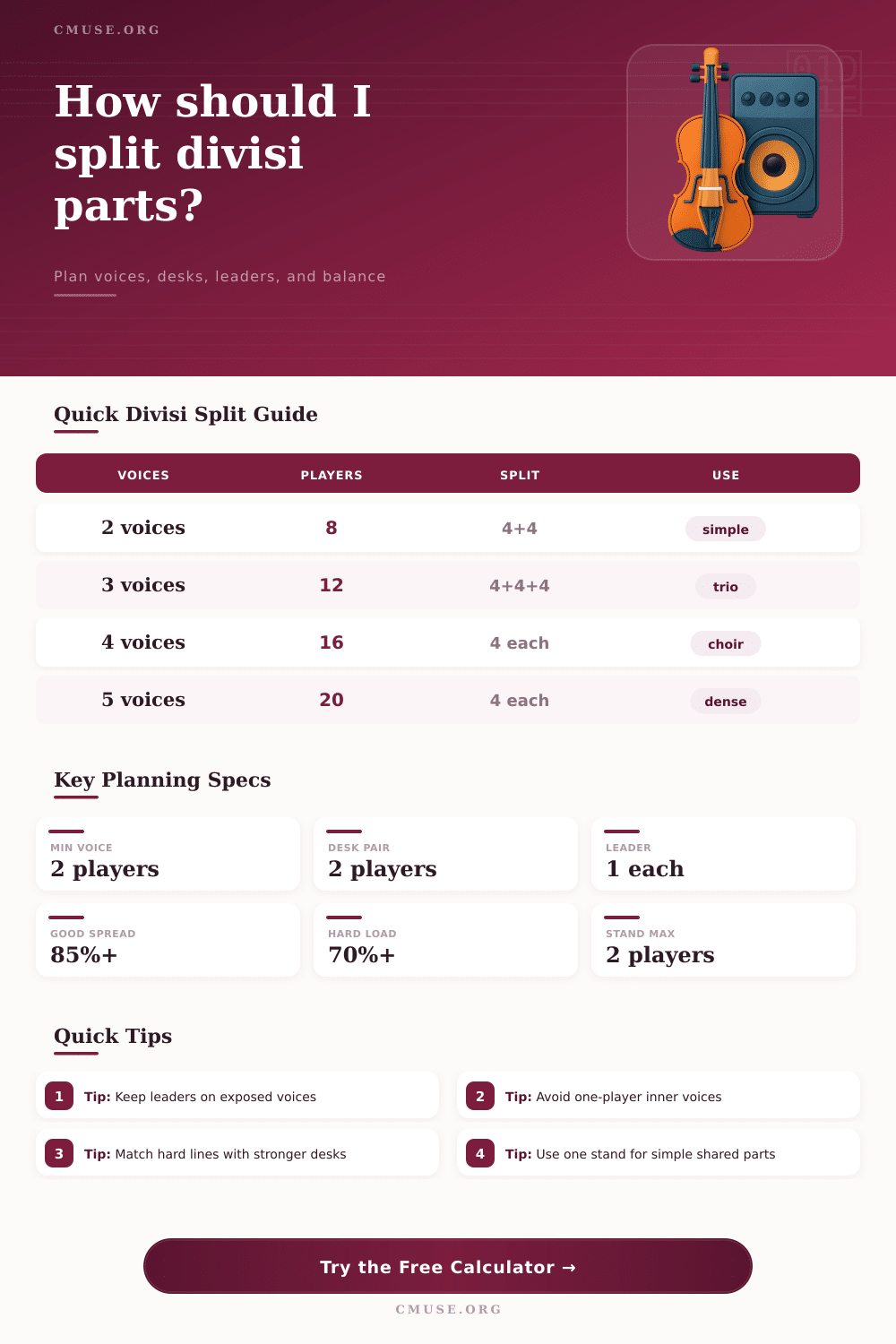
Above is a calculator devised by Ensemble leaders to check out the distribution of players; the desk coverage; any need for stand sharing, section leaders; balance, and of course, the level of difficulty before practising the passage with divisions. From a chaos of seating arrangement, it becomes a considered plan.
Why Divisi Needs Good Planning
What matters immediately is the real-world count of performers compared than the written number of parts. At a glance, this look like it’s a straightforward equation: you’ve got sixteen violin players, but you’re writing in four different staves. Four player on each part sounds fair, and so far, so good. Balance isn’t merely mathematical parity; it also take account of the physical world. A musician may be in place, but he or she’s squeezed onto one of six stands rather than one of eight, and what happens then is that the outer voices obscures the inner ones. Whether the music collapses inwards, or opens out, depends on this practical spatial consideration.
The placement of leaders shift the sound’s main focus for the section. You can nominate principals and then place them where they need to be; for instance, at the head of the upper part or underneath the melody to protect it. Why? Because as humans we tend to latch onto strong pitches automaticly. Even with the best preparation in rehearsal, the result will of a wobble if your strongest player is tucked away inside a harmony and a weaker one are tasked with holding that exposed solo line.
High levels of complexity combined with exposure signal a high difficulty load. Are you expecting too much from one desk supported by not enough elsewhere? The system will warn you. Until something goes wrong during a performance, people usually don’t think about stand sharing policies. A shared stand will work like magic if the players is reading on the same rhythm, but it creates logistical friction with independent bowings or playing from separate staves. This tool handles such situations with ability to specify strict solo stands or mixed seating. If you opt for the latter, forcing two contrasting parts onto the same music rest, you’re inviting your players to divide their focus between turning pages and reading notes. Recipe for missing entries?
On the page are reference tables of common textures such as double stops in quartets or how a four-part split can work. This illustrate where numbers of player feel naturaly and when they stretch their ingenuity. A three-note chord divisi often require nine players to keep each voice distinct and stable. Having fewer than the required parts make the harmonic basis thin; having more may mean too many people in the stand without increasing clarity. In any split arrangement where there are inner voices, these should of being carefully guarded. These is what hold the harmony together, but they often end up being given to the least experienced player by default. If you find yourself in an exposed texture don’t put one novice player on a key inner line. Give them a confident partner who will be able to hold both the rhythm and pitch. The calculator also visualizes how this might work out so as not to accidental weaken your harmonic centre to support the outer edges.
All of this comes back to the need for rehearsal security, which depends on how much time you have to prepare. The more time you have to rehearse, the higher the challenge rating can be. This works as long as the percentage of the load is acceptable in the tighter distribution. One rehearsal before the big night makes for a safe split every time. The calculator will determine the percentage loads according to what you input and provide an at-a-glance look at which musician are getting the biggest bang for their buck. High scores suggest simplifying the arrangement or redistributing players to reduce stress points.
When it’s done well, a good bit of divisi planning feels invisible. The sound is never strained or unbalanced. Musicians breathe together, pitches fall naturaly into place, and entrances happen exactly on time without any panic. It’s not about making something as complex as possible just to be complex; it’s about finding the most direct way through the notation they’ve been given.
Remember when you sit down to plan your section before practicing, everything you choose will affect everything else later on. As the baton rises the room falls silent and that moment shows just how much thought has gone into the planning before then.