Part Copying Time Calculator
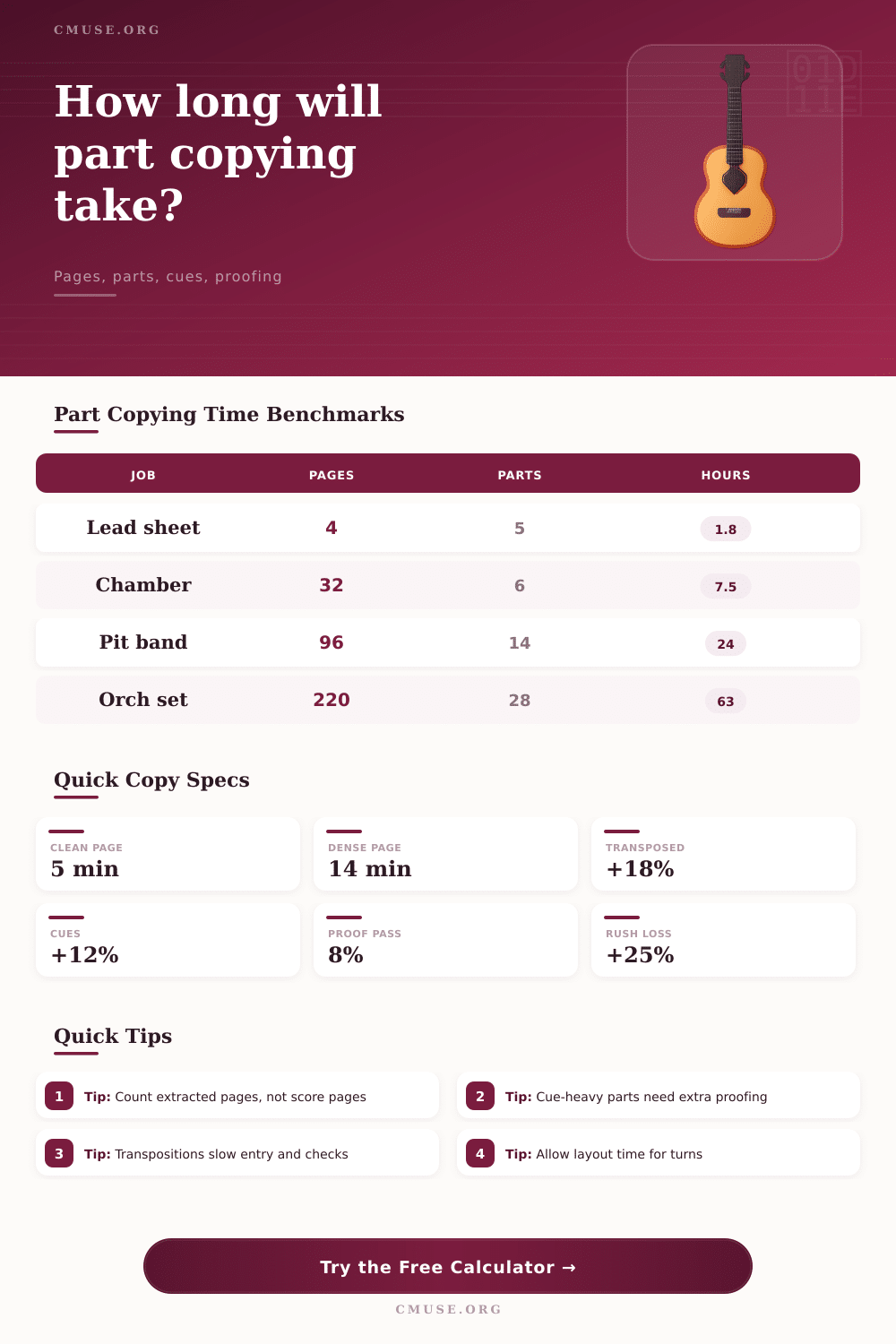
Estimate copyist hours for extracted music parts using page counts, instruments, transpositions, articulations, cues, proofreading passes, and layout complexity.
🎼 Real Part-Copying Presets
📝 Copyist Job Inputs
The estimate models practical preparation hours for copying, extracting, checking, and delivering music parts. It is not a pricing tool.
Estimated Part-Copying Schedule
🎵 Copyist Spec Grid
📊 Page and Complexity Benchmarks
| Copying task | Typical pages | Base minutes/page | Best use |
|---|---|---|---|
| Clean lead sheets | 1 to 3 per part | 4.5 to 6 | Chord symbols, melody, lyrics, compact rhythm parts |
| Standard ensemble parts | 4 to 10 per part | 6 to 9 | Chamber, school ensemble, theatre doubling books |
| Dense instrumental parts | 8 to 18 per part | 10 to 14 | Tuplets, divisi, percussion maps, mixed meters |
| Session or opera materials | 12 to 30 per part | 12 to 18 | Precise cues, cuts, inserts, stage references |
🎺 Instrument Set Multipliers
| Instrument set | Multiplier | Why it changes time | Watch item |
|---|---|---|---|
| Lead sheets and rhythm | 0.88 | Fewer independent staves and lighter formatting | Chord spelling and repeats |
| Strings | 1.02 | Divisi, bowing text, and stand-friendly page turns | Shared desks and tacets |
| Woodwinds | 1.12 | Transpositions, doublings, cue choices, and rests | Instrument changes |
| Brass | 1.10 | Transposed keys, mute text, and exposed entrances | Key and clef checks |
| Pit band mixed winds | 1.22 | Doubling books, patch cues, and condensed layouts | Book changes |
| Full orchestra | 1.30 | Many part families and cross-checking demands | Section consistency |
🔍 Proofing and Cue Load Table
| Requirement | Typical add | Included checks | Copyist note |
|---|---|---|---|
| Light cues | 6% | Key entrances after long rests | Usually one cue staff or text cue |
| Standard cues | 12% | Entrances, rehearsal letters, exposed attacks | Best fit for most ensemble parts |
| Heavy cues | 20% | Long rests, offstage entries, sectional handoffs | Needs careful spacing review |
| Critical session cues | 28% | Conductor references, streamers, punches, click notes | Proof against the session score |
📄 Common Part-Copying Project Sizes
| Project | Parts | Part pages | Expected time |
|---|---|---|---|
| Small lead sheet packet | 5 | 12 | 1.5 to 3 hours |
| String quartet movement | 4 | 28 | 4 to 7 hours |
| Big band arrangement | 18 | 115 | 18 to 30 hours |
| Full orchestra cue package | 32 | 260 | 55 to 85 hours |
💡 Copyist Notes
No-one wants to see their orchestra descending into chaos on opening night; part copying is what prevents it.
Three times under-estimated by composers. You’ve completed the score, pleased with your form, harmonies and melody. You might assume extracting the parts will take an afternoon, but composers actualy underestimate that task by a factor of three.
Why Making Music Parts Takes So Long
Oh dear, no. Woodwind transposition doesn’t just change the key, it is a brand new line that must be carefully re-entered. The calculator above models the true number of hours it will take to extract, check and format, bridging the gap between artistic satisfaction and practical deliverable.
Don’t count the total number of pages in the full score as your total number of parts. There may be four different violins on one page, a couple flutes on another, and a busy brass section on another page of orchestral score. Pulling each of those out onto a separate page for an individual player can cause that one sheet of score to expand to three or four sheets of part. You enter the total number of extracted part pages specifically because that’s where the work exists.
Each page has to have its layouts adjusted to accommodate playable turns. It requires proofing to check for any stray note. Headers, rehearsal letters, etc., has to be added if not included in the source material.
Another layer of friction that few account for is transposition. In most notation programs, it’s not just a case of a find-and-replace when you transpose an instrument part. You have to check every accidental. You must make sure the dynamics carries over. You also has to make sure articulations follow the new notes properly. This multiplier takes into account transposition time because it adjusts the time according to the number of parts needing to be transposed as a percentage of all parts. If your pit band is heavily mixed, or if you’re working with brass-heavy ensembles, then this will kick in hard.
Brass players want their parts to be in standard transpositions or concert pitch equivalent without fault. An error in one accidental in a trumpet part can stand out much more then a typing error in a string bowing marking.
Equally important is the number of notes on each page. It’s not hard to type a page of nothing but rests; it is easy to lay them out so performers can read their way around the page. However, trying to do the same with a page packed with complex rhythmic notation, divisi, tuplets, etc., will take you far longer to enter and check. Virtuoso density make all the difference to the time per page baseline.
Often we find these are pages where editorial help is required to make them performable at speed. This can mean adding cues for an instrument that has not played for a minute; clarifying a rhythm that could be read in more than one way; or inserting rehearsal numbers. This is where the project goes from being a liability, to being delivered professionally.
Good copyists makes multiple passes. At least one pass checks against the source score for accuracy. A second pass check readability and layout. A third pass might focus only on cueing and transposition. For every extra pass taken by the proofreader, add time to the calculator since it will be inevitable that something is missed that requires a last minute fix at far greater cost in terms of stress then saving an hour or two.
Too frequently, the issue of layout is overlooked until it’s too late. What happens when you have a fast passage with a page turn? That could destroy your performance. What about large stage parts or fold-out pages? These need extra formatting time to actually work in the musicians’ hands. There are fields in the tool regarding layout difficulty as well because who cares how cleanly a musical line reads if the performer has to stop and turn a page at an important entrance?
With these figures in hand you can set reasonable due dates. Don’t attempt to squeeze a forty-hour job into three days, you’ll burn out. You’ll make mistakes. Mistakes require revision. Revision multiplies time exponentially. Allow room for any unforeseen sources of quality problems or late-comer composers.
The objective isn’t just completion, but to provide copies that the performers will believe are worthy of their confidence. Clean notation, readable cues, playable turns… All these draw the performer’s attention away from decoding and toward the art of making music. And that’s what careful copying time estimation in the end preserves: the performance; and that is protected by honoring the process of preparation.
You should of planned for this more carefully.