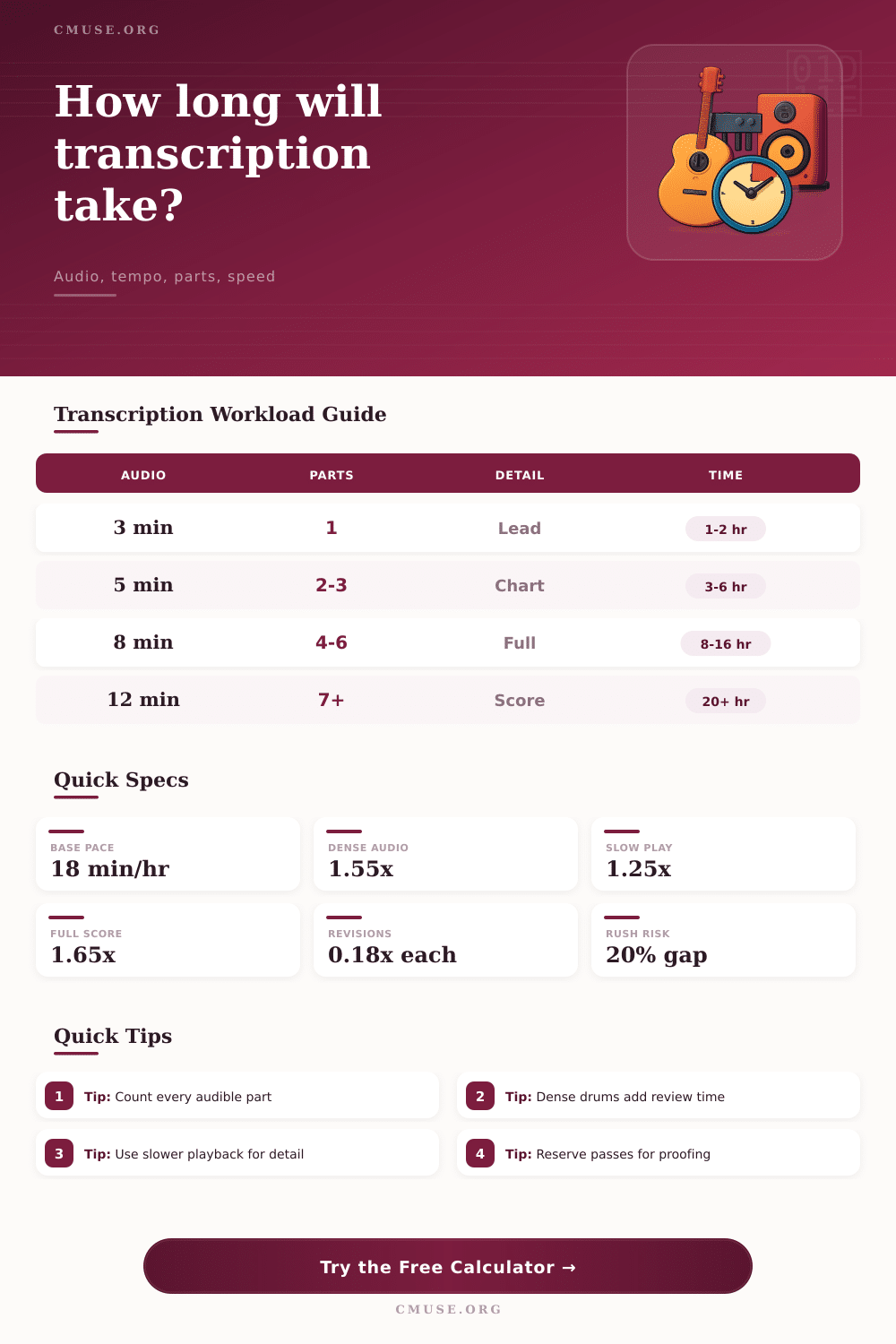
Transcription Time Estimate Calculator
Estimate practical notation time from audio length, tempo, musical density, instrument count, playback speed, complexity, and revision passes.
🎵Real Transcription Presets
🎧Audio And Notation Inputs
Estimated Transcription Schedule
📊Current Transcription Spec Grid
📘Reference Pace Table
| Transcription Target | Typical Source | Base Pace | Best Use |
|---|---|---|---|
| Chord symbols only | Clear harmony and steady form | 28 audio min/hr | Lead sheets and rehearsals |
| Melody with chords | Single lead plus harmony | 22 audio min/hr | Singers and solo lines |
| Instrument part | One featured part | 18 audio min/hr | Solos and excerpts |
| Rhythm section chart | Bass, drums, keys, guitar | 12 audio min/hr | Band performance charts |
| Small ensemble score | Three to six lines | 8 audio min/hr | Quartets and chamber parts |
| Full score reduction | Layered ensemble or orchestra | 5 audio min/hr | Dense score preparation |
🎚Density And Clarity Factors
| Factor | Low Workload | Moderate Workload | High Workload |
|---|---|---|---|
| Tempo | Under 80 BPM | 80 to 140 BPM | Over 140 BPM |
| Density | Long notes, open space | Regular groove or melody | Fast fills, chords, layers |
| Playback speed | 75% to 100% | 60% to 75% | 40% to 60% |
| Audio clarity | Clean separated parts | Some overlap or room tone | Noise, bleed, compression |
| Revision passes | 0 to 1 pass | 2 passes | 3 or more passes |
🎼Common Transcription Scenarios
| Scenario | Audio Length | Parts | Typical Time |
|---|---|---|---|
| Solo vocal memo | 3 to 4 minutes | 1 melody | 1 to 2 focused hours |
| Piano ballad | 4 to 6 minutes | 2 staves | 4 to 8 focused hours |
| Jazz combo head | 5 to 7 minutes | 4 to 5 parts | 8 to 14 focused hours |
| Drum groove study | 2 to 3 minutes | Kit detail | 3 to 7 focused hours |
| String quartet | 6 to 9 minutes | 4 parts | 12 to 24 focused hours |
| Big band excerpt | 2 to 5 minutes | 10 or more parts | 18 to 35 focused hours |
📝Notation Detail Comparison
| Notation Level | Includes | Multiplier | Watch Point |
|---|---|---|---|
| Chord chart | Form, chords, rehearsal marks | 0.72x to 0.82x | Ambiguous harmony |
| Lead sheet | Melody, lyrics cues, chords | 0.88x to 0.95x | Pickup notes and repeats |
| Part transcription | One written staff or tab line | 1.00x | Rhythmic precision |
| Rhythm chart | Groove, hits, slash notation | 1.18x to 1.45x | Fills and articulations |
| Full score | Multiple staves and dynamics | 1.38x to 1.68x | Balance between parts |
💡Planning Notes
Hit record, capture a three-minute riff. Silence follows. I stare at the waveform as I realize it’s going to be hours of tedious work converting these seconds into something legible.
At this point, most projects gets stuck in the space between hearing the music, and having it written down. This isn’t ear training anymore. This is logistics. How much time am I realy committing to this before I start my Friday night?
How to Plan Your Transcription Time
That’s why we blend instrument count, density, and tempo into an accurate timeline you can use to plan instead of guessing. That’s the largest pitfall for musicians. Treating all audio as equally long. A sparse solo vocal line is nothing like three minutes of a dense big band arrangement. The former will take quick transcription. The latter is a weekend project.
This is where the tool comes in. It lets you account for the number of audible parts and for how dense music is. Your brain has to pick out separate lines at the same time when there are multiple instruments layering on top of one another. It’s not just about writing notes. It’s about untangling a knot. That extra mental effort take time that simple audio length can’t predict. It’s the difference between reading a single sentence versus solving a puzzle while reading.
The tempo affects how much there is to learn, which perhaps isn’t as obvious as you might think. If the piece is fast, there are more beats per minute. This means there are more bars, which lead to more decisions regarding articulation and rhythm. A ballad played at seventy BPM contains far less information in the same amount of time than a track at one-hundred and forty BPM. Not only will you be stopping and starting more frequently but also rewinding smaller sections; not sure if it’s a triplet or an eighth on the next beat? The calculator covers that, too. It calculates your estimate based off the number of measures to complete, not just how much time passes on a clock.
And then there’s the whole thing about being able to hear what’s going on and how slow you can make it go. Sure, we’ve all spent a long time listening back in super slow motion to nail a tricky bit. But playing it back slowly has a cost. It breaks your workflow by forcing you to play the recording in small pieces. You can’t feel any phrase shapes, and you waste even more time fiddling with your computer instead of typing notes. And if the original audio isn’t clear or has bleed from other instruments that’s extra friction. What’s buried underneath a kick drum? You’ll be guessing at frequencies that are buried under a kick drum or lost in room noise. All of this inflates the grand total of hours because it turns a simple copy task into something like a forensic investigation.
The last factor that affects your time is complexity of notation. Writing chord symbols is fast. You also has to write out breath marks, dynamics markings, and grace notes. They become an order of magnitude difference in workload depending on whether it’s a published arrangement or a lead sheet. Decide what level of detail you realy need for your end product. Simplify if learning the tune is the only goal. Be prepared to grind away if you’re engraving to print.
All this helps protect your enjoyment of the music. If you know how long something should of take (six hours as opposed to two), you can plan to match. You can block off some decent chunks of time, manage client expectations realistically, and avoid burning yourself out on a Friday afternoon. You can plan in rest periods. Tackle the hard stuff when your brain’s fresh. Turn in work that feels like it was properly worked over, not rushed. It lets you keep the art in focus while planning for the work.
Look at your audio first, then instantly ask: What’s going on in there, within its length? Is it slow or fast? Is it layered or simple? Is it messy or clean? Put that information into the estimator, use the buffer you have, and get back to making music with a workable schedule and a clear head.