Interval Recognition Score Calculator
Grade an ear-training set with ascending and descending recognition, harmonic or melodic mode balance, weighted interval difficulty, response speed, correct counts, and streak reliability.
Weighted interval counts
Direction and mode correct counts
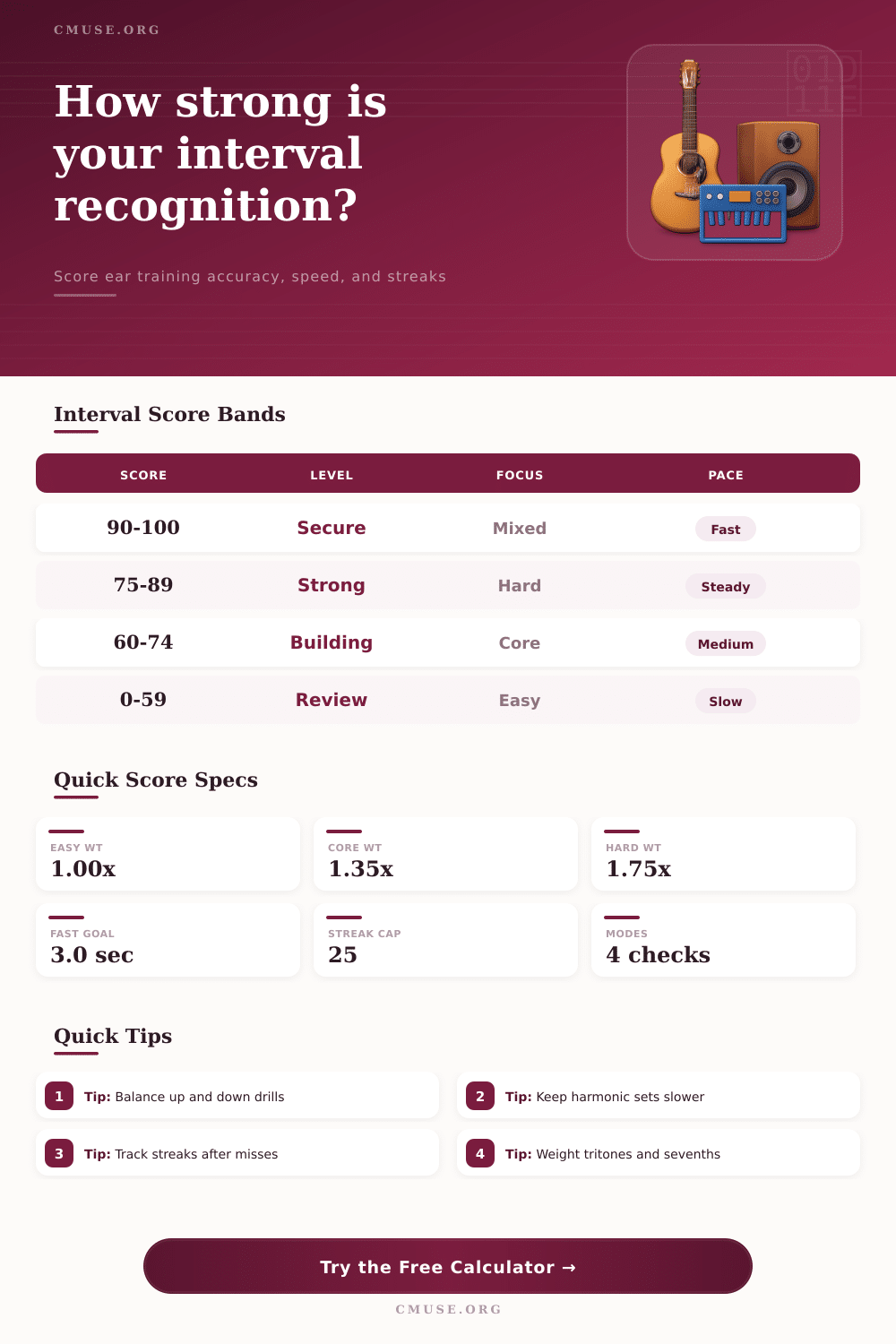
| Interval group | Examples | Base weight | Common mistake |
|---|---|---|---|
| Easy landmarks | Unison, octave, m2, M2, P5 | 1.00x | Guessing octave vs unison |
| Core singing intervals | m3, M3, P4, m6, M6 | 1.35x | Major/minor color swap |
| Hard color intervals | Tritone, m7, M7 | 1.75x | Resolving before naming |
| Compound intervals | 9th, 10th, 11th | 1.75x | Ignoring octave span |
| Mode or direction | What it tests | Score effect | Balanced target |
|---|---|---|---|
| Ascending melodic | Scale-degree lift | Clarity bonus | 40-60% of melodic |
| Descending melodic | Resolution hearing | Direction bonus | 40-60% of melodic |
| Harmonic | Vertical sonority | Mode bonus | 30-55% of session |
| Mixed random | Transfer speed | Readiness bonus | No single lane over 70% |
| Score band | Interpretation | Best next focus | Speed guide |
|---|---|---|---|
| 90-100 | Secure recognition | Random harmonic sets | Under 3.0 seconds |
| 75-89 | Performance ready | Hard intervals and mode swaps | 3.0-4.5 seconds |
| 60-74 | Developing consistency | Descending and minor colors | 4.5-6.5 seconds |
| 0-59 | Needs review | Sing easy landmarks slowly | Over 6.5 seconds |
| Practice set | Prompt mix | Target correct | Useful benchmark |
|---|---|---|---|
| Beginner seconds | m2/M2, up and down | 16 of 20 | Hear half vs whole step |
| Perfect core | P4/P5/octave | 18 of 24 | Name without singing twice |
| Tritone focus | A4/d5 against P4/P5 | 12 of 18 | Separate tension from size |
| Mixed exam | All simple intervals | 36 of 48 | Stable in both modes |
For most musicians, ear training is a binary thing: nailed it, didn’t nail it. This works well enough if you’re taking an exam, but from a music learning point of view, this completely misses the texture of how you listen. You might get all the easy ones right but fail seventh in a chord. This doesn’t tell you if you can pick up on changes of harmony in a choir or improvise easy in a jazz combo.
What that means is where the real work starts and that’s what the calculator above will do for you, crunch numbers. What’s wrong with traditional practice logs is that they assume each interval is an input on par with every other. A perfect fifth is very different than a minor seventh. The former is a cornerstone of Western music; it’s also readily identifiable by anyone who’s ever hummed a song on the radio. Identifying a minor seventh often involve resolving tension in your head before naming it. That difficulty means this tool value that more challenging interval since accurately recognizing it indicates greater internalization.
Why Ear Training Scores Are Not Enough
If you practice an octave or two for an hour, you may feel like you are accomplishing something. However, you may be missing the difficult struggle that will actualy help you build real recognition abilities. The other measure most people miss out on is speed. Hesitation in a live setting or even during rehearsals can sound like unsureness. You might know the answer later, but taking six seconds to find a major third mean your brain hasn’t recognized it yet. It’s still translating. This lag between response time and target is what the calculator grades against.
If you find that you have slow response times alongside high accuracy then it’s likely that you’re working out the puzzle not hearing the pattern. And this is the dividing point between the musician who has learned the sound itself and those who are simply memorising the solfege association. The largest holes in your kit may be hidden by direction and mode balance. Most of us tend to think of scale degrees as moving upwards, so it is much easier to identify ascending melodic intervals than descending ones. Harmonic intervals pose a whole other problem, requiring you to process vertical sonority rather than linear movement.
The score breakdown will alert you to an imbalance if your correct answers skews overwhelmingly in favor of ascending melodic drills. You may sound like a champ in practice, but when faced with complex harmony in actual music, all of that confidence dissapears. Keeping those distinct categories help you call out what your ears really aren’t great at tracking. It also stops you from assuming general skill means you’ve got everything covered.
And here’s where we get to streak reliability; how consistent are you when the pressure’s on? We all know we can pick out three intervals in succession accurately on a lazy afternoon. But what about 20 times in a row? If you’re consistently accurate, those neural pathways must be pretty robust. And the tool stops you tracking your streaks beyond a sensible limit so as to avoid skewing your results with an outlier session. You don’t want to chase perfection, but set a base level of reliability. If you miss one, the streak resets; this reminds you that ear training is difficult until it becomes a habit.
These connections is spelled-out in the tables on the page. You’ll see that speed targets are combined with difficulty weights into an overall picture of your skills. And while you might want to check your total score, also use them as diagnostics for where you need more practice: If you’re lagging on harmonic recognition, then adjust the mix of what you practice. If you’re slow on core intervals, make your drills slower so the color snaps into focus instantly.
Passing a test is never the goal of ear training. That’s just a means to get the ability to intuitively access your growing library of sound without having to think consciously about it. You’re moving from active decoding to passive recognition, like how you no longer think about shapes of letters once you’ve learned how to read. The mirror the calculator gives you shows you where you are on that journey. When your scores show that you can reliably recognize every category, even tricky ones like downward motion or the seventh, you will know what happened. You have started to hear intervals not as things to be solved but simply as music.