Ear Training Accuracy Calculator
Score interval recognition, chord quality, rhythm reading, and melody dictation with difficulty weighting, target planning, and streak pressure in one focused practice calculator.
🎯Real Ear-Training Presets
🎵Accuracy Inputs
Ear Training Score
👂Ear/Spec Grid
📊Category Breakdown
| Ear Skill | Attempts | Correct | Accuracy | Weight | Focus Cue |
|---|---|---|---|---|---|
| Intervals | 20 | 16 | 80% | 1.00 | Keep seconds and sixths distinct |
| Chords | 16 | 12 | 75% | 1.15 | Compare thirds before extensions |
| Rhythm | 12 | 9 | 75% | 1.10 | Subdivide before answering |
| Melody Dictation | 8 | 5 | 63% | 1.25 | Sing contour before notation |
📝Difficulty Reference
| Level | Multiplier | Typical Material | Use When |
|---|---|---|---|
| Beginner | 0.90 | Seconds, thirds, simple rhythms, major/minor triads | Building recognition vocabulary |
| Intermediate | 1.00 | Sevenths, modes, compound meter, four-bar melodies | Normal weekly practice tracking |
| Advanced | 1.15 | Inversions, chromatic notes, syncopation, mixed drills | Preparing for theory exams |
| Conservatory | 1.30 | Dense chords, atonal lines, fast dictation, odd meters | Audition or placement tests |
🎼Preset Reference
| Preset | Main Skill | Question Mix | Difficulty | Target |
|---|---|---|---|---|
| Beginner Intervals | Intervals | 40 interval prompts plus light rhythm | Beginner | 80% |
| Major-Minor Chords | Chords | Triad quality and inversion checks | Intermediate | 82% |
| Rhythm Clapback | Rhythm | Meter, subdivision, syncopation response | Intermediate | 85% |
| Conservatory Mock | Mixed Ear | Intervals, chords, rhythm, melody under pressure | Conservatory | 90% |
📈Target Planner
| Target Band | Accuracy | Practice Signal | Next Adjustment |
|---|---|---|---|
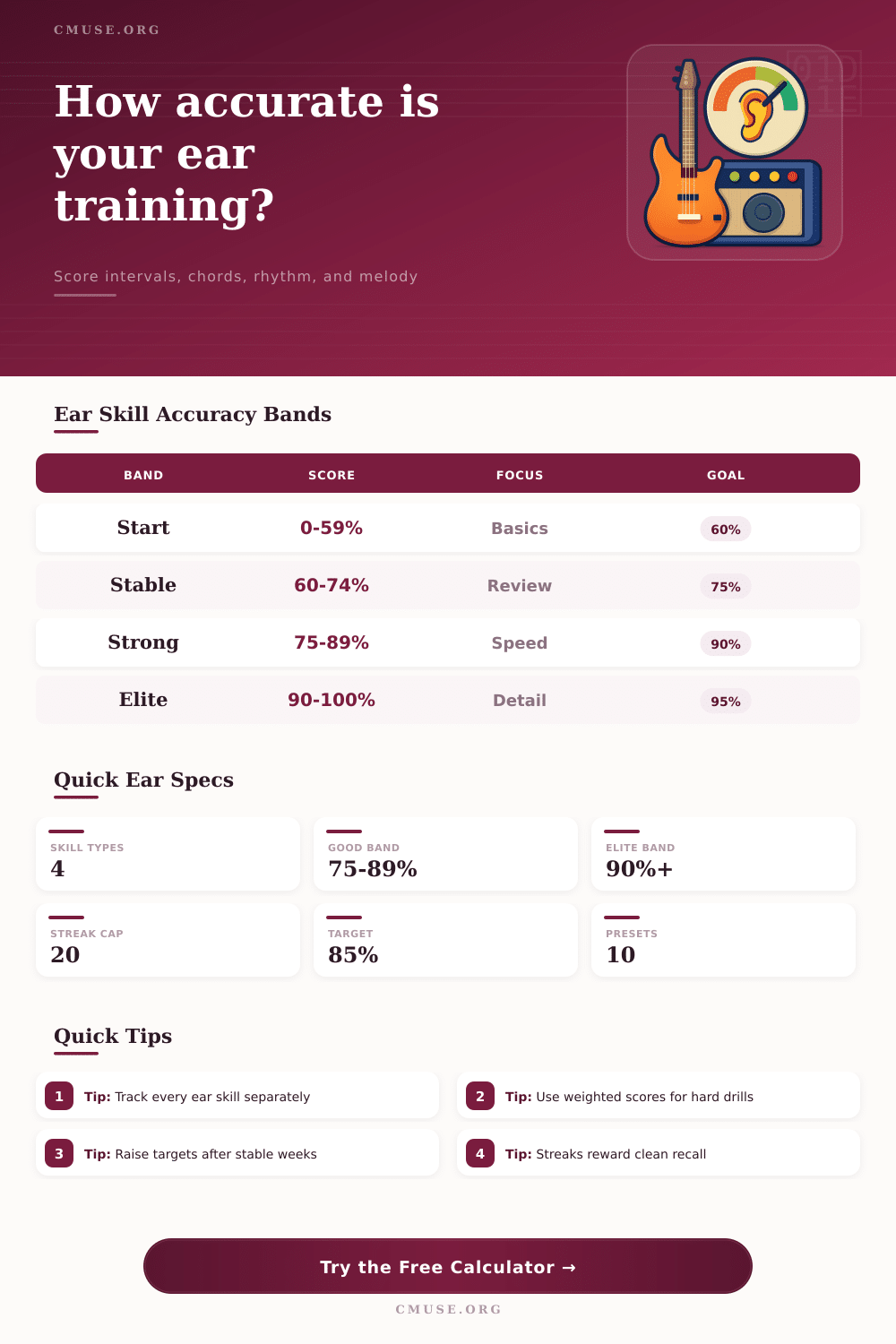
| Recovery | 0-59% | Skill map is unstable | Lower tempo and isolate one skill |
| Stable | 60-74% | Core recognition is forming | Add short mixed review blocks |
| Strong | 75-89% | Ready for harder examples | Raise difficulty or reduce replays |
| Elite | 90-100% | Audition-level consistency | Practice under time limits |
💡Scoring Tips
You crush the interval drills and breeze through the major and minor chords, but then the melody dictation hits and your confidence evaporates. Even though you planned ahead, you might sit down for your ear training session and feel too unsure of yourself to do well. This is because what we think of as ear training are really a mix of several different cognitive tasks. These is divided into four buckets in the calculator above. Understanding why that matters is how you will improve.
Intervallic tests your ability to recognize distances between pitches, which is a linear problem. A chord test your ability to perceive harmonic colors and identify intervals correctly. Rhythm test your ability to maintain pulse and control subdivisions. Melodic Dictation, Stresses working memory significantly more than the other categories as it require understanding of tonal center, recognition of melodic contours and memory for pitches.
How to Measure Your Ear Training Progress
When you average those four out together without weighting one or another then you end up with a number that sounds good but isn’t all that helpful. For instance, if someone has a strong sense of rhythm and chord recognition but can’t remember melodies well, they may have an overall high accuracy score that actualy hides their weakness in this area. Often students believe they are getting better because their total score rises; however, their ability to sing what they hear remain unchanged.
That’s why the difficulty multiplier exists. Identifying an inverted diminished seventh at speed require a different set of neural pathways to solving a major third slowly. Identifying a simple interval is easier than identifying one within more complex chromatic lines. Your raw percentage will reflect this. Ninety percent correct on simple intervals isn’t as impressive than seventy-five percent on more challenging ones. The weighted score aim to even the playing field. It won’t let you inflate your scores by staying with easy beginner settings to avoid the tougher stuff.
What you’re after is a score that relates to your capabilities in a real recording or rehearsal situation rather then one gained under the control of a learning environment. And then there’s the next layer: the hints and the streaks. There’s no reference tone to sing along with before you answer; no replay in a performance situation. If you use lots of hints in practice, they’re going to inflate your perceived ability but deflate your true retention. And the calculator punishes this, because it differentiates between recalling something from memory vs recognizing it with help.
Streaks of correct answers without help show internalization, which is something that raw accuracy percentages can’t always pick up on. They signal that this has crossed from short-term attention to long-term recognition. Once you have some level of mastery over these areas, then you need to re-set your goals. For the novice, maybe you want to work on achieving six out of ten words correct (a 60% score). Those at an intermediate level might aim for 75%, which is steady but not quite rock-solid under pressure. Elite musicians may aim for around 90% or more, where they can recognize what is being played without thinking about it. That is to say: automatic, not analytical recognition.
You won’t just know the music; your recognition will become automatic rather than analytical. If you find yourself seeing a rise in the balanced skill index across all four areas at once, this is where the rubber meets the road: true learning are underway. You are not specializing in any particular area; you’re developing your overall listening ear.
It takes away the guess work in your practicing so instead of just feeling like “I’m getting better” you can actualy see what’s not working for you. Maybe your rhythm needs work, but you’re great with chords. Great, do more of that next time. It becomes an objective target instead of a subjective frustration. Most musicians use notebooks or apps as tools to create their own feedback loop.
Measure it correctly, ear training is a muscle You can’t get better at something unless you measure it properly. Break your ear training into buckets (melody, rhythm, chords, intervals). Next, weigh each of those by how hard they are and if they are separate from each other. You now have an actual map of your ears. This clarity enables you to practice smarter (not just longer) because you’ll now know EXACTLY which bucket to focus on when you sit down to work next time.
You won’t be guessing anymore; you’ll be engineering results. And that shift from vague guesswork to targeted accuracy is what shows the difference between casual players and serious musicians. Ask the right question, and the numbers don’t lie.