Music Theory Quiz Score Calculator
Score theory, ear training, notation, dictation, partial credit, penalties, and pass thresholds in one grading worksheet.
🎼 Quiz Presets
📝 Quiz Format
📘 Theory Question Types
🎧 Ear Training Section
📊 Live Score Breakdown
| Section | Maximum | Earned Before Penalty | Penalty | Final |
|---|---|---|---|---|
| Theory subtotal | 0 pts | 0 pts | 0 pts | 0 pts |
| Ear subtotal | 0 pts | 0 pts | 0 pts | 0 pts |
🎯 Quiz Spec Grid
📑 Question Type Reference
| Question Type | Common Skill | Typical Points | Partial Credit |
|---|---|---|---|
| Multiple choice | Terms, intervals, key signatures | 1 point | Usually none |
| Short answer | Roman numerals, scales, chord labels | 2 to 4 points | Common for setup work |
| Written analysis | Cadences, modulation, figured bass | 5 to 10 points | Rubric based |
| Ear identification | Intervals, triads, modes, meter | 1 to 2 points | Sometimes for close answers |
| Dictation | Melody, rhythm, bass line | 4 to 12 points | Usually phrase based |
🎓 Passing Threshold Bands
| Band | Percentage Range | Result Label | Typical Interpretation |
|---|---|---|---|
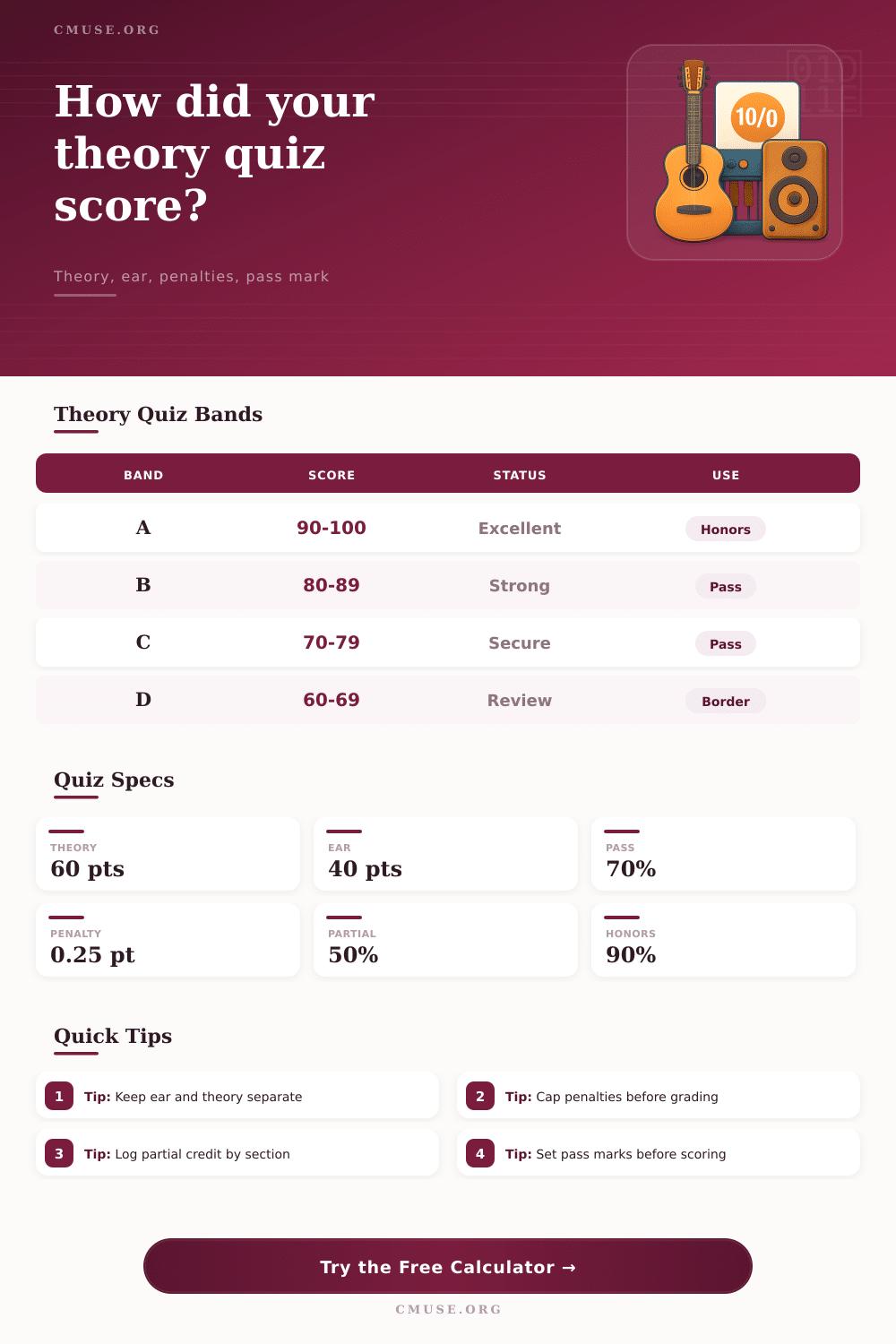
| Honors | 90% to 100% | Excellent | Secure theory and aural response |
| Strong pass | 80% to 89% | Confident | Small gaps in one section |
| Pass | 70% to 79% | Meets threshold | Enough points for the set mark |
| Borderline | 60% to 69% | Needs review | Close to standard, below pass |
| Below standard | Below 60% | Retake advised | Major gaps across sections |
🗂 Preset Format Table
| Preset | Question Mix | Ear Share | Pass Mark |
|---|---|---|---|
| ABRSM Grade 1 | Keys, rhythm, intervals | 15% | 66% |
| ABRSM Grade 5 | Harmony, terms, score reading | 20% | 66% |
| AP Music Theory | MC, FRQ, aural skills | 45% | 70% |
| College Fundamentals | Notation and analysis quiz | 25% | 70% |
| Jazz Harmony | Chord symbols and progressions | 20% | 75% |
| Ear Training Midterm | Intervals, chords, dictation | 70% | 70% |
💡 Scoring Tips
Two things is expected for music theory examinations; firstly knowledge of the rules and secondly an intuitive understanding of how something sounds. They don’t split this neatly in most exam systems. Using a specialist calculator give you a proper idea of where you stand. It divides the test into categories such as ear-training and theory. Just because you know that a dominant seventh chord exists doesn’t mean you can hears it.
The weighting can be adjusted according to your syllabus. Perhaps your teacher care more about written analysis than interval identification. Here you adjust the balance towards theory. Dictation, short answer, and other tasks earns partial credit on the math. If it’s close but not exactly correct, then at least they tried. Effort earn some partial credit.
How to Use the Music Theory Score Calculator
And penalties are no problem for the calculator either. For example, multiple choice questions might be penalized for random guessing. Enter in the percentage of points deducted per wrong guess and let it knock down your score ahead of time. You won’t have to wonder what your grade will be when everything is finished. Points is lost to formatting mistakes. Maybe you nail down a chord progression with detailed accuracy, then you write the incorrect note value or forget an accidental. There’s a place on the calculator for these notational penalties. They don’t take too many points off per mistake but compound fast when working on something intricate. Without accounting for them, you may find your ultimate score looks like a F while you feel confident about what you learned. Knowing how this affects it as you go makes it easier to determine whether the risk of rushing would of been worth it.
Different courses has different pass and fail thresholds. For example, many student believe anything over 70% is a pass, but on their honours track, they might require 90% for top marks. These categories is clearly explained in the calculator. It will tell you if it’s a passing grade or if it’s squeaking through by a hair. If there are certain weak areas, it’ll tell you that. Are you having problems with dictation because of a listening skill deficit? Do vocabulary issues cause a problem on multiple choice tests? One doesn’t necessarily mean the other.
For example, for the ABRSM or AP Music Theory exams, there is pre-sets available. There’s a set structure to these tests and they are scored in a way that we understand (points per question). Once loaded, it can provide a benchmark to check yourself against real deal. It isn’t about gaming the system, it’s more about practicing under realistic conditions. If you can make your study sessions feel like actual one, then you’ll learn how the scoring mechanism operates, i.e. You will see how partial credit work and how much each wrong answer cost you.
The point of all this, the point of music theory in general: It’s about communicating. You’re learning the language so you can talk about the music with fellow musicians. Get good at the tests to master the vocabulary; but don’t let them take the place of the music itself. But don’t let them take the place of the music itself. Run the numbers to get the best test results; use the calculator to reduce any dumb mistakes. Now pick up the pencil and turn off the computer. Listen to some records. The tests will show you how well you do on paper, but only the music can show you whether or not you’re actualy learning.