Recital Program Length Calculator
Estimate total recital runtime from programmed music, movements, applause, stage changes, spoken announcements, intermission, encore, and practical pacing buffer.
🎼Recital presets
⏱Program timing inputs
Use pieces for audience-facing items and movements for internal pauses inside sonatas, suites, song groups, or multi-section works.
Recital timing estimate
🎵Recital spec grid
📋Reference timing tables
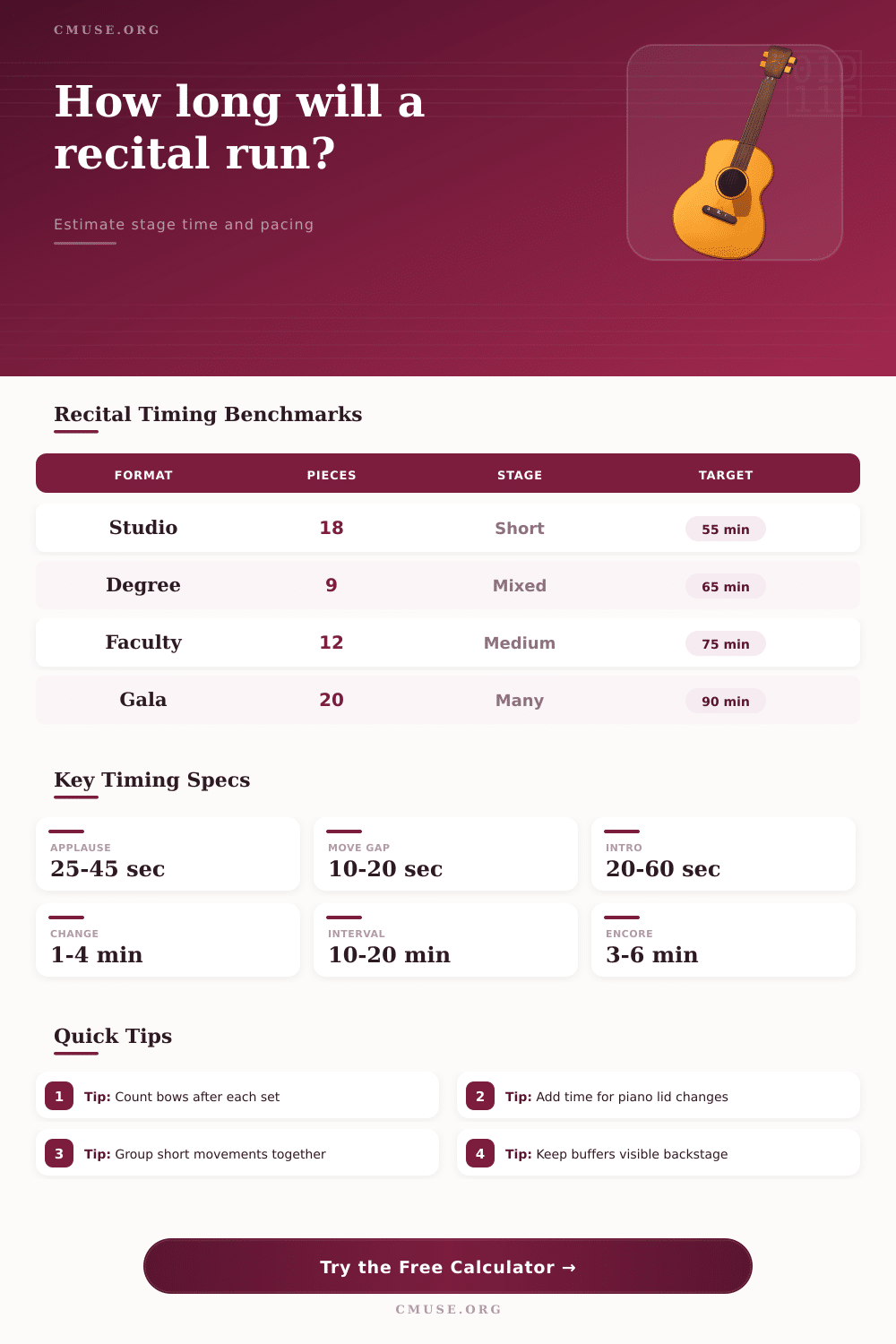
| Recital type | Music target | Total target | Intermission pattern |
|---|---|---|---|
| Junior studio recital | 30-45 minutes | 45-60 minutes | Usually none |
| Senior studio recital | 45-60 minutes | 60-75 minutes | Optional short interval |
| Undergraduate degree recital | 45-55 minutes | 60-75 minutes | Often none or 10 minutes |
| Master's degree recital | 55-70 minutes | 75-90 minutes | Often 10-15 minutes |
| Faculty or guest recital | 60-75 minutes | 80-100 minutes | Usually 15-20 minutes |
| Timing element | Lean estimate | Normal estimate | Use when |
|---|---|---|---|
| Applause and bow | 20 seconds | 35 seconds | Count once per piece or set |
| Movement pause | 8 seconds | 12 seconds | Inside multi-movement works |
| Spoken intro | 25 seconds | 45 seconds | Host, performer, or stage manager remarks |
| Stage reset | 1 minute | 2.5 minutes | Chairs, stands, piano lid, percussion, or mics |
| Encore cycle | 3 minutes | 5 minutes | Includes brief applause before the encore |
| Program layout | Pieces | Movements | Stage changes |
|---|---|---|---|
| Solo piano recital | 6-10 works | 12-24 sections | 0-1 resets |
| Voice and piano recital | 14-22 songs | 14-22 sections | 1-3 resets |
| Mixed chamber recital | 5-9 works | 12-28 sections | 3-8 resets |
| Studio class recital | 18-35 items | 18-35 sections | 4-12 resets |
| Gala or showcase | 16-28 items | 16-34 sections | 8-16 resets |
| Buffer choice | Added time | Best fit | Backstage meaning |
|---|---|---|---|
| 0% | None | Rehearsed broadcast timing | Every cue is fixed |
| 5% | Small margin | Professional chamber program | Minor bow and walk time |
| 8% | Normal margin | Most recitals | Natural applause and reset drift |
| 12% | Broad margin | Shared programs | Multiple performers and setups |
| 15% | Large margin | Student showcases | Extra entrances, tuning, and page turns |
💡Timing notes
Forty-five minutes out from a recital, there is a certain kind of panic that occurs, but not one associated with any loss of memory. You’re suddenly aware that the selection of pieces you’ve chosen won’t all fit within time frame that the venue sold you. Perhaps you’ll find yourself down to fifteen minutes, while the only piece you chose is a twelve-minute sonata. Add the chair-shuffle for the next set of student; allow some applause following the initial student performer. What was once an art form, calculating the duration of your program (is now a logistical puzzle). The difference between a smooth evening and a chaotic scramble rarely come down to musical talent. It comes down to honoring those unseen minutes that shrink your performance.
To be clear: when using the calculator (above), you don’t have to manually translate all those applause seconds into hours. The calculator do that for you as soon as you enter your movement structures and piece counts. Where mistakes happen is when people aren’t sure what their inputs mean. They think of a recital as one long piece of music from start to finish, it’s not. A recital is a string of interruptions. Depending on the audience, each one last about thirty to forty-five seconds of applause following each piece. Larger works can has pauses as brief as ten seconds between movements. These quickly multiply when there are eighteen such breaks.
How to Plan Recital Timing
Don’t forget to include stage change times. If you have three different-sized ensemble rotating through, then you’re talking minutes spent resetting microphones, moving stands, and opening/closing piano lids. Give yourself at least sixty seconds per set-up…and more if the lighting cues is ill-timed or the stage crew is overwhelmed. The price-tag of all this transition is greatly underestimated by most student. They compose a fifty-minute-long programme of music and think it’s going to finish at fifty minutes.
Nope! Allow time for introductions, which can take anywhere from 20 seconds for a brisk host to 60 seconds for someone who loves to hear about your background. Then allow time for the interval plus some buffer time in case people linger in lobby or walk back too late. A good rule-of-thumb is to include an eight-percent buffer that allows for any naturaly drift. That’s the moment when the piano tuner asks you to hold for another minute, or the applause goes on longer then planned because someone enjoyed that adagio. Include that margin or you’ll be running over-time and causing unnecessary stress on performers as well as annoying the house manager.
Included in this tool are the reference tables which offer helpful comparison points for various formats; ie: a faculty showcase versus a junior studio recital. The former may have fewer but longer pieces. The latter is often structured with many brief items and numerous stage resets, which could of extend beyond one hour even though the actual music might only last forty minutes. The key here is to think about what kind of thing it is you’re putting on before entering the math into the system.
For example, staging many acts, like in a mixed variety show, would make the setup logistics dominate the math. But if you were scheduling a solo degree recital, focus would be on multi-movement works and when you pause between movements. Pacing also involve thinking about the attention span of the audience: too many short pieces spaced far apart can fragment the experience while too many long blocks of music without any break might get tedious. So it’s all about finding that right balance between efficient operations and musically varied content. Similar types of ensembles grouped together reduce stage clutter. Introductions kept brief keep things moving along at a high speed.
If something goes wrong then knowing exactly how much time you have make for making intelligent cuts in performance. If you’re running long you can cut a piece, or if the audience is really going and you’ve got some wiggle room you could stretch out an encore. Having planned for the worst case scenario in terms of your timing provide the ability to improvise in the actual moment. Control replaces anxiety.
To produce a recital is just as much about managing the production as it is an exercise in musical expression. The performer works tirelessly to get their part right, but without a supporting framework, the entire thing fail. It takes into consideration each moment of silence, each movement from chair to chair, each bow. If you eliminate those elements that create stress then you’re not worried about the clock ticking away; you’re free to focus on the music. The result is clarity that is far better than anything you could gain by trying to cut corners and add another minute.